 Bellingham Roofing
 Blaine's Coastal Climate Asks More of Your Siding Than Most of the Country
Blaine sits right on the water at the northern edge of Whatcom County, and that location shapes everything about how siding performs here. Homes get a steady dose of salt-laden marine air, wind-driven rain that hits walls sideways instead of just running off a roof, and a long, damp shoulder season that keeps north- and west-facing walls shaded and wet for weeks at a time. Add in the moss and algae that thrive in that kind of moisture, and you have a siding environment that's noticeably harder on a building envelope than what a house fifty miles inland deals with.
Most siding products are engineered and warrantied for average national conditions, not for a bay-front town with salt exposure and near-constant humidity. That mismatch is where a lot of premature siding failure comes from — not bad luck, but a product that was never really built for this specific climate.
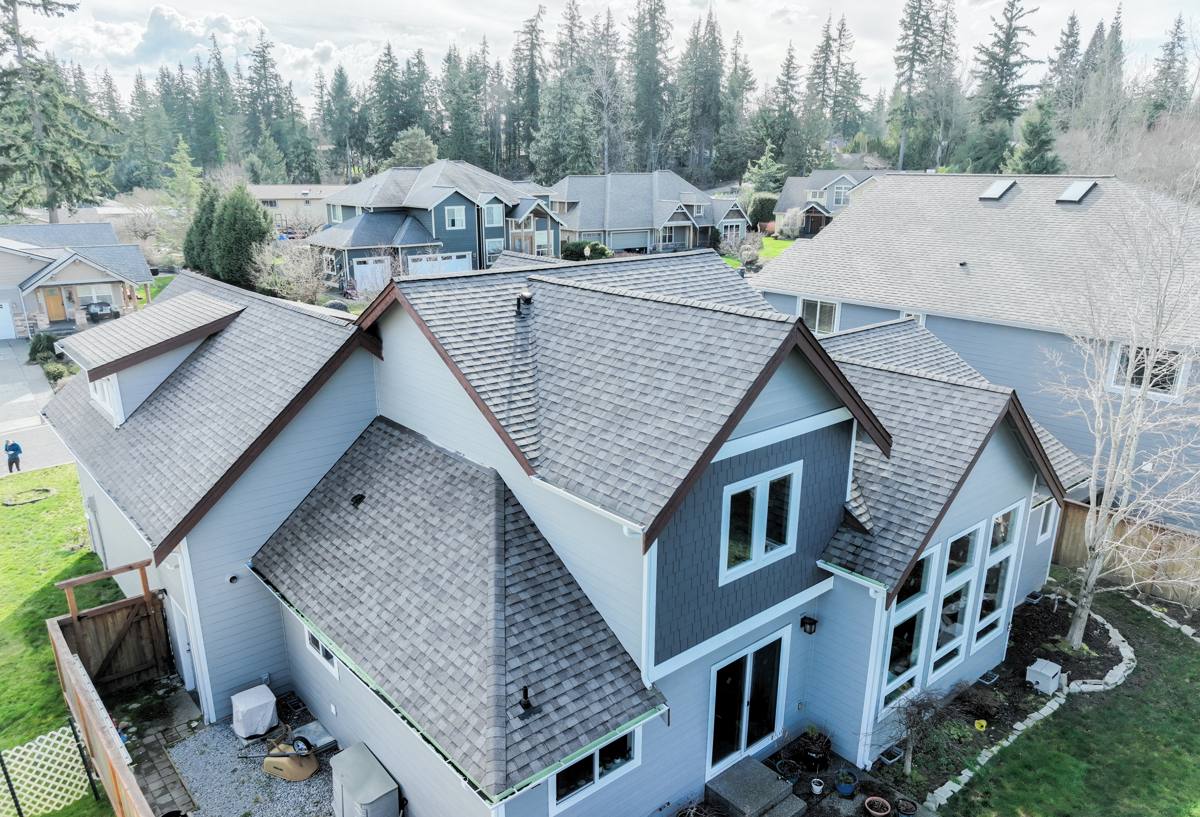
What Blaine Homes Actually Need From Their Siding
Before we talk about installation, it's worth being specific about what "good siding" means in this setting. For a Blaine home, that comes down to four things:
- Moisture resistance that holds up over decades, not just through the first few winters
- Dimensional stability so panels don't swell, cup, or gap as they cycle wet and dry through the year
- A factory finish that resists salt-air fading and doesn't require repainting every few years
- A surface and installation detail set that discourages moss and algae growth rather than giving it something to hold onto
These aren't abstract concerns. They're the specific failure points we see repeatedly on older homes near the water — siding that looked fine for a decade and then went downhill fast once moisture found a way in.
Signs a Blaine Home Needs Siding Replacement, Not Another Repair
Coastal exposure tends to produce a particular pattern of damage. Homeowners often patch the visible symptom without addressing the underlying cause, which just delays the real fix. Watch for:
- Soft or spongy spots when you press on siding, especially near the bottom courses and around window trim
- Persistent moss or dark streaking that comes back within a season of cleaning
- Visible cupping, warping, or separation at panel seams
- Paint that's failing in sheets rather than just fading evenly
- Interior signs like musty smells, peeling interior paint, or soft drywall near exterior walls
- Siding that's more than 20-25 years old and made of wood, hardboard, or an early-generation composite
Any one of these on its own might be a repair. Several together, especially on the weather-facing sides of the house, usually mean the siding system as a whole has reached the end of its useful life.
Why We Install Only James Hardie Fiber Cement
We've made a deliberate decision as a company: we install James Hardie fiber cement siding, and we don't install vinyl, LP SmartSide, primed spruce, cedar, or other fiber cement brands. That's not a marketing position — it's a standard we set after weighing how each of those products actually performs against the conditions we see on the ground in Whatcom County.
Vinyl is affordable and low-maintenance in mild inland climates, but it expands and contracts significantly with temperature swings, can crack in impact-prone areas, and simply isn't a great match for the wind-driven rain a bay-front property takes on. Wood products offer a classic look but demand ongoing painting, sealing, and vigilance against rot — maintenance that's tough to keep up with in a climate this wet. Engineered wood products like LP SmartSide are treated to resist moisture, but they're still wood-based at the core, which means the failure mode if that treatment is ever compromised — through a missed caulk joint, a bad install detail, or just decades of exposure — is moisture intrusion into a wood substrate.
James Hardie's fiber cement is non-combustible, doesn't support the kind of rot and pest issues wood-based products can face, and holds its dimensions through wet-dry cycling far better than wood or vinyl. Combined with the ColorPlus factory finish, it's the product we've found holds up honestly in this specific coastal climate — not the easiest sell, but the one we're willing to warranty our workmanship against.
James Hardie Product Lines and Why the Right One Matters Here
James Hardie engineers its siding by climate zone (HZ), which matters more in a place like Blaine than it does further inland. The company builds different formulations to handle different combinations of moisture and temperature exposure.
| Consideration | What It Means for a Blaine Home |
|---|---|
| HZ climate-zone engineering | Formulated moisture resistance matched to Pacific Northwest marine exposure rather than a generic national spec |
| ColorPlus factory finish | Baked-on finish resists salt-air fading and chalking better than field-applied paint, and cuts down on repainting cycles |
| Panel and lap profile options | Lets us match existing architectural style — lap, shingle, or panel — while upgrading the material underneath |
| Water-managed installation details | Flashing, gapping, and fastening specs designed to shed wind-driven rain rather than trap it against the wall |
The product itself is only half the equation. How it's installed — flashing details, gapping at seams, fastener placement, starter strip technique — determines whether that climate engineering actually gets to do its job.
Our Siding Replacement Process
Replacing siding correctly is a sequence, and skipping or rushing any step is where long-term problems start. Here's how we approach it:
- On-site assessment. We inspect the existing siding, sheathing, and trim to identify moisture damage, and check how the home is currently detailed for water management.
- Tear-off and substrate inspection. Once old siding is removed, we can see the sheathing directly. Any rot or soft spots get addressed before anything new goes up — covering damaged sheathing just locks the problem inside the wall.
- Weather-resistive barrier and flashing. We install or verify a proper drainage plane, window and door flashing, and kick-out flashing at rooflines, since these details matter as much as the siding itself in a climate like this.
- Hardie installation to spec. Panels are installed following manufacturer fastening and gapping requirements, which is what keeps the warranty valid and the assembly performing over time.
- Trim, caulking, and finish details. Corner boards, trim, and caulk joints are finished to shed water rather than collect it.
- Final walkthrough. We walk the completed job with the homeowner and go over what maintenance, if any, is needed going forward.
Cost Factors for Siding Replacement in Blaine
Every home is different, but the same variables tend to drive the price on a Blaine project:
| Factor | Why It Affects Cost |
|---|---|
| Home size and wall complexity | More square footage, dormers, and cut-ins mean more material and labor |
| Existing siding condition | Hidden rot found during tear-off requires sheathing repair before new siding goes on |
| Siding profile chosen | Lap, shingle, and panel styles vary in material and installation time |
| Trim and detail work | Corner boards, window trim, and fascia detailing add labor beyond the flat wall area |
| Site access | Tight lots, slopes, or limited staging area can affect scaffolding and logistics |
We won't quote a number without seeing the home, but we'll always walk you through exactly what's driving your specific estimate, and we won't pad it with work you don't need.
Why a Crew That Already Works Blaine Makes a Real Difference
A lot of siding problems in coastal Whatcom County trace back to installation that was done to a generic standard rather than a coastal one. A contractor who mostly works drier, inland areas may not default to the flashing and gapping details that matter most here, simply because they don't see the consequences of skipping them as often.
Working in and around Bellingham and Blaine regularly means we're used to designing every install around wind-driven rain and salt exposure as the baseline, not the exception. That shows up in small decisions — how kick-out flashing is handled at roof-wall intersections, how much gap is left at butt joints for expansion, where control joints go — that don't show up on a spec sheet but show up ten years later on the wall.
Maintenance After Your New Siding Is Installed
James Hardie siding installed correctly needs far less upkeep than wood or engineered wood, but "less" isn't "none," especially in a moss-prone coastal climate. A simple annual routine goes a long way:
- Rinse siding down once a year to clear salt residue and organic buildup before it takes hold
- Trim back vegetation and tree limbs that keep walls shaded and damp
- Check caulk joints around windows, doors, and trim for cracking or separation
- Clear gutters regularly so overflow doesn't run down the wall face
- Address any moss growth promptly rather than letting it establish
None of this is intensive work, but staying ahead of it is what lets fiber cement siding deliver on its long service life in a climate that's genuinely tough on building materials.
If your Blaine home's siding is showing its age, we're happy to take a look and talk through what's actually going on with it — no pressure, no obligation. Fill out the form below to schedule a free estimate.