 Bellingham Roofing
 Why Sunnyland Roofs Wear Differently Than Roofs Inland
Sunnyland sits close enough to Bellingham Bay that homes here deal with a mix of conditions that inland Whatcom County neighborhoods don't get in the same combination. Salt-laden air off the bay accelerates corrosion on exposed metal fasteners, flashing, and vent components. Driving rain off Puget Sound doesn't just fall straight down — wind-driven moisture gets pushed sideways and upward under shingle edges and around penetrations, which is exactly where a poorly detailed roof starts leaking first. And the long, wet moss season that runs from fall through spring keeps roof surfaces damp for extended stretches, giving moss, moss spores, and algae plenty of time to take hold on north-facing slopes and shaded sections under mature trees.
None of this means a roof in Sunnyland needs exotic materials. It means the installation details — flashing, fastening, ventilation, and underlayment choices — have to be handled correctly for this specific climate, not just installed to a generic manufacturer minimum. A roof that would perform fine in a drier climate can underperform here if those details are rushed.
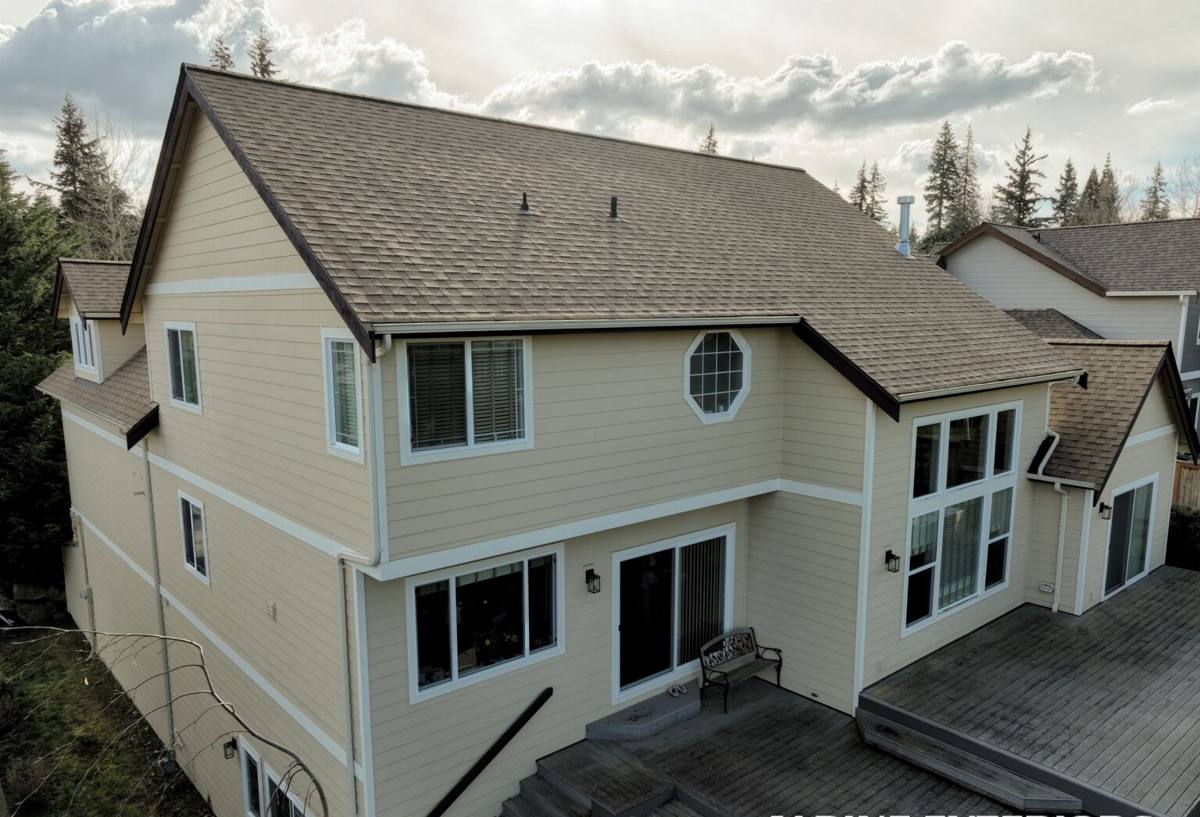
What a Correctly Installed New Roof Actually Involves
"New roof" sounds like one job, but it's really a stack of individual systems that all have to work together. Skipping or shortcutting any one of them is where most premature roof failures start, regardless of how good the shingles or panels themselves are.
Deck Inspection and Repair
Before anything goes down, the roof deck itself needs to be checked for soft spots, delamination, or rot — especially around old penetrations, valleys, and eaves where past leaks may have gone unnoticed. Installing new roofing over a compromised deck just hides the problem for another few years.
Underlayment
Given how much sustained wet weather Bellingham gets, underlayment matters more here than in drier regions. A synthetic or self-adhering underlayment provides a more reliable secondary water barrier than older felt products, particularly in valleys, around chimneys, and along eaves where ice and wind-driven rain concentrate.
Flashing
Flashing around chimneys, skylights, vents, and wall-to-roof transitions is where the majority of roof leaks originate — not in the field of the shingles themselves. In a salt-air environment, the type and finish of flashing metal matters, since some finishes corrode faster than others when exposed to airborne salt over years.
Ventilation
Balanced intake and exhaust ventilation keeps the attic space at a consistent temperature and moisture level. Without it, condensation builds up on the underside of the deck, which feeds mold and accelerates rot from the inside — a problem that has nothing to do with the shingles above and everything to do with airflow underneath them.
Fastening
Correct nail placement, count, and depth affect wind resistance directly. Roofs that get hammered by winter storms coming off the water need every fastener seated properly, not just close enough.
Comparing Roofing Materials for Sunnyland's Conditions
There's no single "best" roofing material for every home — it depends on budget, roof pitch, architectural style, and how much long-term maintenance a homeowner wants to take on. Here's how the common options stack up specifically against the salt air, rain, and moss conditions typical of this neighborhood.
| Material | Performance in Salt Air | Moss/Algae Resistance | Typical Lifespan (Local) |
|---|---|---|---|
| Asphalt composition shingle (standard) | Good, with corrosion-resistant fasteners and flashing | Moderate — benefits from algae-resistant granules | 20–30 years |
| Asphalt composition shingle (algae-resistant, copper-infused) | Good | Better — copper granules slow algae growth | 25–30 years |
| Standing seam metal | Very good with marine-grade coatings; standard coatings can pit over time | Very good — hard, smooth surface sheds moisture and resists moss anchoring | 40–50+ years |
| Cedar shake | Fair — needs regular maintenance near salt air | Poor without diligent upkeep — retains moisture, prone to moss and rot | 20–30 years with active maintenance |
We typically steer homeowners in this area away from untreated cedar shake unless they're committed to an ongoing maintenance schedule, simply because the material's tendency to hold moisture works against it in a climate that already keeps roofs damp for months at a time. That's a maintenance-burden and moisture-behavior tradeoff, not a knock on the product itself — cedar performs well in drier climates with proper upkeep.
Fastener and Flashing Metal Choices
In coastal-adjacent neighborhoods like Sunnyland, we favor corrosion-resistant fastener coatings and flashing metals over standard galvanized options where budget allows. The cost difference is modest relative to the whole project, and it directly addresses the salt-air factor that's specific to this location rather than Whatcom County as a whole.
Moss and Algae: Managing It From the Start
Moss doesn't just look bad — left unaddressed, it lifts shingle edges, holds moisture against the roof surface, and can work its way under flashing over time. A new roof installation is the right moment to build in moss resistance rather than treating it as a maintenance afterthought:
- Algae-resistant shingle granules on sun-exposed and shaded slopes alike
- Zinc or copper strips near the ridge on shade-prone sections, where runoff naturally carries trace metals down the slope
- Adequate roof ventilation to reduce the damp, stagnant conditions moss favors
- Keeping overhanging branches trimmed back so slopes get more sun and airflow after installation
None of these steps eliminate moss entirely in a climate this wet, but together they slow it down significantly and reduce how often a homeowner needs to schedule a roof cleaning.
Our New Roof Installation Process
The sequence matters as much as the materials. Here's how a new roof installation typically proceeds on a Sunnyland home:
- On-site inspection of the existing roof, deck, attic ventilation, and any trouble spots (chimneys, skylights, valleys)
- Written estimate outlining material options, scope, and timeline — no pressure to decide on the spot
- Tear-off of the old roofing down to the deck, with the deck inspected and any damaged sheathing replaced
- Installation of underlayment, ice and water protection in vulnerable areas, and new flashing throughout
- Installation of the chosen roofing material to manufacturer specifications, adjusted for local wind and moisture exposure
- Ventilation components installed or upgraded as needed for balanced attic airflow
- Full site cleanup, including magnetic sweep for stray fasteners
- Final walkthrough with the homeowner before the job is considered complete
Signs a Sunnyland Home Needs Replacement, Not Another Repair
Not every roofing problem calls for full replacement, but there's a point where repeated repairs cost more over time than a new roof would. Some signs worth taking seriously:
- Granule loss heavy enough that shingles look patchy or bald in spots
- Shingles curling, cracking, or lifting at multiple locations, not just one isolated area
- Daylight visible through the roof deck from inside the attic
- Persistent moss growth that returns quickly after cleaning
- Water stains on interior ceilings, especially after wind-driven rain events
- A roof approaching or past the upper end of its expected lifespan, with multiple prior repairs on record
Cost Factors Homeowners Should Understand
Every roof is different, so we don't quote a number without seeing the roof, but the following factors are what actually move the price on a Sunnyland project:
| Factor | Why It Affects Cost |
|---|---|
| Roof size and complexity (valleys, dormers, pitch) | More cuts, flashing, and labor hours |
| Material choice | Standard asphalt vs. algae-resistant vs. metal carries different material and labor costs |
| Deck condition | Rot or soft sheathing found during tear-off adds repair scope |
| Ventilation upgrades | Adding or correcting intake/exhaust venting is often bundled into a replacement |
| Access and site conditions | Steep pitch, tree cover, or limited staging area affect labor time |
As a broad range, most full asphalt shingle roof replacements on typical single-family homes in this area run from the high single digits to low five figures, with metal roofing costing more upfront but less over its longer lifespan. We'll give you specific numbers once we've actually looked at your roof.
Permits and Local Code Considerations
Roof replacement in Bellingham typically requires a building permit, and code requirements touch on things like underlayment type, ventilation ratios, and ice barrier placement in vulnerable areas. We handle the permitting process as part of the job so homeowners aren't left tracking down City of Bellingham or Whatcom County requirements on their own.
Why Local Experience in Sunnyland Specifically Matters
A crew that regularly works in this neighborhood already knows which slopes tend to hold moss longest, how much wind-driven rain exposure a given orientation typically sees, and which flashing and fastener choices hold up against the salt air coming off the bay. That's not something you get from a general roofing checklist — it comes from doing the work here repeatedly and paying attention to how roofs in this specific area actually age. It also means faster response if something needs attention after the job is done, since we're not driving in from across the county.
If you're weighing repair versus replacement, or just want an honest look at what your roof actually needs, we're glad to come out and take a look. The estimate is free, there's no pressure to commit on the spot, and you can use the form below to get started.