 Bellingham Roofing
 Why Lynden Homeowners Are Choosing Metal Roofing
Lynden sits inland from Bellingham Bay in the heart of Whatcom County's farmland, but that distance from saltwater doesn't spare it from the same weather pattern that soaks the whole region: long stretches of steady rain, wind that comes in sideways off open fields, and a moss season that can run nine months out of the year under the right (or wrong) conditions. A lot of the roofs we look at in Lynden are asphalt shingle roofs on their second or third replacement in a homeowner's lifetime here, and the question we hear most is simple — is there something that just holds up better in this climate. For a lot of homes, metal roofing is that answer, but only when it's specified and installed correctly for this specific area.
Metal roofing isn't automatically right for every home or every budget, and we'll say that plainly during an estimate rather than oversell it. But for homeowners planning to stay put for decades, or dealing with a roof that keeps needing moss treatment and shingle repair every few years, a properly installed metal system solves problems that asphalt in Whatcom County's climate never fully solves.
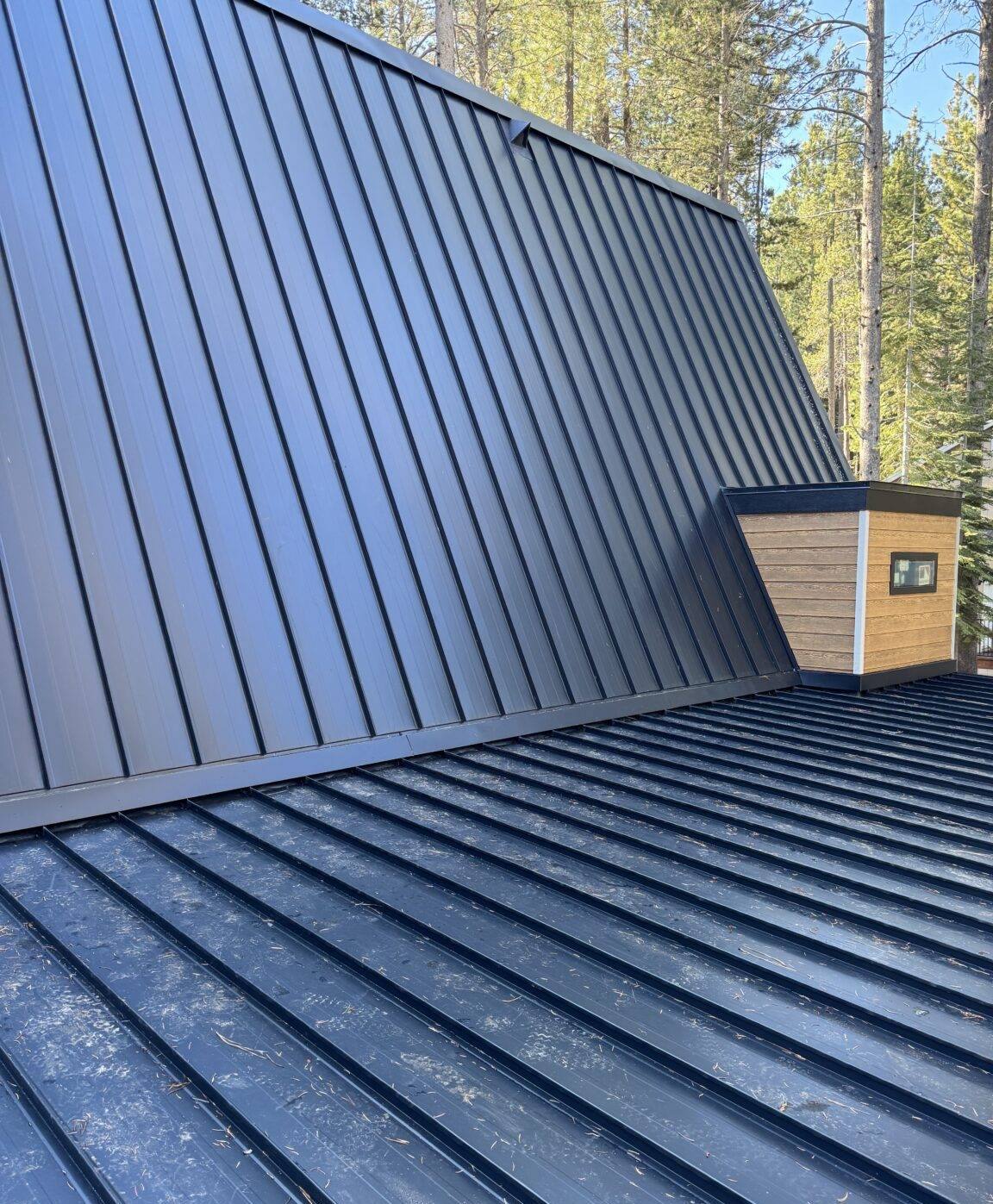
What Lynden's Climate Actually Does to a Roof
Whatcom County's marine climate shows up differently depending on where you are — closer to the water near Bellingham, salt air adds its own corrosion pressure on fasteners and flashing, while further inland toward Lynden, the bigger factors are open exposure, tree-lined properties, and the sheer volume of rain the roof sheds over a season. A metal roofing system built for this area has to answer to all of it.
Moss and Algae Growth
Shaded roof sections, north-facing slopes, and roofs near mature trees hold moisture longer, and moss takes hold in that moisture. On asphalt shingles, moss roots into the mat itself and lifts granules as it grows. Correctly installed metal panels give moss nothing to root into, which is one of the biggest practical differences homeowners notice within the first couple of years.
Wind-Driven Rain
Rain that comes in at an angle, rather than falling straight down, tests every seam, lap, and fastener on a roof. This is where the difference between a mediocre metal roof installation and a correct one shows up fastest — driving rain will find any underlayment gap, any shallow overlap, or any flashing detail that was rushed.
Temperature Swings and Panel Movement
Metal expands and contracts with temperature more than asphalt does. Over a full year in this region, panels move slightly as conditions shift from cold, damp mornings to warmer afternoons. Fastening systems and panel clips have to allow for that movement, or over time you get oil-canning (a wavy, rippled look in the panel field) or fasteners that work themselves loose.
Panel Systems: Standing Seam vs. Exposed Fastener
Not all metal roofing is the same product wearing different colors. The two systems homeowners in Lynden most often choose between behave very differently over a 30-to-50-year service life.
| Factor | Standing Seam | Exposed Fastener |
|---|---|---|
| How panels attach | Hidden clips under raised seams — no fasteners penetrate the panel face | Screws driven through the panel face into the deck or purlins |
| Movement tolerance | Panels float on clips, allowing expansion/contraction without stress | Panel is fixed at each screw, so movement concentrates stress at those points |
| Long-term maintenance | Very low — no exposed fasteners to back out or reseal | Fastener washers age and typically need checking or replacing over the roof's life |
| Typical upfront cost | Higher material and labor cost | More affordable, often used on shops and outbuildings |
| Best fit | Primary homes, steeper slopes, longer ownership horizon | Budget-conscious projects, secondary structures, shorter timelines |
Our standard for primary residences in this area leans toward standing seam whenever the budget allows, specifically because of the fastener issue. An exposed-fastener roof isn't a bad product — it's a legitimate, widely used system — but it does carry an ongoing maintenance obligation that a lot of homeowners don't want to sign up for twenty years down the road.
What a Correctly Installed Metal Roof Includes
The panel itself is only one piece of the system. Most metal roofing problems we get called out to inspect trace back to what's underneath or around the panels, not the panels themselves. A correct installation for Lynden's climate includes:
- A synthetic or self-adhering underlayment rated for the panel type and slope, not a repurposed shingle underlayment
- Proper deck inspection and repair before any panel goes down — metal will telegraph an uneven or rotted deck
- Ice-and-water shield at eaves, valleys, and any low-slope transitions where wind-driven rain collects
- Panel clips or fasteners matched to the manufacturer's spacing and torque specifications, not field-guessed
- Closures and flashing at every penetration — plumbing vents, chimneys, skylights — cut and formed to fit, not caulked as a shortcut
- Ridge and hip venting that keeps the attic breathing so condensation doesn't form on the underside of the panels
- Fastener and panel material compatible with each other to avoid galvanic corrosion between dissimilar metals
Skip any one of these and the roof can still look right from the ground for a year or two. The failures show up later, usually as a leak at a penetration or a soft spot in the deck that nobody catches until it's already caused interior damage.
Mistakes We See on Existing Metal Roofs Around Lynden
Because metal roofing has a long service life, we regularly get called to look at older metal roofs — some installed decades ago, some more recently — where the workmanship didn't hold up as well as the material did. The recurring issues are consistent: fasteners driven at the wrong angle so the washer doesn't seat and seal properly, valleys where two panels were butted together instead of properly lapped, and flashing around chimneys or vents that was caulked instead of fabricated to shed water. None of these are metal roofing problems — they're installation problems that any panel type would suffer from. It's part of why we treat the install process, not just the material choice, as the real determinant of how the roof performs.
Our Process for a Lynden Metal Roofing Project
We keep the process straightforward and give homeowners a clear sense of what's happening at each stage:
- On-site assessment — we walk the roof and attic, check deck condition, ventilation, and existing moss or moisture damage before recommending anything
- System and panel selection — based on the home's slope, exposure, and your budget, we walk through standing seam versus exposed fastener and color/profile options
- Tear-off or deck repair — old roofing removed, deck inspected board by board, and any soft or damaged sections replaced before underlayment goes down
- Underlayment and flashing — the layer most homeowners never see, and the layer that determines whether the roof stays dry for the next several decades
- Panel installation — installed to manufacturer spec for fastener spacing, seam engagement, and thermal movement allowance
- Final walkthrough — we go over the finished roof, ventilation, and any maintenance notes specific to your property's exposure and tree cover
What Affects the Cost of a Metal Roof in Lynden
Metal roofing costs more upfront than asphalt shingles, and the range depends on several factors specific to the job rather than a flat per-square-foot number:
| Cost Factor | Why It Matters |
|---|---|
| Panel system (standing seam vs. exposed fastener) | Standing seam requires more material forming and labor time per square |
| Roof pitch and complexity | Multiple valleys, dormers, and penetrations all add flashing and labor |
| Deck condition | Rot or sagging discovered during tear-off adds repair costs before panels go on |
| Existing layers to remove | Tear-off of old shingles or a prior roof adds disposal and labor |
| Gauge and coating of the panel | Heavier gauge steel and better factory finishes cost more but hold up longer against Whatcom County's rain and moss cycles |
| Ventilation upgrades | Older attics often need added ridge or soffit venting to perform correctly under a metal roof |
We give a written, itemized estimate rather than a single lump number, so you can see exactly where the cost is going and where there's room to adjust the scope if needed.
Keeping a Metal Roof Performing for Decades
Metal roofing is genuinely low-maintenance compared to asphalt, but "low-maintenance" isn't "no-maintenance" in this climate. Gutters still need clearing, especially on properties near mature trees where needles and leaves collect and hold moisture against the eave. An annual visual check for any shifted flashing, debris buildup in valleys, or early moss establishment in shaded sections goes a long way toward getting the roof's full service life. None of this compares to the recurring shingle repair and moss treatment cycle a lot of Lynden homeowners are used to — it's simply a lighter, less frequent version of upkeep.
Why Local Experience in Lynden Matters
A metal roof installed correctly for a dry inland climate isn't necessarily installed correctly for Whatcom County's combination of driving rain, moss pressure, and seasonal temperature swings. A crew that already works in and around Lynden knows which slopes and exposures in this area tend to hold moisture, how local permitting and inspection works, and how to sequence a project around the rain patterns here so the deck isn't left exposed longer than it needs to be. That familiarity shows up in the details — flashing choices, underlayment selection, venting layout — that separate a metal roof that performs for fifty years from one that needs attention in five.
If you're weighing metal roofing for a home in Lynden, we're happy to walk your roof, answer honest questions about what fits your budget and your property, and put together a straightforward estimate with no pressure to sign anything on the spot. Use the form below to get started.