 Bellingham Roofing
 Siding Replacement in Lynden: When Repair Isn't Enough Anymore
Every siding job in Lynden eventually runs into the same question: is this a repair, or does the whole wall need to come off? Whatcom County's climate makes that call more common here than in drier parts of the state. Salt-tinged marine air works on fasteners and trim year-round, driving rain gets pushed sideways into wall assemblies during fall and winter storms, and a moss season that can run most of the year keeps shaded, north-facing walls damp longer than they should be. Siding that's absorbed a decade or two of that combination often looks fine from the curb while the wall behind it has already started failing.
Siding replacement is a different job than a patch, a few board swaps, or a recoat. It means removing the existing cladding down to the sheathing, assessing and correcting whatever the old siding was hiding, and rebuilding the wall assembly the way it should have been built the first time. On Lynden homes specifically, we replace old siding with James Hardie fiber cement exclusively — a professional standard we hold to for every replacement project in this climate, not just the ones where a customer asks for it by name.
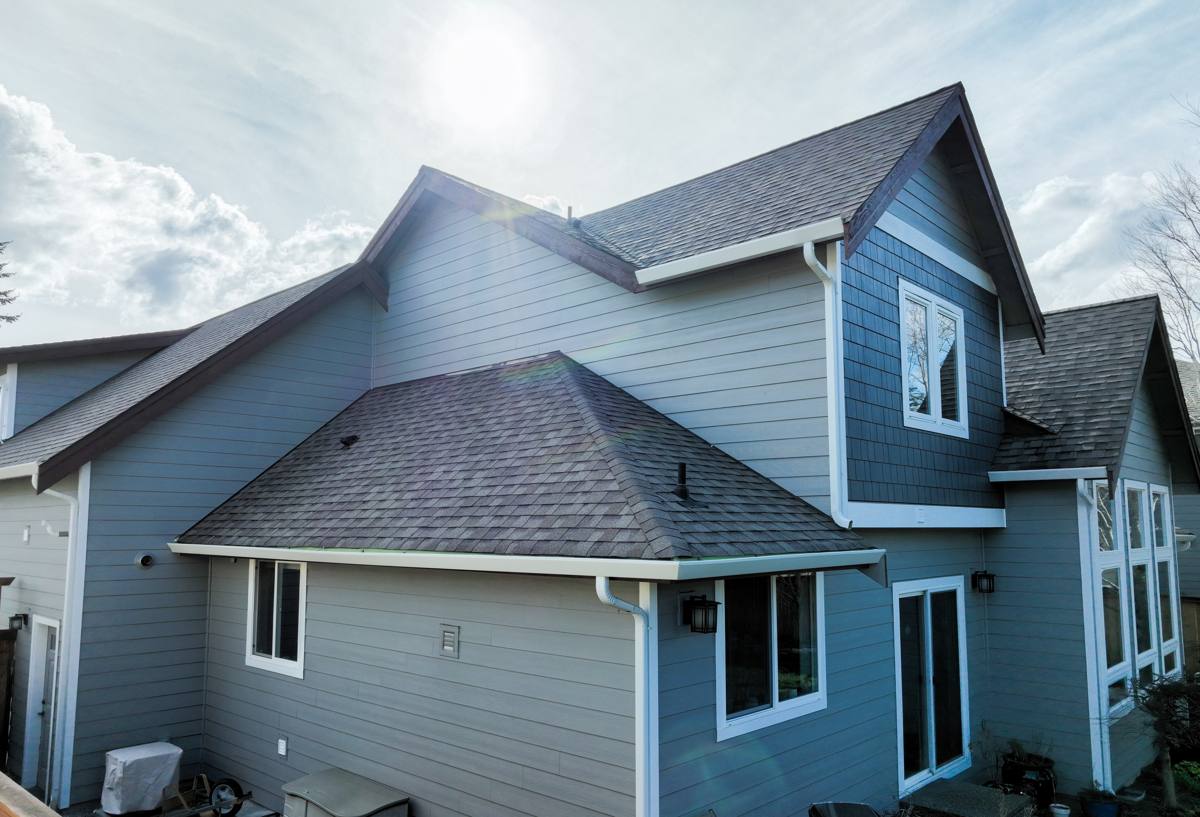
How to Tell a Lynden Home Needs Full Replacement, Not Repair
Not every problem calls for tearing off a wall. A cracked board, a failed caulk joint, or isolated impact damage can often be repaired without touching the rest of the siding. Full replacement becomes the right call when the damage is systemic rather than isolated — when it points to a wall assembly that's been letting moisture in for years rather than a single localized failure.
- Soft, spongy, or crumbling siding in multiple areas, not just one board or corner
- Bubbling, peeling, or persistent staining that returns quickly after cleaning or repainting
- Visible warping, cupping, or separation at seams across several sections of a wall
- Moss or mildew that keeps coming back on the same walls no matter how often it's cleaned
- Rot or soft spots discovered around window and door trim, especially near the bottom of the wall
- Siding that's original to a home 20-plus years old and has never been fully inspected behind the surface
If more than one or two of these show up on the same wall, that's usually a sign the problem is in the assembly, not just the surface, and a targeted repair will only mask it for a season or two before it resurfaces somewhere nearby.
What Tear-Off Actually Reveals in This Climate
This is the part of a replacement project that a homeowner can't see until the old siding comes off, and it's also the part that determines how the rest of the job goes. In Whatcom County's wet climate, we regularly find moisture damage that never showed up on the exterior surface at all — sheathing that's gone soft or delaminated behind the siding, house wrap that's torn, missing, or installed with the laps running the wrong direction, and window flashing that was never properly integrated into the wall in the first place. Wind-driven rain finds these gaps and works its way in slowly, so by the time a homeowner notices staining or softness on the outside, there's often been water intrusion happening out of sight for a while.
None of that is a reason to be alarmed going into a project — it's a reason to work with a crew that expects to find it and knows how to fix it correctly rather than covering it back up. A siding replacement that skips this step and just fastens new material over compromised sheathing solves the cosmetic problem and leaves the structural one in place.
Sheathing and Moisture Barrier
Any soft or damaged sheathing gets identified and replaced before anything new goes on the wall — installing new siding over compromised sheathing just resets the clock on the same failure. A correctly lapped, continuous weather-resistive barrier goes back over the repaired sheathing, since this layer, not the siding itself, is the wall's real defense against wind-driven rain that gets past the cladding.
Flashing at Every Penetration
Windows, doors, hose bibs, vents, and any other wall penetration need flashing that directs water back out, not into the wall cavity. This is one of the most common places we find corner-cutting on older installs, and it's also one of the most common sources of the hidden moisture damage tear-off reveals in the first place.
Correct Installation to Manufacturer Spec
James Hardie's warranty and long-term performance depend on installation following the manufacturer's spec — correct fastener type and placement, proper clearances at grade and roof lines, and joints and seams treated the way the product system calls for. Skipping these details doesn't just risk the warranty; it's often exactly how the old siding failed in the first place.
Why We Only Replace Old Siding With James Hardie
We used to install a wider range of siding products. We narrowed that down to one system after seeing, repeatedly on tear-offs across this climate, which materials actually held up over decades and which ones didn't. We don't install LP SmartSide, vinyl siding, Cemplank, Allura, primed spruce, or cedar. Each has a place in the market, and plenty of homeowners are satisfied with them. But for a full replacement project — where the whole point is fixing the problem for good rather than buying a few more years — we'd rather stand behind one system fully than offer something cheaper that shifts maintenance risk back onto the homeowner.
- Non-combustible core: Fiber cement doesn't feed a fire the way wood-based siding products can.
- Factory-applied ColorPlus finish: Baked on under controlled conditions, so it holds color and resists fading and moisture far longer than a field-applied paint job.
- Climate-engineered HZ5 formulation: Built specifically for regions with heavy moisture exposure and freeze-thaw cycling, which describes northern Whatcom County accurately.
- Dimensional stability: Fiber cement doesn't swell, cup, or warp with repeated wetting the way engineered wood products can.
- Strong transferable warranty: Backed by Hardie when installation follows their spec, which matters more on a full replacement than almost anywhere else, since it's the one chance to get the whole wall assembly right at once.
How a Replacement Project Runs, Start to Finish
- Walkthrough and assessment: We inspect the existing siding, look for signs of trouble at trim, window edges, and low wall sections, and talk through what we expect to find once tear-off starts.
- Tear-off: Old siding and trim come off the wall, exposing the sheathing and weather barrier underneath.
- Sheathing and moisture repair: Any soft, delaminated, or water-damaged sheathing gets identified and replaced before anything new goes back on.
- Weather-resistive barrier and flashing: A new, correctly lapped barrier goes on, with flashing properly integrated at every window, door, and penetration.
- James Hardie installation: Fiber cement siding and trim go on to manufacturer spec, with fastener placement, clearances, and joint treatment all following Hardie's installation guidelines.
- Final walkthrough: We go over the finished wall with the homeowner, including any trim or color details, before calling the job complete.
Cost Factors in a Lynden Siding Replacement
| Factor | Why It Matters |
|---|---|
| Home size and wall complexity | More square footage and more corners, gables, and trim details mean more material and labor |
| Condition of the sheathing underneath | Rot or moisture damage found at tear-off adds repair scope that can't be estimated until the old siding is off |
| Number of windows, doors, and penetrations | Each one needs flashing work, which adds time regardless of overall wall size |
| Siding profile and trim style chosen | Lap siding, shingle-style panels, and board-and-batten all price differently in material and install time |
| Access and site conditions | Tight lot lines, landscaping, or multi-story sections can affect scaffolding and staging needs |
Because so much depends on what tear-off actually reveals, we walk each Lynden property in person before giving a real number rather than quoting off a generic per-square-foot rate.
Why Hiring a Crew That Already Works in Lynden Matters
A siding replacement is disruptive by nature — the wall is open for a stretch of time, and in this climate that window matters. A crew that works across Whatcom County regularly understands how to sequence a Lynden job around the weather, how long a section of open wall can reasonably sit before the next storm system moves through, and which wall orientations on a given property are drying out fine versus which ones need extra attention to flashing and moisture barrier detail. That's a different kind of judgment than a crew that installs siding occasionally in a dozen different climates and treats every project the same way. It also means when tear-off reveals sheathing damage or a flashing problem that wasn't visible beforehand, the answer is already known rather than improvised on the spot.
If your Lynden home has siding that's showing its age — soft spots, recurring moss, staining that won't stay gone, or simply decades of exposure to this climate with no real inspection behind the surface — we're glad to take a look. Reach out using the form below for a free, no-pressure estimate, and we'll give you a straightforward read on whether your home needs a repair, a full replacement, or somewhere in between.