 Bellingham Roofing
 Siding That Has to Work Year-Round in Ferndale
Ferndale sits close enough to the water and open farmland that its homes take a different kind of weather beating than siding a few miles inland. Salt-tinged air off Bellingham Bay and the Strait, wind-driven rain that gets pushed sideways into wall assemblies, and a moss and algae season that stretches from fall through spring all put steady pressure on whatever material is covering a house. Siding here isn't just cosmetic — it's the first line of defense for the wall assembly underneath, and it needs to hold up to repeated wet-dry cycling without failing quietly behind the surface.
We install James Hardie fiber cement siding exclusively. Not because it's the only decent product on the market, but because after years of servicing homes in Whatcom County, it's the one system we're comfortable standing behind for this specific climate. This page walks through what Ferndale homes actually need from their siding, what a correct Hardie installation involves, and how our process works from first call to finished wall.
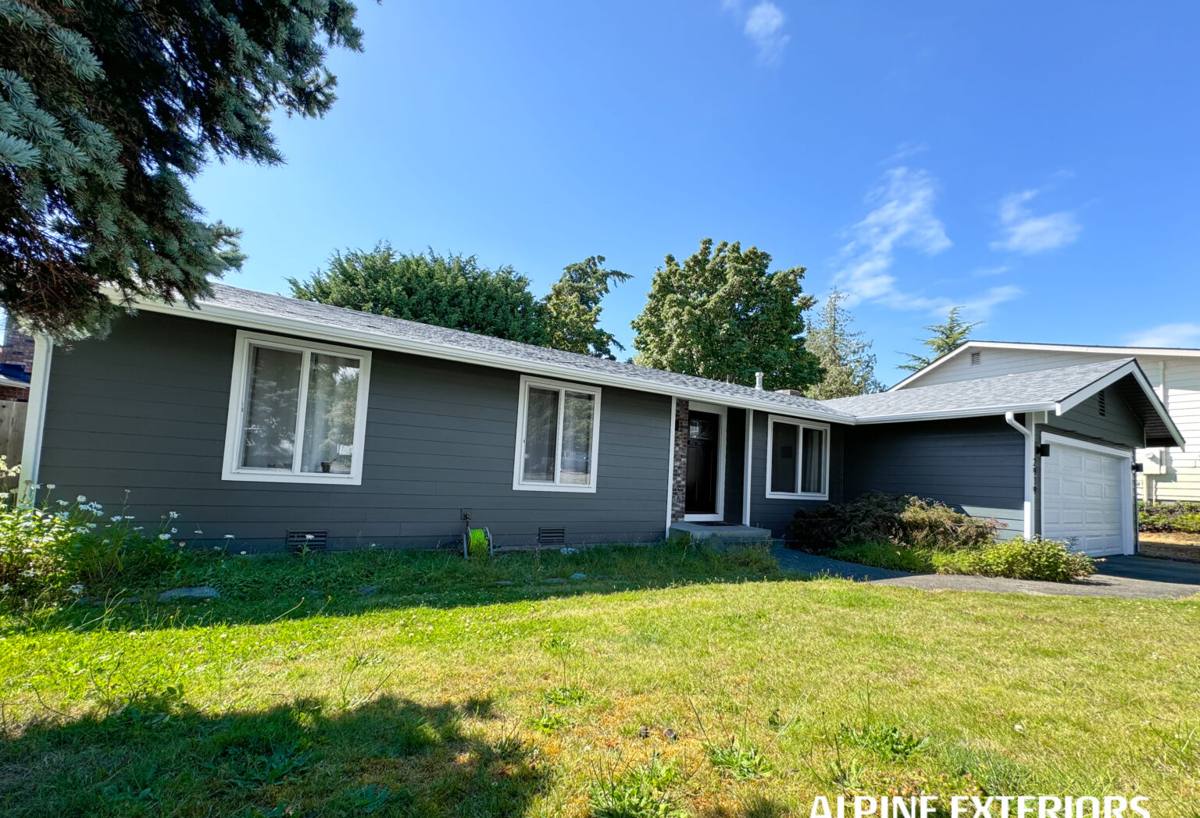
What Ferndale's Climate Actually Does to Siding
Salt Air and Coastal Moisture
Homes closer to Bellingham Bay and the surrounding shoreline deal with airborne salt that accelerates corrosion on fasteners, trim, and any exposed metal — and it degrades softer, less stable siding materials faster than it degrades a dense, engineered fiber cement panel. Salt-laden moisture also tends to linger in cracks and seams longer than plain rainwater, which matters a lot if the siding material underneath is prone to swelling or absorbing water at its edges.
Driving Rain
Whatcom County storms don't always fall straight down. Wind off the water pushes rain horizontally into walls, especially on west- and southwest-facing elevations. That means water is getting forced into laps, seams, and butt joints far more aggressively than in a calmer inland climate. Every seam, corner, and penetration on a Ferndale home has to be treated as a place water will actively try to get behind — not just where it might land.
Moss, Algae, and a Long Wet Season
Shade from mature trees, morning fog off the water, and a wet season that runs much of the year create ideal conditions for moss and algae growth on north-facing and shaded walls. Materials that hold surface moisture stay damp longer, which feeds growth and, over time, can contribute to surface breakdown on less durable claddings. A siding surface that sheds water and dries out quickly is doing real work here, not just looking clean.
Why We Standardized on James Hardie for This Kind of Exposure
James Hardie fiber cement is a cement, sand, and cellulose fiber composite — it's non-combustible, dimensionally stable, and doesn't absorb and swell with moisture the way wood-based or wood-fiber products can. For a climate that cycles wet and dry constantly, that stability matters more than almost any other single property. Panels that don't swell hold their fastening and their factory finish longer, and joints stay tighter over years of seasonal movement.
Hardie's ColorPlus factory-applied finish is baked on and cured under controlled conditions, which gives it better fade and moisture resistance than field-applied paint — and it comes with its own finish warranty separate from the product warranty. For a house exposed to salt air and constant damp shade, a finish that's engineered to hold its bond and color matters more than it would somewhere drier.
Hardie also builds region-specific product lines (their HZ5 formulation is engineered for climates like ours, with freeze-thaw and moisture cycling in mind), which is part of why we don't treat "fiber cement" as a single interchangeable category. We've looked at the alternatives — vinyl, LP SmartSide, primed spruce, cedar, other fiber cement brands — and each comes with a real trade-off for this specific climate: moisture sensitivity, maintenance burden, seam behavior, or a weaker warranty structure. Hardie is the one where the trade-offs are smallest for what Ferndale weather actually does to a wall over a 20-30 year span.
What a Correct Installation Actually Involves
The product only performs as well as the install. Most Hardie siding problems we get called out to inspect on existing homes trace back to installation shortcuts, not the material itself. A correct job for a Ferndale home includes:
- Weather-resistive barrier done right — a properly lapped and sealed water-resistive barrier behind the siding, since driving rain means the siding is a first defense, not the only defense.
- Correct fastener spacing and type — stainless or hot-dipped galvanized fasteners appropriate for coastal salt exposure, placed per Hardie's fastening schedule, not "close enough."
- Proper clearances — siding held off decks, patios, and grade per manufacturer minimums so the bottom edge isn't sitting in standing moisture or splashback.
- Sealed and flashed penetrations — every vent, light fixture, hose bib, and utility penetration flashed and sealed before siding closes over it.
- Butt joints treated as vulnerable points — properly flashed or caulked per spec, since horizontal wind-driven rain finds these first.
- Correct panel and trim gaps — expansion gaps at trim and corners sized to spec so seasonal movement doesn't crack caulk joints prematurely.
Skipping any one of these doesn't usually show up as a problem in year one. It shows up in year five or eight, as a stain, a soft spot, or a section that's holding moss longer than the rest of the wall — by which point it's a repair, not a maintenance item.
Signs an Existing Ferndale Home Needs Siding Attention
| What You See | What It Usually Means |
|---|---|
| Persistent moss or algae on one elevation only | That wall is staying wet longer — could be shade, could be a drainage or flashing issue behind the siding |
| Soft or spongy spots when pressed | Moisture has gotten behind the cladding and is affecting the substrate |
| Paint or finish failing at seams first | Water is concentrating at joints — often a sign of an aging or under-flashed seam |
| Visible gaps or cracked caulk at trim | Expansion joints weren't sized correctly or caulk has reached end of life |
| Rust streaks below fasteners | Fasteners not rated for coastal salt exposure are corroding |
Our Process for a Ferndale Siding Project
1. On-Site Assessment
We walk the exterior, check current siding condition (if any), note problem elevations — usually the ones facing prevailing wind and rain, or shaded north sides — and look at trim, flashing, and moisture-prone areas like deck ledgers and window heads.
2. Product and Line Selection
We help you choose the right Hardie plank profile, texture, and ColorPlus color for the home, factoring in sun exposure (for color and fade considerations) and shade exposure (for moss-prone walls).
3. Prep and Weather Barrier
Old siding removal (if applicable), substrate inspection for hidden moisture damage, and installation or repair of the weather-resistive barrier before a single Hardie panel goes up.
4. Installation to Spec
Fastening, flashing, clearances, and joint treatment done to Hardie's published installation requirements — not shortcuts, because that's what keeps the manufacturer's warranty valid and keeps the wall dry for the long run.
5. Final Walkthrough
We review the finished work with you, including trim, caulk lines, and clearances, before calling the job done.
Cost Factors for a Ferndale Hardie Project
| Factor | Why It Matters Here |
|---|---|
| Home size and elevation count | More wall area and more corners/trim means more material and labor |
| Existing siding removal | Tear-off and disposal of old material adds time, especially if hidden moisture damage is found |
| Substrate repair | Rot or moisture damage found during tear-off has to be fixed before new siding goes on |
| Trim and detail complexity | Homes with more windows, dormers, and architectural detail take more time to flash and finish correctly |
| Product line and finish | HZ5 panels and specific ColorPlus finishes vary in cost by profile and color |
We give exact numbers only after seeing the house in person — anyone quoting a firm price over the phone without inspecting the walls, trim, and substrate condition is guessing.
A Checklist Before You Sign With Any Siding Contractor
- Ask what weather-resistive barrier and flashing details they use — vague answers are a red flag
- Confirm they're a certified or experienced Hardie installer, not just "familiar with fiber cement"
- Ask how fasteners are selected for coastal/salt exposure specifically
- Ask what happens if they find rot or moisture damage during tear-off — get this in writing before work starts
- Confirm who handles the manufacturer warranty registration, and get it in writing
- Ask for a written scope that names clearances, joint treatment, and fastener schedule — not just "install siding"
Why a Crew That Already Works Ferndale Matters
Whatcom County isn't uniform. A home a few blocks from the water deals with different salt and wind exposure than one set back near open fields, and a shaded lot near mature trees fights moss on a totally different schedule than a sun-exposed one. A crew that's done this work across Ferndale and the surrounding area already knows which elevations tend to need extra attention to flashing and which color finishes actually hold up under this specific mix of salt air, rain, and shade — instead of treating every house like a generic install.
If your Ferndale home needs new siding, a repair, or you're just trying to figure out whether what's on the walls now still has years left in it, we're happy to take a look. Reach out for a free, no-pressure estimate — the form below gets you started.