 Bellingham Roofing
 Why Fairhaven Decks Wear Out Faster Than People Expect
Fairhaven sits close enough to Bellingham Bay that salt-laden air is a constant, low-grade factor in how exterior materials age here. It's not the dramatic corrosion you'd see right on the waterline, but it's steady exposure that speeds up rust on fasteners, dulls finishes faster than manufacturers' charts predict, and quietly undermines hardware that wasn't rated for a marine-influenced environment in the first place. Add in Whatcom County's long stretch of wet months, driving rain that comes in sideways off the water during winter storms, and a moss season that can run from early fall through late spring, and you have a set of conditions that ages an outdoor deck differently than it would age fifty miles inland.
We replace decks throughout Bellingham, but Fairhaven jobs come with their own pattern of failure points: ledger boards that trapped moisture against older homes, joists that never had proper flashing tape when they were built, and decking boards that looked fine on top while the structure underneath was quietly rotting. A deck replacement here isn't just about swapping old boards for new ones — it's about correcting the details that let water and salt air do damage in the first place.
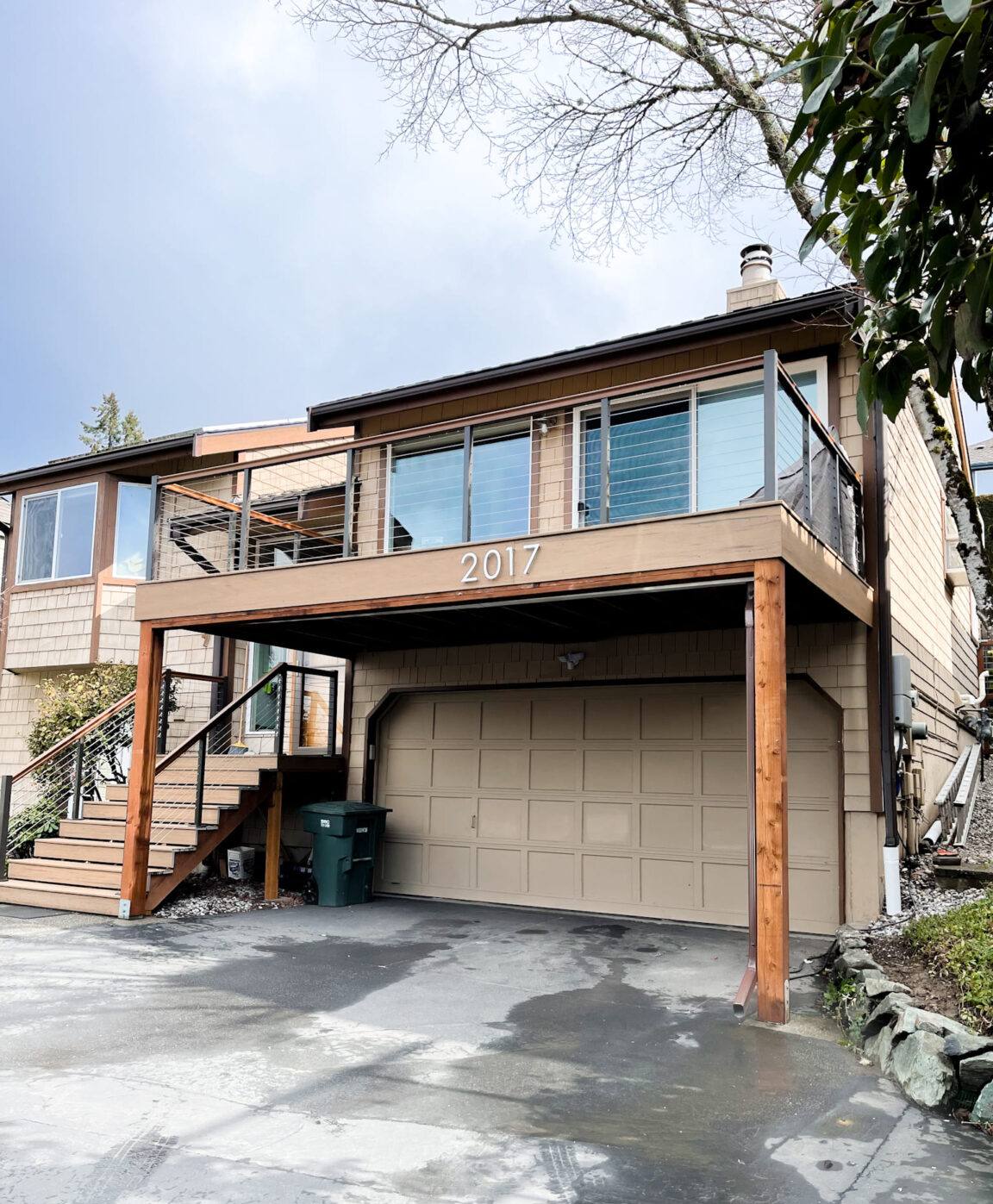
Signs a Fairhaven Deck Needs Replacement, Not Just Repair
Homeowners often ask us whether a deck can be patched instead of replaced. Sometimes it can. But there are a few signs that tell us the structure itself has been compromised and repair would just be delaying an inevitable, more expensive job later.
- Soft or spongy spots in the decking surface, especially near the house or around post locations
- Visible rot, discoloration, or a soft "give" where the ledger board meets the house
- Rust streaking or crumbling at joist hangers, bolts, or other structural hardware
- Railings or posts that wobble more than a small amount when pushed
- Persistent moss or algae growth that comes back within weeks of cleaning
- A deck more than 20-25 years old that has never had its framing inspected
If you're seeing two or more of these, it's worth having someone look at the framing, not just the surface boards. A lot of decks in this area look presentable from a distance while the joists or ledger connection underneath have already failed.
Why Moss Season Makes Small Problems Worse
Moss and algae hold moisture against the wood far longer than open rain does. A deck that dries out within a day after a storm in July can stay damp for a week or more in November, especially in shaded corners or under overhangs that block sun and wind. That extended damp period is exactly what wood-decay fungi need to get established, and once rot starts in a joist or ledger board, it spreads along the grain far faster than most homeowners expect.
Choosing Materials That Actually Hold Up Here
There's no single "best" decking material — every option is a trade-off between upfront cost, maintenance, and how it behaves in a wet, salt-influenced climate. We walk homeowners through the honest version of that trade-off rather than pushing whatever has the best margin.
| Material | Upfront Cost | Maintenance | How It Handles Fairhaven's Climate |
|---|---|---|---|
| Pressure-treated wood | Lowest | Annual cleaning, re-sealing every 1-2 years | Affordable but needs consistent upkeep to resist moss and moisture; neglect shows up fast |
| Cedar | Moderate | Regular sealing, moss treatment | Naturally rot-resistant and handles this climate well, but still needs maintenance to keep that resistance intact |
| Composite decking | Higher | Occasional washing, no sealing | Resists rot and moss growth well; some early composite products had moisture-absorption issues, so we only install boards with a proven track record in wet climates |
| PVC / capped composite | Highest | Minimal | Best moisture and moss resistance of the group; higher cost is the main trade-off |
Whatever the surface material, the framing underneath matters more for long-term durability. A composite deck built on poorly protected joists will still fail from the bottom up — the surface material is only one part of the equation.
What a Correct Deck Replacement Actually Involves
A deck replacement is more than removing old boards and screwing down new ones. Done correctly, it addresses every point where water can get into the structure.
The Ledger Board Connection
The ledger board — where the deck attaches to the house — is the single most common failure point we find on older Fairhaven decks. If it wasn't properly flashed when originally built, water runs down the siding, behind the ledger, and into the rim joist and wall framing behind it. On a replacement, we install proper flashing and a water-resistant barrier at this connection every time, regardless of what was there before.
Footings and Posts
Post bases that sit in standing water or direct soil contact rot from the ground up. We check footing depth and drainage, and use post bases that hold the post above grade rather than letting it sit in a pocket of soil that stays damp for weeks after a storm.
Joist Protection
Unprotected joist tops absorb rainwater directly into end grain, which is the fastest way for a joist to rot from the inside. We use joist tape or an equivalent moisture barrier on top of every joist before decking goes down — a step that's easy to skip and impossible to verify once the deck is finished, which is exactly why it matters who's doing the work.
Drainage and Airflow Underneath
A deck built low to the ground with poor airflow underneath stays damp longer after every rain. Where grading allows, we build in enough clearance and, where needed, drainage paths so water moves away from the structure instead of pooling under it.
Our Deck Replacement Process
- On-site assessment — we inspect the existing deck's framing, ledger connection, footings, and any visible rot or hardware corrosion, not just the surface boards
- Honest scope of work — we tell you plainly whether you need a full replacement, a partial rebuild, or whether repair is genuinely a reasonable option
- Removal — full demolition of the old structure down to what's being reused, if anything
- Framing and structural work — new or corrected ledger flashing, joists, footings, and posts built to current code
- Decking installation — surface material installed to manufacturer spec, including proper fastener spacing and gapping for wood movement
- Railings and finishing details — code-compliant railing height and baluster spacing, stairs, and any trim or skirting
- Final walkthrough — we go over the finished deck with you and explain what maintenance it needs going forward
Fasteners and Hardware: The Detail Most Homeowners Never See
Salt air corrodes standard fasteners and hardware faster than it corrodes wood. A deck can look structurally sound while the nails, screws, or joist hangers holding it together are quietly rusting away underneath. For any deck within reach of salt-influenced air off the bay, we use stainless steel or hot-dip galvanized fasteners and structural hardware rated for coastal exposure, not the standard-grade hardware that's fine forty miles inland but undersized for this environment. It costs more upfront and it's the difference between hardware that lasts the life of the deck and hardware that needs attention again in ten years.
Permits and Code in Bellingham and Whatcom County
Most deck replacements that involve structural changes — new footings, a different size or height, altered railings — require a permit from the City of Bellingham or Whatcom County, depending on where the property sits. Height, guardrail spacing, and stair requirements all follow the adopted building code, and inspectors will check ledger attachment and footing work specifically, since those are the components most likely to be done wrong. We handle the permit process and build to pass inspection the first time, which also protects you if the deck is ever an issue during a future home sale.
Deck Maintenance for Moss Season
Even a well-built deck needs some seasonal attention in this climate. A short list of habits goes a long way toward protecting the investment:
- Clear leaves and debris from between boards before fall rains set in
- Treat visible moss or algae early rather than letting it spread across the whole surface
- Keep gutters and downspouts near the deck clear so runoff isn't dumping directly onto it
- Check railings and stairs for looseness once a year, especially after the wettest months
- Re-seal wood decking on the schedule the product calls for — don't wait until it looks obviously dry
- Watch for soft spots near the house or at post locations, and address them before they spread
What Drives the Cost of a Deck Replacement
| Factor | Why It Matters |
|---|---|
| Deck size and shape | More square footage and more corners/angles both add material and labor |
| Decking material chosen | Composite and PVC cost more upfront than wood but need less ongoing maintenance |
| Condition of existing footings | Reusable footings save cost; footings that need replacement add time and concrete work |
| Height and stairs | Elevated decks with stairs require more structural work and railing code compliance |
| Ledger and structural repair needs | Rot found at the ledger or rim joist during demolition can add scope once it's uncovered |
We give you a real number after we've actually looked at the structure, not a phone estimate based on square footage alone — too many Fairhaven decks have hidden rot that only shows up once the old boards come off.
Why Hire a Crew That Already Works in Fairhaven
A contractor who works this neighborhood regularly already knows which failure points show up most often in homes exposed to bay air and driving winter rain — the ledger connections that were never flashed right the first time, the fastener grades that don't hold up, the drainage issues that come from tight lot lines and mature landscaping. That familiarity means fewer surprises during demolition and a build that's designed for the actual conditions your deck will face, not a generic spec sheet. It also means a warranty and a crew that's still around and reachable if a question comes up five years down the road, not a company that only shows up for one job and moves on.
If your deck is showing its age, or you just want an honest opinion on whether it needs replacing at all, we're happy to take a look. Fill out the form below for a free, no-pressure estimate — we'll tell you straight what we find.