 Bellingham Roofing
 Building New in Blaine: What the Coast Asks of Your Windows
Blaine sits about as close to the water and the wind as it gets in Whatcom County. If you're framing a new home or building an addition here, the windows you choose and how they're installed aren't just a style decision — they're a decision about how the house holds up against salt air, driving rain, and a wet season that can stretch for months. A window that performs fine forty miles inland can struggle here if it wasn't specified and installed with coastal exposure in mind.
Salt Air and Hardware Fatigue
Salt-laden air corrodes exposed metal faster than people expect, especially hinges, locks, screen frames, and any fasteners that aren't rated for coastal exposure. On a new build, this is easy to plan for up front — stainless or coated hardware, proper frame material, and correct sealant choices — but expensive to fix later if the wrong components go in during rough framing.
Wind-Driven Rain and Water Management
Storms coming off the Strait push rain sideways, not straight down. That means water gets tested at every seam, corner, and nailing flange on a window, not just the top. New construction gives you one real chance to get the flashing sequence and water-resistive barrier integration right before siding closes it all up. Get it wrong here and you won't see the problem for years — until there's rot in the sheathing.
Moss, Moisture, and the Long Wet Season
Whatcom County's damp stretch from fall through spring keeps surfaces wet for extended periods. Around window openings, that means sills, trim, and any horizontal surfaces need to shed water fast and dry out between rains. Window selection and detailing play a direct role in whether moss and mildew get a foothold on the surrounding trim.
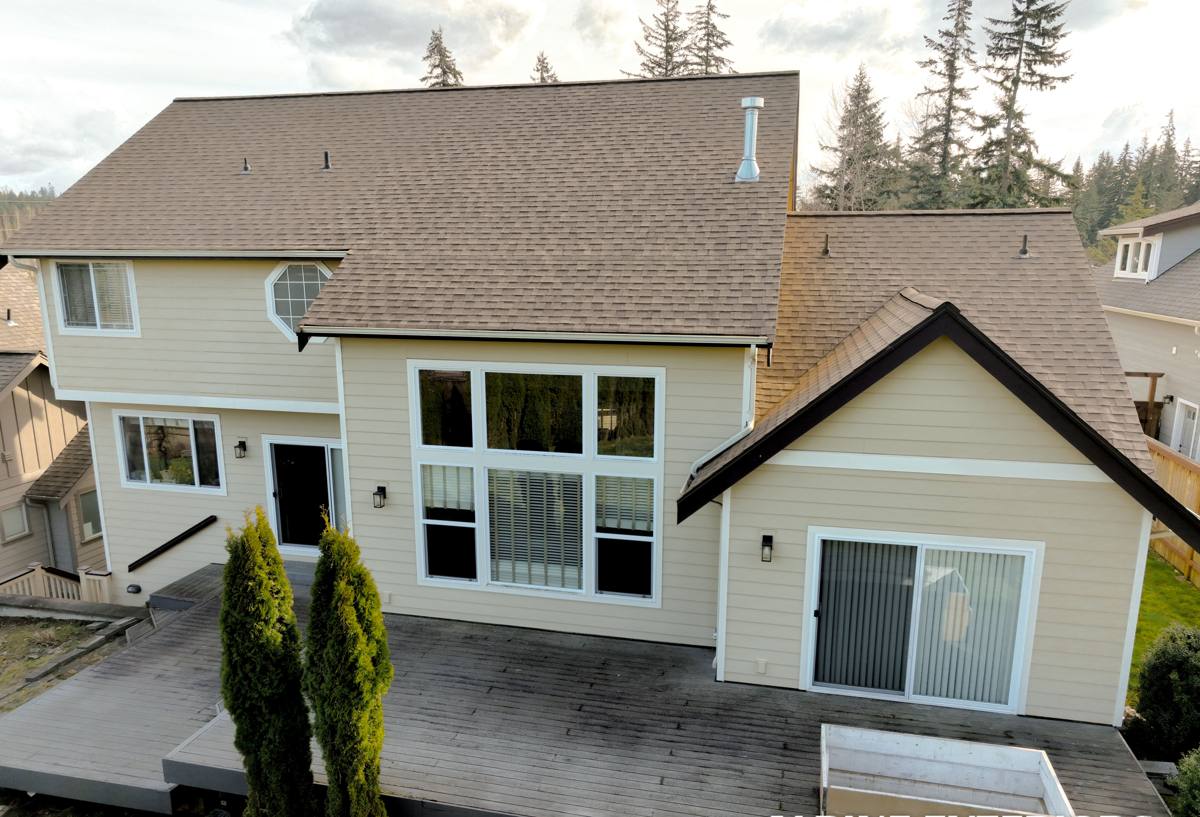
New Construction vs. Replacement: A Different Job
Replacing a window in an existing wall works around what's already there. New construction is the opposite — you're setting the window into a fresh rough opening with no existing siding, trim, or flashing to match. That's an advantage if it's done right, and a liability if it's rushed, because every layer that protects the opening for the next thirty-plus years gets built from scratch.
Flashing and WRB Integration
The window has to integrate correctly with the house wrap or weather-resistive barrier in the proper shingle-lap order — sill pan first, then the sides, then the head, each layer overlapping the one below it so water is always directed outward and down. Skipping the sill pan or taping steps out of order is one of the most common ways a new-construction opening fails early, and it's invisible once the siding goes on.
Rough Opening Tolerances
New-construction windows need a rough opening built to the manufacturer's tolerances — typically a small, consistent gap around the unit for shimming and expansion, not a loose fit "close enough" to the framing. Too tight and the window can bind or crack under seasonal movement; too loose and you're relying on foam and caulk to do a job they were never meant to do alone.
Choosing the Right Window for a Blaine Build
There's no single "best" window for every coastal build — it depends on budget, exposure, and how much upkeep you want to take on. Here's how the common frame materials compare for a home this close to the water.
| Frame Material | Coastal Durability | Maintenance | Typical Cost |
|---|---|---|---|
| Vinyl | Good resistance to salt corrosion; no rust risk | Low — occasional cleaning | Lower |
| Fiberglass | Very strong; dimensionally stable in temperature swings and driving rain | Low | Mid to higher |
| Wood-Clad | Good if cladding and joints are properly sealed; interior wood still needs protection from interior moisture | Higher — cladding seams and any exposed wood need periodic checks | Higher |
| Aluminum | Prone to corrosion and condensation in salt air unless specially coated | Higher | Varies |
We'll talk through these trade-offs with you before anything gets ordered. Our default advice for exposed sites near the water in and around Blaine leans toward vinyl or fiberglass for the durability-to-maintenance ratio, but the right call depends on your home's exposure, your budget, and how it fits the overall design.
Our New-Construction Window Process
New-construction windows go in during a specific window of the build — after the house is dried in structurally but before siding closes up the walls. Timing and sequencing matter as much as the install itself.
- Plan review and takeoff. We work from your plans (or the builder's) to confirm sizes, egress requirements, and window schedule before anything is ordered.
- Ordering and lead-time coordination. Custom sizes and certain frame materials can carry real lead times. We build that into the schedule so windows arrive when the framing is actually ready for them.
- Opening prep. We confirm rough openings are square, plumb, and within tolerance before setting anything — catching framing issues here is far cheaper than catching them after.
- Flashing and WRB integration. Sill pan, jamb flashing, and head flashing go in sequence, tied properly into the house wrap so water sheds outward at every layer.
- Setting and shimming. Windows are set level, plumb, and square, shimmed at the manufacturer's load points, and fastened per spec — not just "nailed until it stops moving."
- Sealing and insulation. Gaps get filled with a compatible low-expansion foam or backer rod and sealant, never packed solid, so the window can move seasonally without stressing the frame.
- Final check. We walk every opening for operation, seal integrity, and squareness before the crew moves on to trim and siding.
Why a Crew That Already Works Blaine Matters
A lot of window problems on the coast don't show up as bad workmanship in general — they show up as generic workmanship applied to a specific site. A crew that mostly works drier, more sheltered areas inland can do everything "by the book" and still under-detail a Blaine opening, because the book doesn't account for how hard and how often wind-driven rain hits a wall that faces open water.
Working this area regularly means we've seen how these homes actually perform after a few wet seasons — which details hold up and which ones don't. It also means we're not guessing at local permitting expectations or typical site conditions; we've been through them before on other Whatcom County builds.
Common Mistakes We See in Coastal New Builds
Most window failures in new construction trace back to a handful of repeatable mistakes, almost all of them invisible until siding or trim comes off years later. Here's what we check for on every job:
- Missing or incorrectly lapped sill pan flashing under the window
- Housewrap or tape applied out of shingle-lap order, letting water track inward instead of out
- Rough openings shimmed unevenly, putting stress on the frame corners
- Foam sealant packed too tightly, bowing the frame and affecting operation
- Standard hardware or fasteners used instead of corrosion-resistant components
- Sills and trim detailed without a slight outward slope, letting water pool instead of shed
- Window schedule mismatched to actual framed openings, forcing field modifications under time pressure
Maintenance and Warranty, Realistically
Even a correctly installed window benefits from a little attention in a climate like this. Rinsing salt residue off exterior frames a couple times a year, keeping weep holes clear of debris, and checking exterior sealant joints annually will catch small issues before they become expensive ones. Manufacturer warranties typically cover the glass unit and hardware defects, but they generally don't cover water intrusion caused by improper installation — which is exactly why the flashing and sealing details above matter as much as the window itself. We stand behind our installation work separately from the manufacturer's product warranty, and we'll walk you through what each one actually covers before you sign off on a window package.
Cost Factors on a New-Construction Window Package
Pricing for a whole-house window package varies a lot based on quantity, sizes, frame material, glass options (like low-E coatings, which we'd generally recommend given the amount of grey-sky daylight this area gets), and how many custom or specialty shapes are in the design. Rather than quote a number that won't mean much without seeing your plans, we'll put together a written breakdown once we know your window schedule — that's the only honest way to price it.
If you're planning a new build or addition in Blaine and want windows specified and installed with this coast in mind from day one, we're happy to walk your plans and put together a straightforward, no-pressure estimate — just fill out the form below to get started.