 Bellingham Roofing
 Metal Roofing Built for South Hill's Hillside Climate
South Hill sits above downtown Bellingham on a slope that catches weather most flatland neighborhoods don't deal with the same way. The elevation and proximity to Bellingham Bay mean homes here take on salt-tinged air, wind-driven rain that comes in sideways off the water, and heavy tree cover that keeps roofs shaded and damp for long stretches of the year. That combination is hard on asphalt shingles and even harder on a roof that isn't detailed correctly. Metal roofing, installed the right way, holds up to all three of those stresses better than most alternatives — but "installed the right way" is doing a lot of work in that sentence, and it's the part that gets skipped more often than homeowners realize.
This page is about metal roofing specifically for South Hill properties — what the local climate demands, what a correct installation actually involves, and how we approach the job differently than a crew that's just passing through Whatcom County for the week.
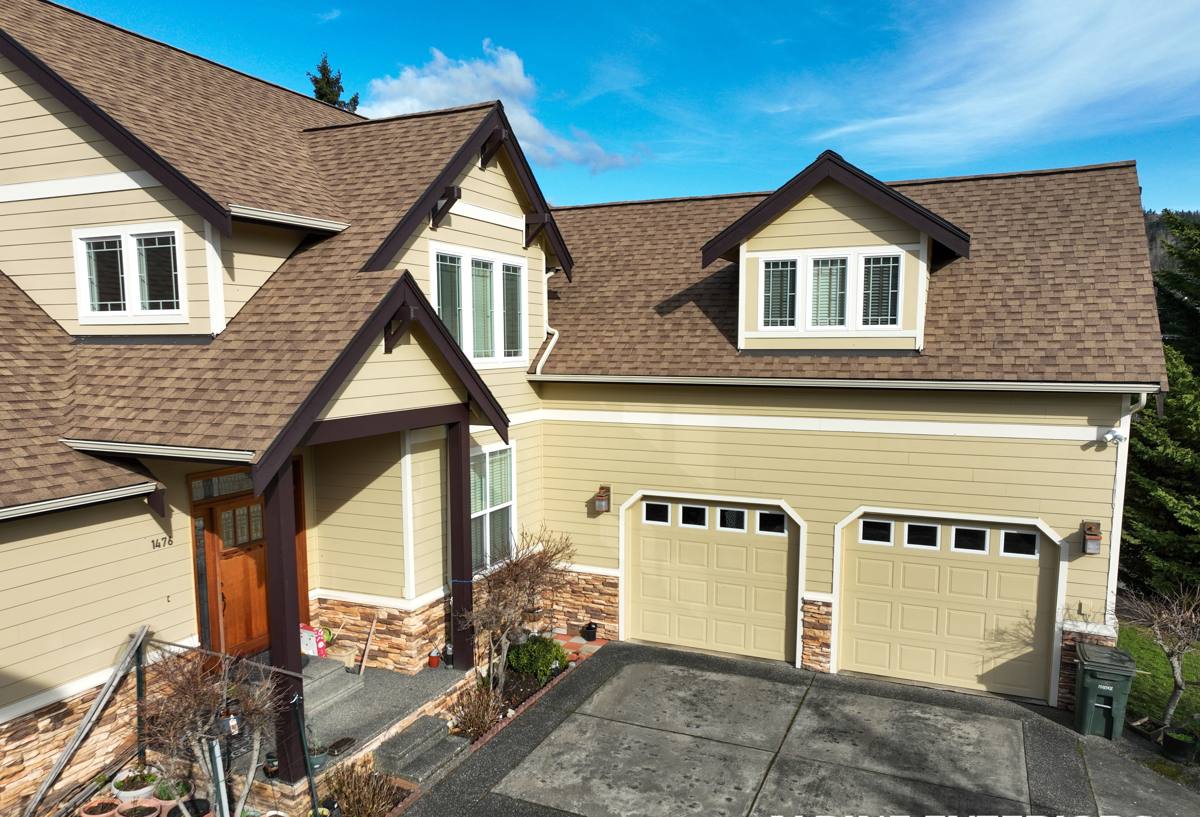
What Bellingham's Climate Does to a Roof Over Time
Salt Air
Homes closer to the bay are exposed to airborne salt that settles on roofing materials and accelerates corrosion on anything with exposed steel or poorly protected fasteners. It's a slow process, but it's constant, and it's one of the main reasons material choice and coating quality matter more here than they would inland.
Driving Rain
Bellingham doesn't just get a lot of rain — it gets rain pushed sideways by wind off the water, which finds its way into every gap a roof system has. Flashing details, seam laps, and penetration seals carry more of the workload here than in drier climates, because wind-driven water will test every weak point eventually.
Moss Season
South Hill's mature tree canopy means shade, debris, and moisture that lingers on roof surfaces well after a storm passes. Moss and algae take hold fastest on roofs that stay damp and shaded, and once established, moss holds moisture against the roofing material and works into laps and fastener penetrations. Metal sheds moss more easily than shingles do, but it isn't immune — a roof with poor drainage or debris buildup can still grow a moss mat over time.
Why Metal Roofing Makes Sense Here
Metal roofing isn't the right fit for every home or every budget, and we'll say that plainly during an estimate rather than oversell it. But for South Hill's conditions specifically, it offers a few real advantages:
- A hard, smooth surface that sheds water fast and gives moss and algae less to grip onto than the rough texture of asphalt shingles
- Long service life when properly coated and maintained, which matters on a house that's going to sit under salt air and rain for decades
- Better wind performance on an exposed hillside lot when panels are fastened and seamed correctly
- Lower long-term maintenance burden than shingle roofs that need moss treatment and granule loss monitoring every few years
None of that is automatic. A metal roof only delivers those benefits if the system underneath — underlayment, flashing, fastening, ventilation — is done correctly. A beautiful panel job over a poorly detailed roof deck will still leak.
Choosing the Right Metal Roofing System
Not all metal roofing is the same, and the choice matters more in a climate like Bellingham's than it might in a drier region.
| System | How It's Fastened | Best Suited For |
|---|---|---|
| Standing Seam | Concealed clips, no exposed fasteners through the panel field | Homes wanting maximum weather resistance and the longest service life — our default recommendation for South Hill's wind-driven rain |
| Exposed Fastener (screw-down) | Screws through the panel face into the deck or purlins | Budget-conscious projects, outbuildings, or lower-slope sections where cost matters more than the longest possible lifespan |
| Stone-Coated Steel | Interlocking panels, often mimicking shingle or tile profiles | Homeowners who want a metal roof's durability with a more traditional shingle-like appearance |
Exposed fastener systems cost less up front, but every screw penetration is a place where the gasket can eventually compress, shrink, or fail — and on a roof that sees this much wind-driven rain, that adds maintenance obligation over time. We install both systems, but for full roof replacements on South Hill homes we generally steer people toward standing seam because the concealed-fastener design removes that recurring weak point rather than managing around it.
What a Correct Metal Roof Installation Actually Involves
The panels are the visible part of a metal roof, but they're not what determines whether it performs for the next 30-plus years. What's underneath and around them matters more.
Underlayment
A synthetic, high-temperature underlayment (not felt) is what keeps the deck protected from condensation and any water that does make it past the panel seams. Given how long South Hill roofs stay damp during moss season, we don't cut corners here.
Flashing
Valleys, chimneys, skylights, and wall intersections are where the vast majority of roof leaks originate — on metal roofs just as much as shingle roofs. Proper flashing detail, not caulk, is what keeps wind-driven rain from working its way underneath.
Fastening and Seaming
Standing seam panels need to be seamed to the manufacturer's specification, with clips spaced correctly for local wind exposure. Exposed fastener systems need screws set to the correct torque — overdriven screws crush the gasket and underdriven screws leave a gap, and both fail eventually.
Ventilation
Metal roofs need proper intake and exhaust ventilation just like any other roof system. Poor attic ventilation traps moisture, which condenses on the underside of the deck and can cause rot from the inside — a problem that has nothing to do with the panels themselves but gets blamed on the roofing material anyway.
Our Process for South Hill Metal Roofing Projects
- On-site assessment — we look at the existing roof deck, slope, tree exposure, and drainage patterns specific to your property, not a generic checklist.
- System recommendation — standing seam, exposed fastener, or stone-coated steel, based on your budget, slope, and how exposed the home is to wind and rain.
- Deck prep — repair or replace any damaged decking before anything goes down; a metal roof installed over a compromised deck is a problem waiting to surface.
- Underlayment and flashing — installed to manufacturer spec, with extra attention to valleys and any point where the roof meets a wall, chimney, or skylight.
- Panel installation — fastened and seamed correctly, with fastener and clip spacing matched to the site's wind exposure.
- Final walkthrough — we go over the finished roof with you, including what maintenance (if any) it'll need going forward.
Cost Factors for South Hill Metal Roofing
Every roof is priced based on its own specifics, but these are the factors that move the number most on South Hill jobs:
| Factor | Why It Matters |
|---|---|
| Panel system | Standing seam costs more upfront than exposed fastener but requires less long-term maintenance |
| Roof complexity | Valleys, dormers, and multiple roof planes mean more flashing work and more labor time |
| Deck condition | Older South Hill homes sometimes need deck repair before a new roof goes on, which is a separate line item |
| Tree cover and access | Mature trees on hillside lots can mean more debris protection, trimming coordination, and access planning |
| Existing roof removal | Tear-off of an old shingle roof adds cost versus installing over an existing deck where code allows |
We'll walk through these factors specific to your home during the estimate rather than quoting a number off a phone call — roof pricing that's accurate has to be based on an actual look at the property.
Maintenance: What a South Hill Metal Roof Actually Needs
One of the real advantages of metal roofing is how little ongoing maintenance it needs compared to shingles — but "little" isn't "none," especially under South Hill's tree canopy.
- Clear gutters and valleys of leaf and needle debris at least once or twice a year, more often if the property has heavy tree cover
- Rinse off any moss or algae growth before it has a chance to establish and hold moisture against the panel
- Check sealant and flashing points periodically, especially around chimneys and skylights, for any sign of cracking or lifting
- Keep overhanging branches trimmed back to reduce shading and debris buildup on the roof surface
- Have the roof looked at after any major windstorm to check for lifted panels or displaced flashing
Why Local Experience on South Hill Matters
A metal roofing crew that works Bellingham regularly knows how South Hill's slope, tree cover, and proximity to the bay change the details of a job — where moss tends to build up first, which orientations catch the worst of the wind-driven rain, and how much ventilation an older home's attic actually needs versus what the code minimum assumes. That's the kind of knowledge that doesn't show up in a spec sheet, and it's the difference between a roof that's technically installed correctly and one that's installed correctly for this specific hillside, in this specific climate, on this specific house.
We're a Bellingham-based crew working in Whatcom County, and South Hill is part of our regular service area — not a one-off trip. If you're weighing metal roofing for a South Hill home, we're happy to come take a look and give you a straight answer about what your roof actually needs, with no pressure and no upsell. Reach out using the form below for a free estimate.