 Bellingham Roofing
 Siding Repair in Sehome: A Job That's Easy to Get Wrong
Siding repair sounds simple from the outside: find the damaged board, swap it out, move on. In practice, it's one of the easier exterior jobs to do badly and one of the harder ones to do right, especially in a neighborhood like Sehome, where salt air, driving rain, and a long moss season all take their toll on a wall over time. A patch that only addresses what's visible on the surface can leave the actual problem, trapped moisture, a failed flashing detail, a soft spot in the sheathing, sitting behind the new piece of siding, ready to show up again in a year or two.
We repair siding on homes throughout Bellingham, and Sehome comes up often enough that we know its housing stock and its climate pressures well. This page is specifically about siding repair in Sehome: what the climate does to siding here, how we decide between a repair and a replacement, what a correct repair actually involves, and why we do all of it in James Hardie fiber cement rather than whatever material happens to already be on the wall.
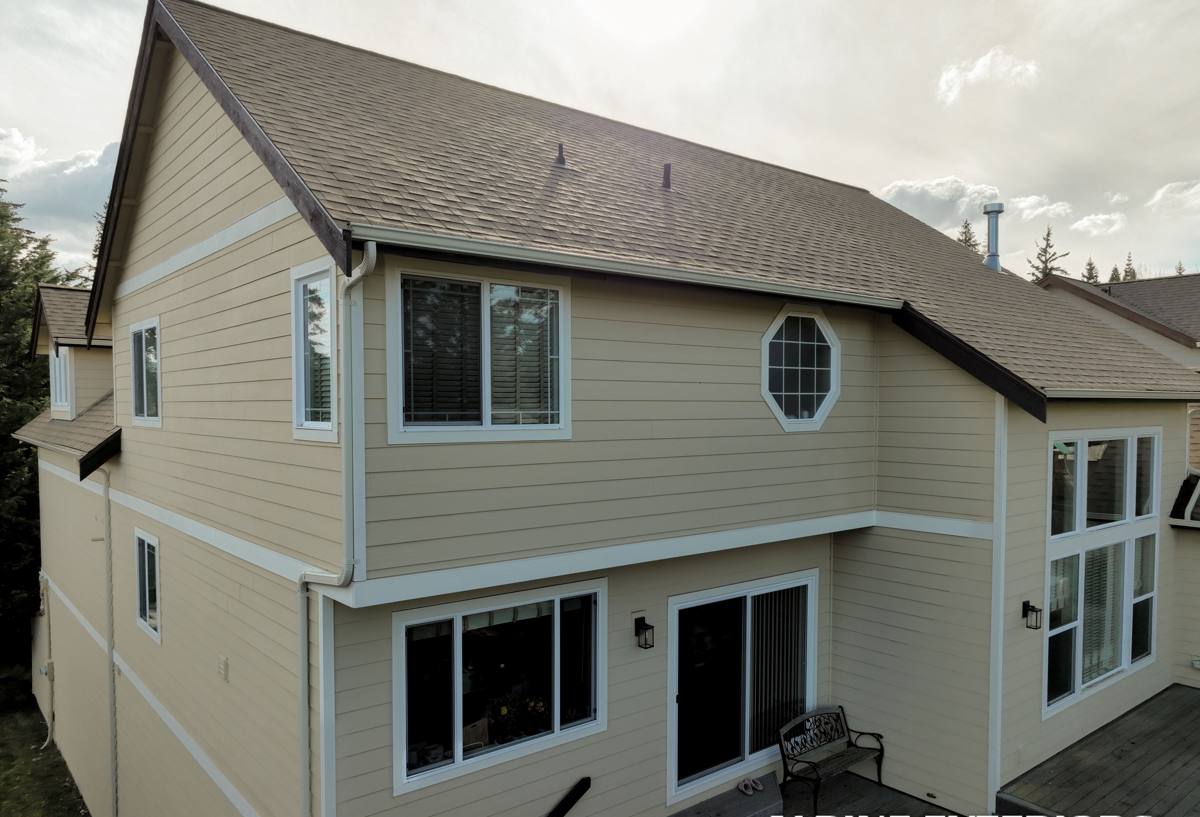
What Sehome's Climate Does to Siding
Salt Air
Bellingham sits on the Salish Sea, and salt-laden air moves through the whole area, Sehome included, even in neighborhoods set back from the immediate waterfront. Salt accelerates corrosion on fasteners, flashing, and any exposed metal trim tied into a siding system. A repair that reuses corroded nails or skips fresh corrosion-resistant flashing at a patch site is a repair that's already counting down to its next failure.
Driving Rain
Rain in this part of Washington usually arrives on a wind rather than falling straight down, which pushes moisture sideways into seams, laps, and trim joints instead of just running off. That wind-driven pattern is exactly why siding damage in Sehome so often shows up first around windows, at butt joints, and along lower courses near grade, the places where sideways-moving water finds a way in if a seam or a flashing detail isn't sealed correctly.
A Long Moss Season
Mature tree cover and mild, moist conditions give Bellingham a moss and mildew season that can run most of the year on shaded walls, and Sehome's tree canopy is no exception. Moss and algae growth on siding isn't just a cosmetic issue; organic growth holds moisture against the surface, and on porous or lower-grade materials that sustained dampness works its way toward the substrate over time. A repair that just cleans off the growth without addressing why that section of wall stays damp longer than the rest of the house is a short-term fix.
Repair or Replace? How We Make the Call
Not every damaged section of siding needs a full re-side, and we don't push a replacement when a repair will genuinely hold up. The decision comes down to how far the damage has spread and what condition the wall assembly is in underneath the siding, not just how bad the visible section looks.
- Isolated damage, sound substrate: A cracked board from an impact, a single section damaged by a fallen branch, or localized rot caught early, these are usually straightforward repairs if the sheathing and water-resistive barrier underneath are still in good shape.
- Repeated failures in the same area: If a section has already been patched once or twice and keeps failing, that's usually a sign of an underlying flashing or drainage problem, not a siding problem, and patching it a third time without fixing the cause is a waste of money.
- Widespread moisture damage: When we open up a damaged section and find soft sheathing, staining that extends well beyond the visible bad board, or moisture that's tracked along a wide area, a full-section or full-wall replacement is usually the more honest recommendation.
- Age and material of the existing siding: Siding nearing the end of its service life, or siding in a material that's known to trap moisture, may not be worth patching even if the current damage is limited, because the rest of the wall is likely close behind it.
We open up damaged areas before quoting a repair, not after starting the work, so the scope and price reflect what's actually happening behind the siding rather than a guess based on the surface.
What a Correct Siding Repair Actually Involves
A proper repair is a sequence, not a single step, and skipping any of these is how a "fixed" section ends up failing again.
- Diagnose before removing anything. We identify where moisture is actually entering, a failed caulk joint, a flashing gap, wind-driven rain finding a lap seam, before assuming the siding itself is the root cause.
- Remove damaged material carefully. Cutting back to sound material on all sides of the damage, not just replacing the single worst board, so the repair isn't bordered by material that's already partway degraded.
- Inspect the water-resistive barrier and sheathing. Any tears in the house wrap, soft or delaminated sheathing, or evidence of long-term moisture gets addressed before new siding goes back on. Covering up a compromised substrate with fresh siding just hides the problem again.
- Correct the flashing detail. If the original failure traces back to missing or undersized flashing, kickout flashing at a roof-to-wall intersection, or poor window flashing, the repair has to fix that detail, not just replace the siding around it.
- Install matched replacement material. New sections need to match the existing siding's profile, exposure, and finish closely enough that the repair doesn't stand out as an obvious patch.
- Fasten and seal correctly. Corrosion-resistant fasteners, proper nailing patterns, and sealant only where the manufacturer's installation spec calls for it, over-caulking a fiber cement joint can trap moisture just as easily as leaving it open.
Why We Repair Exclusively With James Hardie
We install and repair James Hardie fiber cement siding exclusively. We don't work in LP SmartSide, vinyl, Cemplank, Allura, primed spruce, or cedar, and that matters as much for repair work as it does for full installs.
| Factor | Why It Matters for Repair Work |
|---|---|
| Non-combustible core | Fiber cement doesn't feed a fire the way wood-based siding can, a consideration for the whole wall assembly, not just the patched section. |
| Factory-applied ColorPlus finish | A color that's baked on in the factory holds up and matches more predictably over time than field-applied paint, which makes patched sections blend in better and fade at closer to the same rate as the surrounding wall. |
| Climate-engineered HZ5 formulation | Built for regions with heavy moisture exposure and freeze-thaw cycling, which fits Whatcom County's climate better than siding formulated for drier regions. |
| Dimensional stability | Fiber cement doesn't swell, cup, or warp the way engineered wood products can, so a repaired section stays flush with the surrounding siding instead of standing proud or shrinking away from it. |
| Strong transferable warranty | Repairs performed to Hardie's installation spec keep the product warranty intact, which isn't always true of off-spec patch jobs. |
If a Sehome home already has a different siding material and needs a repair, we're upfront that patching it in kind is sometimes the more practical near-term move, but we'll also tell you plainly when the smarter long-term answer is converting that section, or eventually the whole wall, to Hardie rather than continuing to chase repairs on a material that struggles with this climate.
Our Siding Repair Process
The process is the same discipline whether the job is a single damaged board or a full section of wall.
- On-site inspection: We look at the damage, the surrounding siding, and the flashing and drainage details around it before quoting anything.
- Honest scope and estimate: A written estimate that reflects what we actually found, including what happens if we open the wall and find more than expected.
- Substrate check once opened up: If we find sheathing damage or a moisture path we didn't expect, we stop and talk it through with you before proceeding, rather than covering it and moving on.
- Repair and finish: Matched material, correct fastening, corrected flashing where needed, and a finish that blends with the rest of the wall.
- Cleanup and walk-through: We walk the completed repair with you so you know exactly what was done and why.
What Drives Siding Repair Costs
| Cost Factor | What It Depends On |
|---|---|
| Extent of visible damage | A single board versus a full section or corner of the house |
| Substrate condition | Whether the sheathing and water-resistive barrier are sound or need repair once opened up |
| Color and profile matching | How close a match is available for the existing siding's plank width, texture, and finish |
| Access and height | Second-story sections, steep rooflines nearby, or landscaping that limits access |
| Underlying cause | Whether a flashing or drainage correction is needed alongside the siding itself |
Exact pricing depends on what we find once we're actually looking at the wall, which is why we walk each Sehome property in person rather than quoting sight unseen.
Signs a Sehome Home Needs Siding Repair
- Soft or spongy siding when pressed, especially near the bottom of the wall or around window and door trim
- Visible cracking, splitting, or gaps at board seams and corners
- Moss or dark staining that returns quickly after cleaning, particularly on shaded or north-facing walls
- Peeling paint or a chalky, faded finish that stands out from the rest of the wall
- Bubbling, staining, or a musty smell on interior walls that back onto exterior siding
- Nail heads that have backed out, popped, or rusted through the finish
- Warping, cupping, or boards that no longer sit flush against the wall
If you're seeing more than one of these on the same section of wall, it's worth having someone look at it before the damage spreads further, especially heading into another wet season.
Why a Crew That Already Works Sehome Matters
Sehome's mix of older housing stock, central-Bellingham lot sizes, and tree-shaded walls means the same general climate pressures show up in slightly different ways from one house to the next. A crew that repairs siding across this neighborhood regularly has a sense of where problems tend to originate here, which flashing details get skipped on older homes, which walls stay damp longest under mature tree cover, and how sideways-driven rain tends to find its way into a lap seam on this kind of construction. That familiarity shows up in better diagnosis, not just faster work: knowing what's likely hiding behind a damaged board before the wall is even opened saves time and helps set realistic expectations from the first visit.
Get a Free, No-Pressure Estimate
If you've got a section of damaged, soft, or aging siding on a Sehome home, we're glad to take a look and give you a straightforward assessment of what's actually going on and what it'll take to fix it properly. Reach out using the form below to schedule a free estimate, no pressure, no upsell script.