 Bellingham Roofing
 Siding Installation in Puget: Built for Bellingham's Coastal Climate
Puget sits close enough to the water that its homes take on a different set of exterior challenges than houses further inland in Whatcom County. Salt air moves through the neighborhood on a regular basis, storms off the water push rain sideways into wall assemblies rather than straight down, and mild, damp conditions keep moss and mildew active for most of the year. Any siding installation in this part of Bellingham has to account for all three at once, not just look right on the day it goes up. We install James Hardie fiber cement siding exclusively, and in a location like Puget that standard isn't a marketing line — it's a direct response to what we've seen happen to weaker siding systems in coastal Whatcom County conditions.
This page focuses specifically on siding installation for Puget homes: what the local climate demands, what a correct installation actually involves, how our process runs from first walkthrough to final punch list, and why it matters to hire a crew that already understands this particular stretch of the Bellingham coastline rather than one learning it on your project.
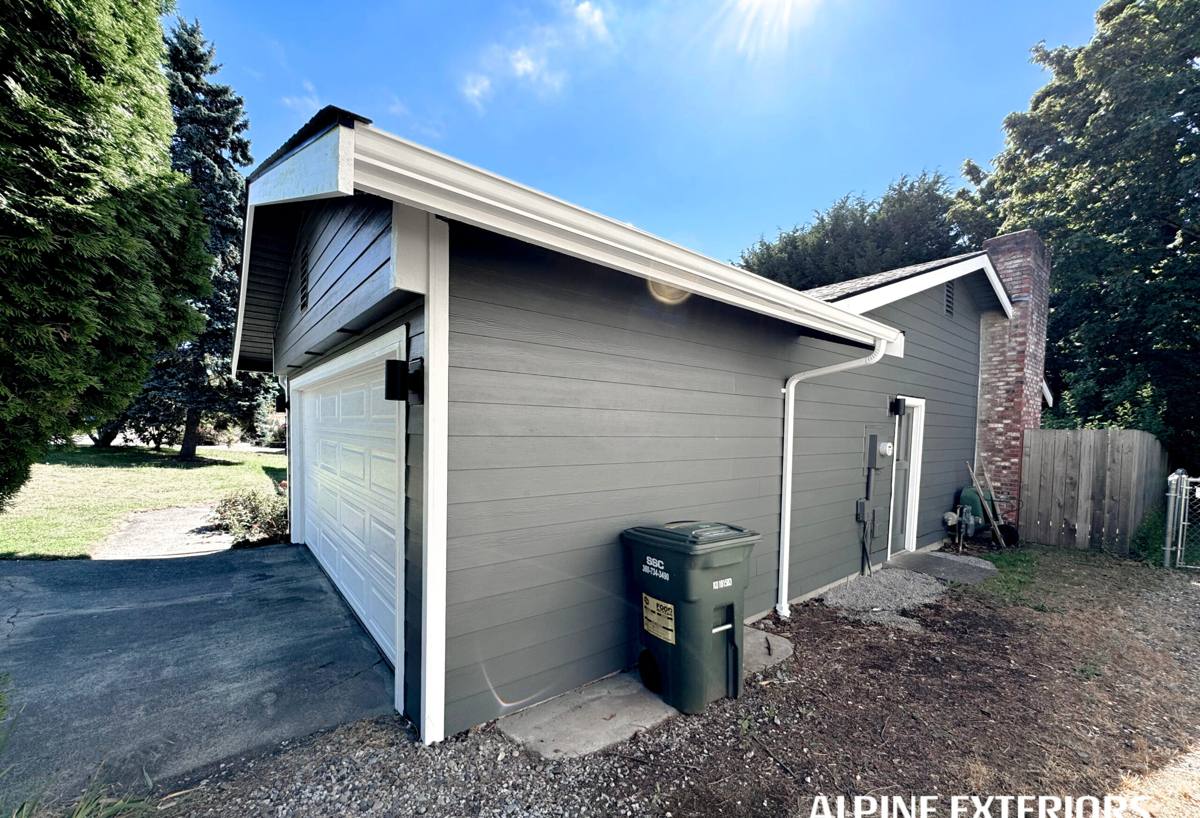
What Puget's Climate Does to Siding
Salt Air Off the Water
Homes in Puget sit close enough to Bellingham Bay and the broader Puget Sound shoreline that salt-laden air is a regular part of the local environment, not an occasional event. Salt accelerates corrosion on exposed fasteners, metal flashing, and trim hardware, and it breaks down lower-grade paints and coatings faster than they'd wear in a dry inland climate. Material choices that would be perfectly adequate forty miles from the coast can fall short here simply because the air itself is more aggressive on unprotected surfaces.
Driving Rain and Wind-Driven Moisture
Storm systems coming off the water rarely deliver rain in a straight, predictable drop. Wind pushes moisture sideways into wall surfaces, window and door flashing, and the seams where trim meets siding — the exact places a rushed or corner-cutting installation tends to leave gaps. That sideways-driven rain is harder on a wall assembly than the same total rainfall would be somewhere calmer, and it's a big part of why installation detail matters more in Puget than it would in a more sheltered part of the county.
A Long Moss and Mildew Season
Bellingham's mild temperatures combined with near-constant coastal moisture add up to a moss and mildew season that can run close to year-round on shaded or north-facing walls. Surfaces that stay damp the longest are the first to show growth, and any siding material with even slight surface porosity becomes an easier foothold over time. In Puget, that shows up earliest on tree-shaded lots and walls that don't get much direct winter sun.
Why We Only Install James Hardie Fiber Cement in Puget
We don't install every siding product on the market, and that's a deliberate professional standard rather than a limitation. In a coastal Bellingham neighborhood like Puget, the products that look comparable on a spec sheet often behave very differently once they've spent a few winters absorbing salt air and wind-driven rain. James Hardie fiber cement is what we've found holds up consistently under those conditions when installed correctly, for several specific reasons:
- Non-combustible core: Fiber cement doesn't feed a fire the way wood-based siding products can, a real factor for both household safety and insurance underwriting.
- Factory-applied ColorPlus finish: The color coat is baked on in a controlled factory process rather than brushed on in the field, giving it stronger resistance to fading, chalking, and coastal moisture exposure than most field-applied finishes.
- Climate-engineered HZ product lines: Hardie's HZ5 formulation is built specifically for regions with sustained moisture and freeze-thaw cycling, which describes coastal Whatcom County conditions well.
- Dimensional stability: Fiber cement doesn't swell, cup, or warp the way engineered wood products can after repeated wetting and drying cycles off the water.
- Strong transferable warranty: Hardie backs the product with one of the stronger warranty structures in the siding industry, contingent on installation following their published spec.
We don't install LP SmartSide, vinyl siding, Cemplank, Allura, primed spruce, or cedar. Each of those has a place in the market, and plenty of homeowners are satisfied with them elsewhere. But for a neighborhood this close to the water, we've made the call to install one system we can fully stand behind rather than offer a cheaper alternative that quietly shifts maintenance risk back onto the homeowner a few years down the road.
What a Correct Siding Installation Involves
Fiber cement only performs the way it's rated to when it's installed to spec, and in a coastal setting like Puget, the details that are easiest to skip are also the ones that matter most. Here's what we treat as non-negotiable on every job:
Tear-Off and Substrate Inspection
Before new siding goes up, the old material comes off and the sheathing underneath gets inspected for rot, soft spots, or existing moisture damage. Skipping this step is one of the most common ways a siding project ends up covering a problem instead of fixing it — new siding over damaged sheathing just hides the issue for a while longer.
Rain Screen and Drainage Plane
A small drainage gap behind the siding lets any moisture that does get past the exterior surface drain downward and evaporate instead of sitting against the wall sheathing. This detail matters in any climate, but it matters more in a place like Puget where wind-driven rain increases the odds that some moisture reaches behind the cladding at some point over the life of the house.
Fastener Schedule and Corrosion Resistance
Hardie specifies exact fastener spacing, placement, and corrosion-resistant fastener types for a reason. Loose spacing or the wrong fastener grade is one of the more common causes of early siding failure we find on tear-offs, and it's a detail that's invisible once the job is finished — which is exactly why it can't be an afterthought during installation.
Flashing, House Wrap, and Joint Sealing
Every seam, window opening, and wall penetration needs flashing and house wrap that's lapped correctly to shed water down and out, not up and in. Butt joints and trim transitions get sealed with the same attention, because those are the first places wind-driven, salt-laden moisture finds a way behind the siding on a lesser installation.
Our Process, Start to Finish
Siding installation in Puget follows the same disciplined sequence on every home, adjusted for the specific house rather than rushed to fit a generic template:
- Site walk and assessment: We walk the property, look at existing siding condition, sun and shade exposure, tree cover, and proximity to the water, and talk through what we're seeing with the homeowner.
- Written scope and product selection: We put together a clear scope of work and help select the right Hardie product line, profile, and color for the home, with the coastal exposure factored in from the start.
- Tear-off and substrate repair: Old siding comes off, sheathing gets inspected, and any rot or damage found underneath gets addressed before anything new goes on.
- Weather barrier and flashing installation: House wrap, flashing, and the rain screen drainage gap go in first, forming the moisture-management layer that the visible siding depends on.
- Hardie siding installation to manufacturer spec: Panels or planks go up following Hardie's fastener schedule, joint treatment, and clearance requirements exactly, not loosely.
- Trim, caulking, and punch list: Trim work gets finished, joints get sealed, and we walk the job with a detailed punch list before calling it complete.
- Final walkthrough: We go over the finished work with the homeowner directly, so nothing about the installation is a mystery once we leave.
Signs a Puget Home May Need New Siding
Some warning signs are easy to spot from the ground; others take a closer look. Homeowners in Puget should watch for:
- Moss or dark staining that returns quickly after cleaning, especially on shaded or north-facing walls
- Soft, spongy, or bubbling siding, particularly low on the wall or around window and door trim
- Rust streaking or visibly corroded fasteners and trim, more common this close to the water
- Peeling paint, chalking, or visible warping on older wood-based or engineered wood siding
- Gaps opening up at butt joints, corners, or trim transitions
- A noticeably higher heating bill, which can point to moisture-compromised insulation behind the siding
- Visible cracking, especially around fastener heads on aging fiber cement or wood products
Cost Factors for Siding Installation in Puget
| Factor | What It Affects | Coastal Consideration in Puget |
|---|---|---|
| Home size and wall area | Total material and labor cost | No coastal-specific change, but larger tear-offs mean more surface exposed for substrate inspection |
| Tear-off vs. overlay | Whether old siding is removed or new siding installed over it | We recommend tear-off in Puget so hidden moisture damage isn't sealed behind a second layer |
| Substrate repair | Cost of fixing rot or water damage found once old siding comes off | More likely on homes with a history of wind-driven rain exposure or minimal maintenance |
| Trim and detail complexity | Labor time for corners, window and door surrounds, transitions | Extra care and sealing needed at every joint given salt air and driving rain |
| Hardie product line and finish | Material cost per square foot | HZ5 formulation and ColorPlus finish recommended for direct coastal exposure |
These are general cost drivers, not a quote. Two houses on the same street in Puget can need very different scopes of work once old siding actually comes off and the sheathing underneath is visible, which is why we walk every property in person before putting a real number on a project rather than pricing from a phone call or a photo.
Why a Crew That Already Works in Puget Matters
A contractor who works this stretch of the Bellingham coastline regularly has already seen how salt air, driving rain, and a long moss season behave on real houses here — not just how a product performs on a manufacturer's spec sheet. That experience shapes practical decisions on installation day: which walls stay wet longest and need extra flashing attention, where fastener corrosion resistance is worth the added cost, and which details are worth the extra time so a homeowner isn't dealing with a callback after the next storm off the water. Puget's coastal exposure isn't identical to more sheltered parts of Whatcom County, and a crew that understands the difference builds accordingly instead of applying a one-size-fits-all approach to every job.
Get a Free, No-Pressure Estimate
If your Puget home needs new siding or you're not sure whether what's on the walls now is holding up the way it should, we're glad to take a look and give you a straightforward, honest assessment. Use the form below to schedule a free estimate — no pressure, no upsell script, just a real look at what your home needs.