 Bellingham Roofing
 Composite Decking for Lynden Homes
Lynden sits inland from Bellingham Bay, but it doesn't escape what Whatcom County weather does to an outdoor deck. The same marine airflow that carries salt-tinged moisture off the water pushes east across the county, and it combines with long stretches of driving rain and a moss season that can run from October through May. A deck built here needs to handle standing water, constant dampness, and organic growth every single year, not just survive one bad winter.
We install composite decking specifically with that pattern in mind. This page covers what Lynden homes actually need from a composite deck, what correct installation looks like, and how our process works from first call to final walkthrough.
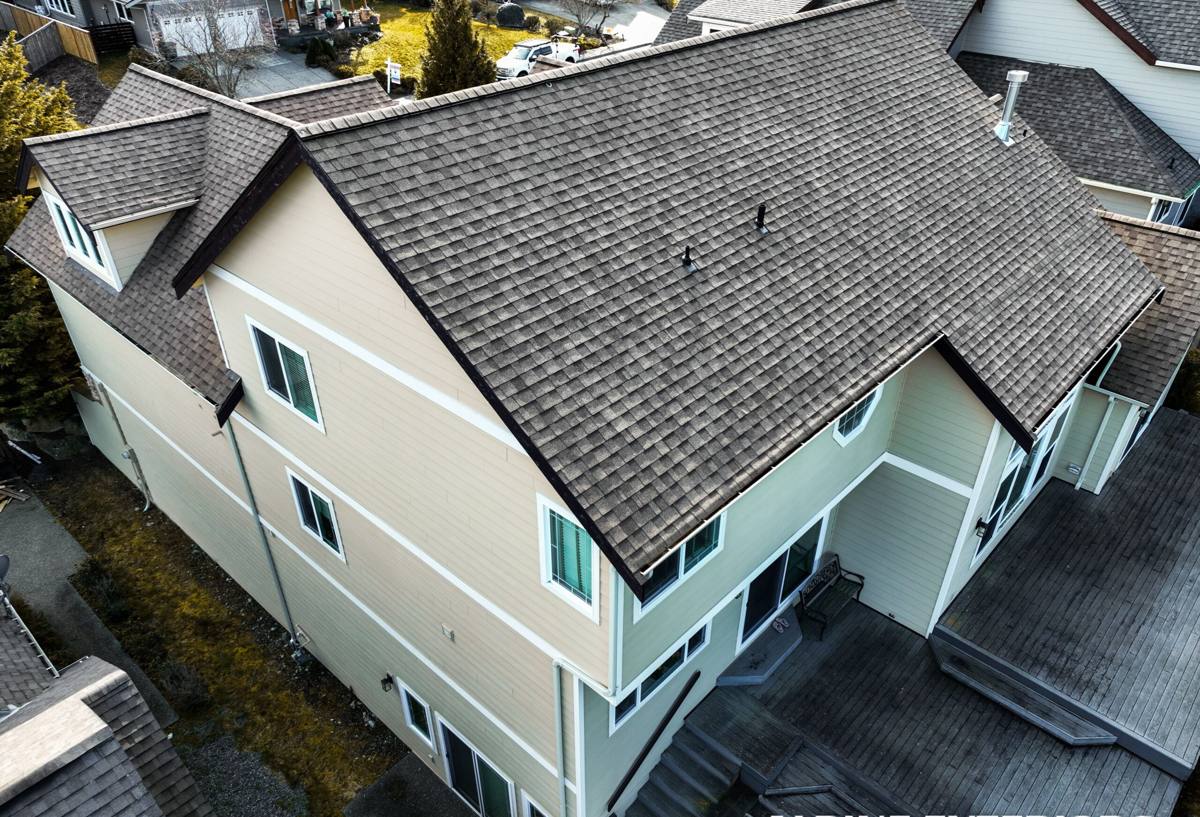
What Lynden's Climate Does to a Deck
Before talking about materials, it helps to understand the failure modes we're designing against. Whatcom County's wet season isn't just about rainfall totals — it's about how long surfaces stay wet between dry spells.
- Prolonged moisture exposure: Long rainy stretches mean deck boards, fasteners, and framing stay damp for days at a time rather than drying out between storms.
- Moss and algae growth: Shaded decks under trees or on the north side of a house develop moss and algae film that makes surfaces slick and, on the wrong material, can work into the wood grain.
- Salt-influenced marine air: Even inland, airborne moisture carries mineral content that accelerates corrosion on unprotected fasteners and hardware over time.
- Freeze-thaw cycling: Whatcom County gets enough cold snaps that trapped moisture in a board or joist can freeze, expand, and split material that wasn't properly dried or sealed.
None of this is unique to any one yard in Lynden — it's the regional pattern. But it means a deck that looks fine going in can start failing within a couple of seasons if the material and the install don't account for it.
Why Composite Decking Makes Sense Here
Composite decking doesn't absorb water the way wood does, and it doesn't need annual staining or sealing to keep moisture out. For a climate like ours, that's the main practical advantage: less maintenance burden, and less risk of the slow rot that shows up in wood decks a few years in when a homeowner has missed a season of upkeep.
That doesn't mean composite is maintenance-free or that every composite board performs the same. Capped composite boards (with a protective outer shell) handle moss and staining far better than uncapped or older-generation composite, which can still absorb some moisture at cut edges and fastener points if those areas aren't treated correctly during install. The board matters, but so does how it's installed — a good board with a bad install still fails.
Where We Land on Wood vs. Composite
We install both, and we're honest with homeowners about the trade-off. Wood costs less upfront and can look great, but in this climate it demands real annual maintenance — cleaning, sealing, and periodic board replacement — to hold up. Composite costs more upfront but trades that recurring labor for a longer, lower-maintenance service life. For most Lynden homeowners who want to actually use their deck instead of maintaining it, composite is the better long-term fit. We won't tell you wood is a bad choice — it just requires a commitment composite doesn't.
What a Correct Composite Deck Installation Involves
Composite boards are only as good as what's underneath and holding them together. Most of the problems we get called out to fix on other contractors' composite decks trace back to the substructure or fasteners, not the boards themselves.
Framing and Ledger Attachment
The ledger board — where the deck attaches to the house — is the single most common failure point on any deck in a wet climate. It needs proper flashing to keep water from tracking behind the siding and into the house framing, and the connection needs to be engineered for the load, not just nailed and hoped for. We flash every ledger correctly and use appropriate structural hardware, not shortcuts.
Fasteners and Hardware
Given the marine-influenced air moving through the county, we use corrosion-resistant, coated or stainless hardware throughout — joist hangers, structural screws, and the hidden fastener systems used for composite boards. Cheap or mismatched hardware is where rust starts, and rust-streaked boards are one of the most common complaints we hear about decks installed by crews cutting corners on materials.
Drainage and Airflow Underneath
A deck that traps moisture underneath is a deck that grows moss, mold, and eventually rot in the framing even if the surface boards themselves are composite. We grade and space framing to let water shed and air circulate underneath, and we won't build a low-clearance deck without addressing drainage first — it's the difference between a deck that stays dry-smelling and one that develops a musty crawlspace underneath within a year or two.
Composite Board Options: A Practical Comparison
Not every composite board is built the same. Here's how the main categories generally compare for a climate like ours:
| Board Type | Moisture Resistance | Moss/Algae Resistance | Maintenance | Typical Cost |
|---|---|---|---|---|
| Uncapped composite | Moderate — can absorb moisture at cuts/edges | Lower — more prone to surface staining | Occasional cleaning, edge sealing | Lowest of the composite options |
| Capped composite (partial cap) | Good on top surface, weaker at edges | Good on exposed faces | Low | Mid-range |
| Fully capped composite | Best — sealed on all sides | Best | Lowest — occasional rinse | Higher, longest expected service life |
| Pressure-treated wood (for comparison) | Poor without regular sealing | Poor — prone to moss and staining | Annual cleaning/sealing required | Lowest upfront |
We'll walk through actual product lines and pricing during your estimate — this table is meant to frame the trade-offs, not replace a real quote for your yard and layout.
Our Process From Estimate to Finished Deck
- On-site assessment: We look at your existing deck or build site, drainage patterns, sun/shade exposure, and any moisture or rot issues already present.
- Honest scope and estimate: We walk you through board options, framing needs, and a real cost range before any work starts — no surprise change orders for things we should have caught upfront.
- Demo and structural prep: If replacing an existing deck, we tear out and inspect the framing underneath before building back up, because covering rotten or undersized framing with new boards just hides the problem.
- Framing, flashing, and fastening: Built to the standards above — proper ledger flashing, corrosion-resistant hardware, and drainage-conscious layout.
- Board installation: Composite boards installed per manufacturer spec, with attention to expansion gaps and fastener spacing so the deck stays flat and quiet over time.
- Final walkthrough: We go over care basics with you and make sure you're clear on what (little) maintenance is actually needed.
Maintenance: What Lynden Homeowners Actually Need to Do
Composite decking cuts down maintenance significantly, but "low-maintenance" isn't "no-maintenance," especially with a moss season like ours.
- Rinse or sweep debris off the deck regularly during fall so wet leaves don't sit and stain the surface.
- Clean with a soft-bristle brush and mild soap a couple of times a year — a pressure washer on too high a setting can damage some board finishes, so check manufacturer guidance first.
- Keep gutters and downspouts near the deck clear so runoff isn't dumping directly onto boards or framing.
- Check underneath the deck once a year for standing water or debris buildup that could hold moisture against framing.
- Address any moss growth promptly with an appropriate cleaner rather than letting it establish — it's far easier to prevent than remove once it's set in.
Cost Factors Worth Knowing
Composite decking costs vary by board tier, deck size, height off grade, railing style, and how much structural work the substructure needs. Broadly, homeowners should expect composite to run higher upfront than pressure-treated wood, with the difference offset over the life of the deck by lower maintenance costs and fewer board replacements. We'll give you a specific number for your project rather than a generic range, since framing condition and layout complexity affect cost more than the boards themselves.
Why Hiring a Crew That Already Works Lynden Matters
A deck built for a dry climate and a deck built for Whatcom County are not the same project, even if the finished boards look identical. Crews unfamiliar with our rain patterns and moss season sometimes skip the framing details — proper flashing, drainage clearance, corrosion-resistant hardware — that don't show up as a problem until year two or three. We work in this climate every season, and we build decks to hold up in it, not just to look good at handoff.
If you're planning a new composite deck or replacing an aging one in Lynden, we're happy to take a look and give you a straightforward, no-pressure estimate. Use the form below to get started.