 Bellingham Roofing
 Fairhaven's Climate Is Harder on Siding Than Most Homeowners Realize
Fairhaven sits close to Bellingham Bay, which means homes here deal with a combination of stresses that inland Whatcom County properties don't face nearly as often. Salt-laden air off the water accelerates the breakdown of paint films and corrodes exposed fasteners over time. Driving rain, often pushed sideways by wind coming off the bay, finds its way into seams, laps, and trim joints that would stay dry on a calmer site. And Bellingham's long, wet stretch of fall through spring gives moss, algae, and mildew months on end to take hold on north-facing and shaded walls.
None of this is unusual for the Pacific Northwest as a whole, but Fairhaven's proximity to the water intensifies it. Siding that's marginal elsewhere — undersized caulk joints, thin paint films, wood products that depend on perfect maintenance — tends to show problems here first. That's the lens we bring to every Fairhaven siding job: what does this specific wall, on this specific lot, need to actually hold up through another wet Bellingham winter.
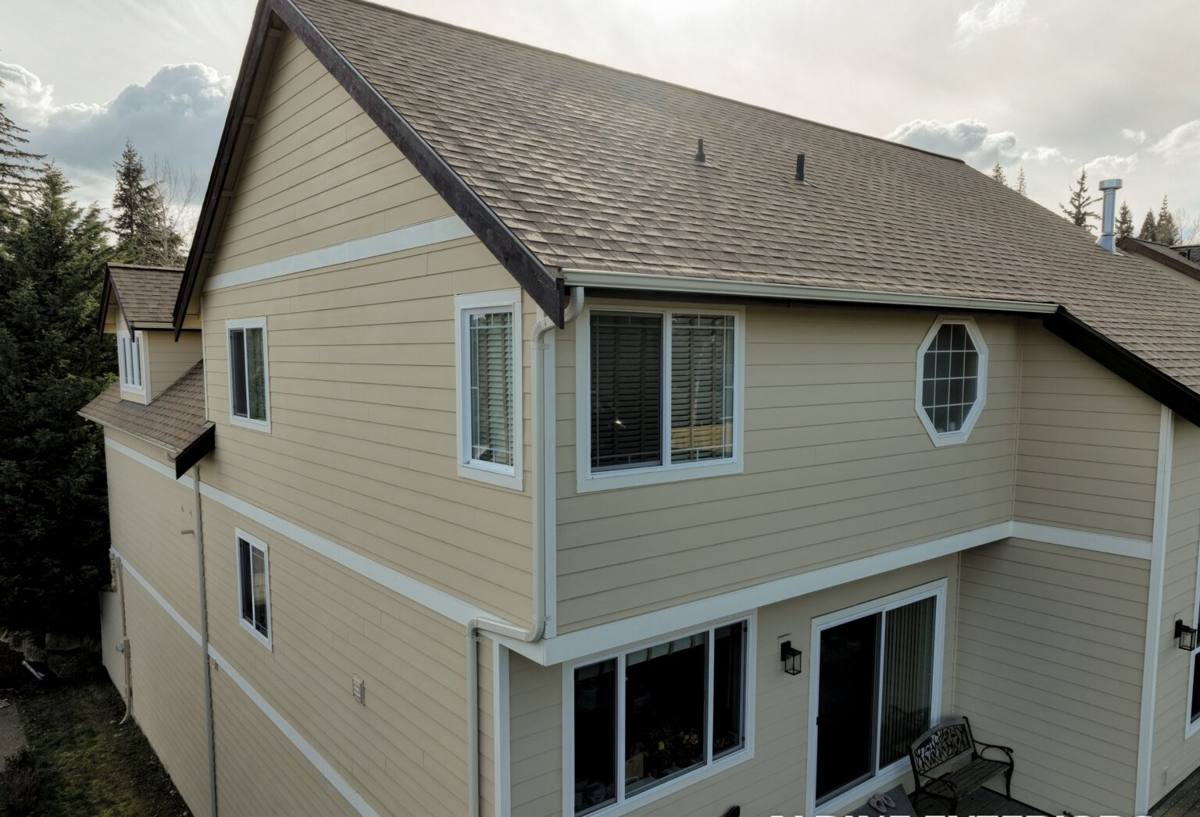
Why We Install James Hardie and Nothing Else
We standardized on James Hardie fiber cement siding company-wide, and Fairhaven's climate is a big part of why. Fiber cement is non-combustible and dimensionally stable — it doesn't expand and contract with moisture the way wood-based products do, which matters when a wall is cycling between saturated and dry for months at a time. James Hardie also engineers specific product lines for regional climate zones through its HardieZone system, and the products used in Western Washington are built for exactly the conditions Fairhaven sees: sustained moisture, cooler temperatures, and coastal exposure.
The factory-applied ColorPlus finish is the other piece. It's baked on under controlled conditions rather than field-applied, which gives it better adhesion and UV resistance than most job-site paint jobs — an advantage that matters more, not less, in a salt-air environment where paint films are under constant chemical and mechanical stress. We don't install LP SmartSide, vinyl, Cemplank, Allura, primed spruce, or cedar. Each of those has legitimate uses elsewhere, but for the moisture load, salt exposure, and long-term maintenance realities of a bay-adjacent neighborhood like Fairhaven, we don't think they hold up as well as Hardie does when installed correctly — and we'd rather stand behind one system we know thoroughly than stretch across several.
What "Climate-Engineered" Actually Means
It's worth being specific rather than just repeating a marketing phrase. HardieZone-engineered products differ in formulation and finish specification based on whether a region sees more freeze-thaw and moisture cycling or more heat and humidity. Western Washington falls into the wetter, cooler category, so the boards specified for Fairhaven homes are matched to that reality rather than a one-size-fits-all national spec. That's a meaningful difference from siding lines that don't vary by region at all.
What Fairhaven Homes Specifically Need From Their Siding
- Moisture management behind the cladding — a drainage plane and proper flashing matter as much as the siding itself, especially on walls that catch prevailing wind-driven rain off the bay.
- Correctly sized gaps and clearances — siding installed tight to trim, decks, or grade traps moisture against the board and against the wall assembly behind it.
- Finish durability against salt exposure — a factory finish that resists chalking and fading holds its look and its protective function longer than field-applied paint in this environment.
- Design that discourages moss and algae growth — shaded, north-facing, or tree-covered walls need attention to how water sheds and how quickly a surface dries.
- Fasteners and flashing that won't corrode — corrosion-resistant hardware isn't optional this close to salt water; it's the difference between a 30-year wall and a 10-year callback.
What a Correct James Hardie Installation Involves
Fiber cement siding is only as good as the installation behind it. James Hardie publishes detailed installation specifications, and deviating from them is the single biggest reason siding fails early — not the product itself. A correct install includes:
- Inspecting and repairing the wall sheathing and weather-resistive barrier before any new siding goes up — covering a moisture problem is worse than not siding over it at all.
- Installing house wrap or a rainscreen drainage gap appropriate to the wall assembly, so any water that does get past the cladding has somewhere to go.
- Proper flashing at every window, door, roofline, and penetration — this is where the majority of real-world leaks originate, not through the field of the siding itself.
- Correct fastener placement, spacing, and embedment per Hardie's published fastening schedule, using corrosion-resistant fasteners suited to a coastal environment.
- Maintaining manufacturer-specified gaps at trim, foundation, and dissimilar materials — usually a minimum clearance to prevent wicking and paint failure at those joints.
- Sealing and caulking only where Hardie's specifications call for it, with a quality sealant rated for exterior fiber cement — over-caulking traps moisture just as badly as under-caulking lets it in.
- A final walk-through checking reveal consistency, fastener lines, and joint treatment before calling the job finished.
Skipping or rushing any one of these steps is usually invisible on install day and shows up two, five, or ten years later as a warranty dispute, a rot repair, or a paint failure that shouldn't have happened this soon.
Our Process for a Fairhaven Project
1. On-Site Assessment
We walk the property and look at more than square footage — sun exposure, shaded and moss-prone walls, existing moisture damage, trim and flashing condition, and how the site sits relative to prevailing wind and rain direction off the bay.
2. Product and Color Selection
We help homeowners choose between plank, panel, or shingle profiles and walk through ColorPlus options, factoring in how each performs on the specific exposures we found during the assessment — not just aesthetic preference.
3. Prep and Tear-Off
Old siding comes off (we don't install over existing cladding), and we inspect and repair sheathing and the water-resistive barrier before anything new goes up. This step is non-negotiable — it's the part of the job nobody sees once it's done, and the part that determines whether the siding lasts.
4. Installation to Manufacturer Spec
Installation follows James Hardie's published specifications for fastening, clearances, and flashing — not shortcuts based on "how we've always done it."
5. Final Inspection and Walkthrough
We review the finished work with the homeowner, checking joints, reveals, and trim details, and answer questions about care and what to expect over the first few seasons.
James Hardie Product Lines We Work With
| Product | Best Use | Why It Fits Fairhaven |
|---|---|---|
| HardiePlank Lap Siding | Most common wall application | Traditional profile, factory finish holds up well against salt air and driving rain |
| HardiePanel Vertical Siding | Accent walls, gables, modern styling | Clean lines for contemporary Fairhaven builds; fewer horizontal joints to maintain |
| HardieShingle Siding | Craftsman and cottage-style homes | Complements Fairhaven's mix of older and newer home styles without the upkeep of real wood shingle |
| HardieTrim Boards | Window, door, and corner trim | Matches fiber cement durability at the joints most exposed to wind-driven rain |
What Affects the Cost of a Fairhaven Siding Job
| Factor | Why It Matters Here |
|---|---|
| Extent of tear-off and sheathing repair | Coastal moisture exposure means hidden rot behind old siding is more common than inland |
| Wall complexity and elevation | Multi-story or bluff-facing walls near the water need more careful flashing detail and access |
| Product line and profile | Plank, panel, and shingle profiles carry different material and labor costs |
| Trim and detail work | Homes with more windows, corners, and rooflines require more flashing and trim labor |
| Site access | Fairhaven's terrain and lot layouts can affect staging and equipment access |
We give real, project-specific numbers after an on-site look — not a rough estimate based on square footage alone, since the condition of what's underneath the existing siding often drives cost as much as the new material does.
Why Local Fairhaven Experience Matters
A crew that hasn't worked near the bay before can install siding perfectly well by the book and still miss the details that matter specifically here — which walls need extra attention to moss and drying time, how far wind-driven rain actually reaches up a wall, or how quickly salt exposure degrades an under-spec fastener. That kind of judgment comes from doing the work in this exact environment repeatedly, not from a general siding background.
There's also a practical side: knowing how Fairhaven's mix of older homes near the historic waterfront core and newer construction farther up the hill tend to be built helps us plan tear-off, sheathing repair, and scheduling more accurately from the first visit, rather than discovering surprises mid-project.
Maintenance Checklist for Hardie Siding in a Coastal Climate
- Rinse siding annually, especially shaded or north-facing walls, to limit moss and algae buildup before it takes hold.
- Inspect caulking at trim, windows, and joints yearly — sealant is the first thing to wear in a salt-air environment.
- Trim back vegetation and tree cover that keeps walls shaded and slow to dry after rain.
- Watch for chalking or fading on south- and west-facing exposures, which take the most direct sun and weather.
- Have gutters and downspouts checked regularly — overflow onto siding is a common, preventable cause of localized damage.
- Address any impact damage or cracked boards promptly rather than waiting for a full repaint or repair cycle.
If you're weighing siding options for a Fairhaven property, we're happy to walk the property with you, point out what your specific walls are dealing with, and put together a straightforward estimate — no pressure, no upsell into a product we don't stand behind. The form below is the fastest way to get that started.