 Bellingham Roofing
 Why Decks in Cordata Wear Out Faster Than Homeowners Expect
Cordata sits in north Bellingham, and like the rest of Whatcom County, it gets the full Pacific Northwest weather cycle: long wet stretches from fall through spring, driving rain that comes in sideways during winter storms, and a marine air influence off Bellingham Bay that reaches homes well back from the water. None of that is unique to any one street or subdivision, but it adds up differently on a deck than it does on a roof or on siding, because a deck is horizontal. Rain doesn't run off a deck the way it runs off a pitched roof — it sits, soaks, and works its way into every joint, fastener hole, and board gap before it evaporates.
Add in a long moss and algae season, especially on decks with any tree cover or a north-facing exposure, and you get a surface that stays damp longer than it should. Moss holds moisture against the wood or composite surface, which accelerates rot in wood decking and can leave a slick, slippery film on any material. Over years, that constant wet-dry cycling is what actually ends a deck's useful life — not one bad storm, but hundreds of ordinary wet Bellingham weeks stacked on top of each other.
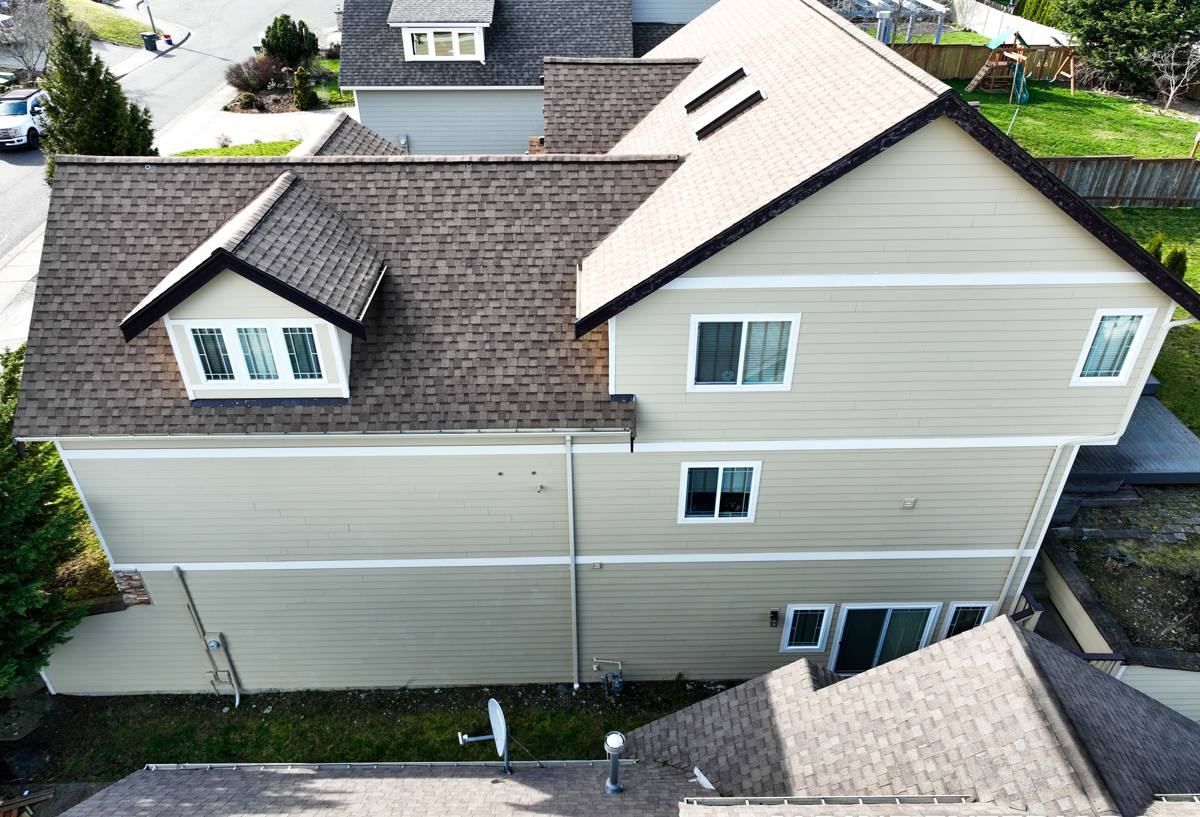
Signs a Cordata Deck Needs Replacement, Not Just Repair
Homeowners often call us thinking they need a few boards swapped out, and sometimes that's true. But there's a point where patching a deck costs more in the long run than starting over, because the problems have moved past the decking boards and into the structure underneath.
Repair Is Usually Enough When:
- A handful of boards are cupped, splintering, or soft, but the framing underneath is solid
- Railings are loose but the posts and connections are intact
- Surface staining or mildew hasn't penetrated below the top layer of wood
Full Replacement Is the Honest Answer When:
- The ledger board — where the deck attaches to the house — shows rot, rust streaks, or soft wood around the bolts
- Joists flex noticeably when you walk across the deck, or feel spongy when probed with a screwdriver
- Support posts or footings have shifted, settled, or show signs of rot at ground contact
- More than a third of the decking boards are failing, which usually means the whole surface was installed at the same time and is aging out together
- The deck predates current fastener and connection standards, which is common on older structures around Bellingham that were built before hardware requirements tightened up
A trustworthy contractor will tell you honestly which category your deck falls into, even when repair is the cheaper answer for us to give.
What a Correct Deck Replacement Actually Involves
A deck replacement done right is a structural project, not a cosmetic one. Swapping in new boards over an old, undersized, or water-damaged frame just resets the clock on the same failure. Here's what we look at on every job:
Ledger Board and House Connection
This is the single most important connection on the deck and the most common failure point in our climate. It needs proper flashing to keep water from tracking behind it into the house rim joist, and structural fasteners rated for the load — not just deck screws.
Footings and Posts
Footings need to be sized and set below frost depth per current code, and posts need proper post-base hardware that keeps the wood up off standing water instead of sitting directly on concrete, where it will wick moisture for years.
Joists and Framing
Joist spacing needs to match the actual decking material being installed — composite and PVC products often require tighter spacing than solid wood — and every cut end should be sealed, since a cut end is where treated lumber loses its protection fastest.
Fasteners and Hardware
All hardware should be corrosion-resistant and rated for ground contact or treated lumber contact. This matters more here than in a dry climate — standard fasteners corrode faster under constant damp exposure and driving rain, and corroded hardware is one of the quiet ways decks fail from the inside out.
Choosing Decking Material for Bellingham's Climate
There's no single "best" decking material — there's a best fit for how a household uses the deck, what upkeep they're willing to do, and what budget they're working with. What we won't do is recommend a product based on what's easiest to install; we'll walk through the real tradeoffs.
| Material | Upfront Cost | Maintenance Needs | How It Handles Wet Weather |
|---|---|---|---|
| Pressure-treated wood | Lowest | Annual cleaning and re-sealing recommended | Needs consistent upkeep to resist rot and moss staining |
| Cedar | Moderate | Regular sealing to maintain color and resist moisture | Naturally more rot-resistant than treated pine, but still needs care |
| Composite decking | Higher | Occasional washing; no sealing or staining | Resists rot well; can still develop surface algae if shaded |
| PVC decking | Highest | Lowest of all options | Fully moisture-resistant board; strongest option for constantly damp, shaded areas |
For decks with heavy tree cover or a north-facing orientation — both common around Cordata's residential lots — we often steer homeowners toward composite or PVC precisely because those spots dry out slowest and get the longest moss season. For decks with more sun exposure, a well-maintained wood deck is a perfectly reasonable and more affordable choice.
Our Deck Replacement Process
- On-site assessment. We inspect the ledger connection, framing, footings, and existing decking to determine the actual scope — not just what's visible from the top.
- Honest scope and material discussion. We walk through repair-versus-replace, material options, and a realistic cost range before any contract is signed.
- Permitting. We handle the paperwork for any work that requires it, so you're not left navigating the City of Bellingham or Whatcom County process on your own.
- Demolition and disposal. Old decking, framing, and hardware are removed and hauled off — we don't leave debris behind for the homeowner to deal with.
- Structural rebuild. Ledger flashing, footings, posts, and joists are installed to current code, sized for the decking material you've chosen.
- Decking, railing, and finish work. Boards, railings, and any stairs are installed with fastener systems appropriate to the material.
- Final walkthrough. We go over the finished deck with you, including what maintenance it will and won't need going forward.
Permits and Code Considerations for Cordata Homes
Deck replacement in Bellingham and unincorporated Whatcom County generally requires a permit once you're rebuilding structural elements — framing, footings, or anything that changes the deck's height or footprint — even if the previous deck never had one pulled. This trips up a lot of homeowners who assume that because a deck already exists, replacing it "as-is" doesn't need paperwork. Requirements can differ depending on exactly where in Cordata a property falls relative to city limits, so we confirm jurisdiction and pull the correct permit as part of the job rather than leaving it for the homeowner to sort out.
What Deck Replacement Typically Costs
Every deck is different, but these are the factors that move the price most on replacement projects in this area:
| Cost Factor | Why It Matters |
|---|---|
| Deck size and shape | Multi-level decks, angles, and curves add labor beyond a simple square footage price |
| Decking material chosen | Composite and PVC cost more upfront than wood but reduce long-term maintenance spending |
| Condition of existing footings | Footings that don't meet current frost-depth or sizing code need to be replaced, not reused |
| Height and stairs | Elevated decks and stair runs add framing, railing, and code requirements |
| Access to the site | Tight side yards or limited equipment access can add time to demo and material staging |
As a broad range, most full deck replacements land somewhere between a few thousand dollars for a small, simple wood deck and well into five figures for a large composite or multi-level structure. The only way to get a number that means anything for your home is a walkthrough.
Maintaining Your New Deck Through Bellingham's Wet Season
A correctly built deck still needs some seasonal attention to reach its full lifespan, especially given how long our wet season runs. This is the basic checklist we give every homeowner after a replacement:
- Sweep leaves and debris off the deck regularly in fall — trapped organic matter holds moisture and feeds moss growth
- Rinse off moss and algae buildup each spring before it has a chance to stain or roughen the surface
- Check that gaps between boards stay clear so water can drain through rather than pooling
- Inspect the ledger board area at the house connection once a year for staining or soft spots
- Re-seal wood decking on the manufacturer's recommended schedule — don't wait until it looks dry and gray
- Confirm downspouts and gutters aren't draining directly onto or near the deck structure
Why It Matters to Hire a Crew That Already Works in Cordata
A deck built to a generic national spec sheet isn't necessarily built for this specific climate. A crew that regularly works Cordata and the surrounding Bellingham neighborhoods already knows which lots hold moisture longest, which fastener and flashing details actually hold up through a full Whatcom County winter, and which decking materials are worth the extra upfront cost versus which are overkill for a given exposure. That local pattern recognition is the difference between a deck that needs attention again in eight years and one that goes the full distance.
If your deck is showing its age, or you just want an honest read on whether repair or replacement makes more sense for your home, we're happy to take a look. Reach out for a free, no-pressure estimate using the form below.