 Bellingham Roofing
 Why Fairhaven Decks Take a Different Kind of Beating
Fairhaven sits close enough to Bellingham Bay that salt-laden air is part of daily life, and it shows up in how a deck ages. Salt air accelerates corrosion in fasteners and connectors, driving rain off the water finds every gap in a poorly flashed ledger board, and Whatcom County's long, wet, low-light stretch from fall through spring is close to ideal growing conditions for moss and algae on horizontal wood surfaces. None of this means a deck can't last for decades in Fairhaven — it means the build has to account for these three things from the first piece of lumber, not patch around them later.
We've built and repaired enough decks in this neighborhood to know which shortcuts show up first as problems: undersized flashing, standard fasteners instead of corrosion-resistant ones, and decking laid tight with no thought to drainage or airflow underneath. This page walks through what a Fairhaven deck actually needs, so you know what to look for whether you're hiring us or comparing bids from someone else.
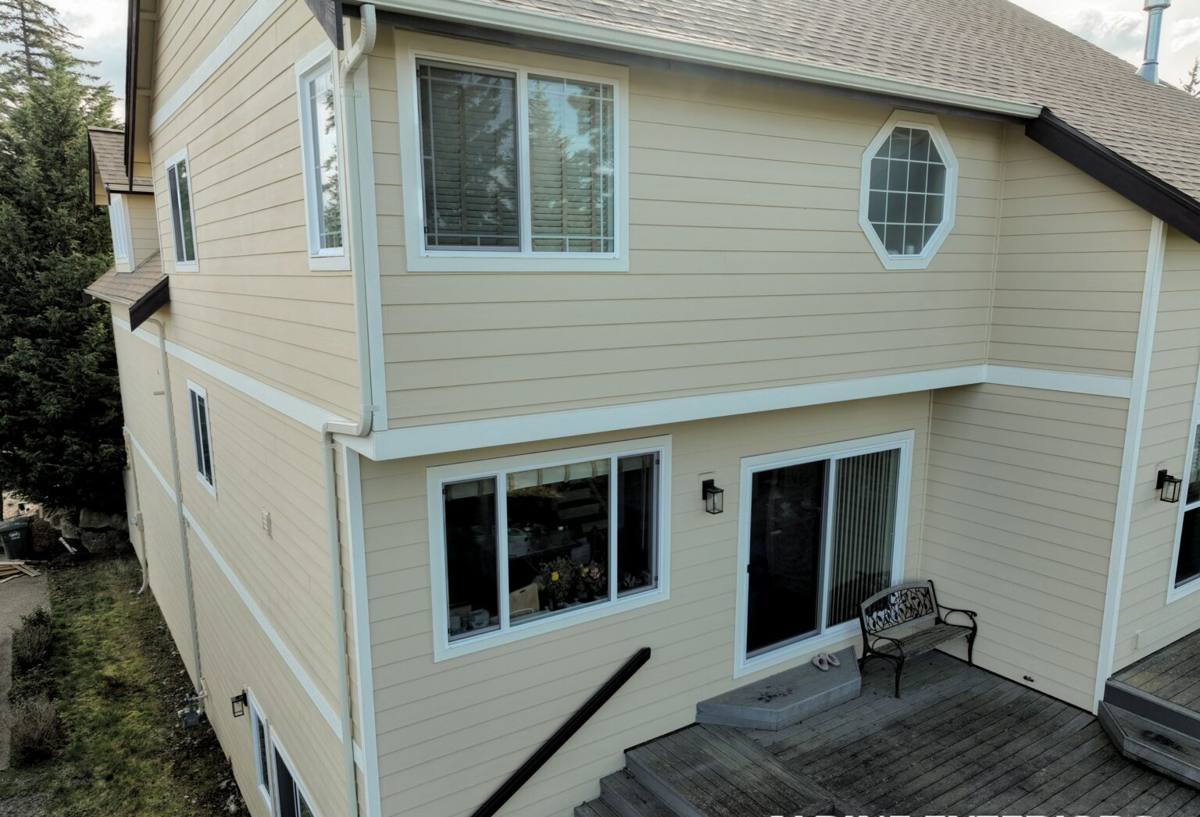
Framing and Ledger Attachment: Where Failures Actually Start
Almost every serious deck failure we've seen didn't start with the decking boards — it started at the ledger board, where the deck attaches to the house. In a climate with as much driving rain as Bellingham gets, that connection has to shed water away from the house framing, not trap it against it.
What correct ledger flashing includes
- A code-compliant flashing detail that directs water out and away from the house rim joist, not just a bead of caulk
- A water-resistive barrier integrated with the house's existing siding or building wrap, lapped correctly rather than just tucked behind it
- Structural ledger fasteners rated for the load and spaced to current code, not just "enough screws to hold it"
- A gap or flashing detail that keeps the ledger board itself from sitting in standing water
This is the part of a deck build that's invisible once the project is finished, which is exactly why it's the part most likely to get shortcut on a low bid. It's also the part that, done wrong, leads to rot inside your wall framing — a repair that costs far more than the deck did.
Decking Materials for a Marine Climate
There's no single "best" decking material — there's a best fit for your budget, your maintenance appetite, and how close your home sits to the salt air and shade that define a lot of Fairhaven lots. Here's how the common options actually compare once you factor in this climate specifically.
| Material | Moisture & salt-air behavior | Moss/algae resistance | Maintenance | Typical lifespan here |
|---|---|---|---|---|
| Pressure-treated fir/hem-fir | Prone to cupping and checking if not sealed regularly | Low — needs regular cleaning | Re-seal or stain every 1–2 years | 15–20 years with upkeep |
| Cedar | Naturally rot-resistant, still needs sealing near salt air | Moderate — still grows moss if shaded and damp | Seal/stain every 2–3 years | 20–25 years with upkeep |
| Composite decking | Doesn't absorb moisture, resists salt corrosion well | Higher — smoother, drains faster, but still needs occasional cleaning | Periodic washing, no sealing/staining | 25–30+ years, manufacturer-dependent |
| PVC decking | Fully moisture-immune | Highest of the common options | Occasional washing | 30+ years, manufacturer-dependent |
Composite and PVC cost more up front, and we tell homeowners that plainly rather than push them toward the higher-margin option. For a lot of Fairhaven properties — especially anything shaded or close to the water — the lower long-term maintenance is worth the difference. For a sunnier, more exposed lot, a well-sealed cedar deck maintained on schedule performs just fine and costs less to start.
Fasteners and Hardware Matter as Much as the Decking
Standard galvanized fasteners can corrode faster than expected in salt-influenced air, leading to rust streaking on the decking and, eventually, weakened connections. We use stainless steel or heavy-coated fasteners rated for coastal/marine exposure on Fairhaven jobs, along with joist hangers and structural hardware rated for the same conditions. It costs a little more in materials. It's not optional as far as we're concerned — it's the difference between hardware that outlasts the decking and hardware that becomes the first thing that needs replacing.
Designing Around Moss, Shade, and Drainage
Moss doesn't need much to take hold: shade, moisture, and a surface it can grip. A lot of Fairhaven's tree cover and proximity to the water check both of the first two boxes for a good part of the year, so the design has to work against the third.
- Board spacing — proper gapping between deck boards lets water drain through instead of sitting on the surface
- Joist tape or capping — protects the tops of joists from the moisture that collects between boards
- Airflow underneath — decks built low to the ground or over poorly ventilated crawlspaces stay damp longer and grow moss faster
- Slope — a slight pitch away from the house keeps water moving instead of pooling
- Surface texture — smoother-faced boards (including most composite and PVC products) shed moss more easily than rough-sawn wood
None of these fixes eliminate moss entirely — anyone who tells you that isn't being straight with you. What they do is buy you real time between cleanings and keep moss from turning into rot underneath the surface, which is the actual damage that matters.
Structural Considerations for Fairhaven Lots
Fairhaven's terrain includes more slope and elevation change than you'll find in flatter parts of Bellingham, and that affects footing depth, post height, and sometimes whether a deck needs additional engineering to meet code on a grade. It also means drainage planning matters more — water moving downhill toward or under a deck needs somewhere to go that isn't your crawlspace or your neighbor's yard.
Footings in Whatcom County need to reach below the frost line and bear on undisturbed, adequately compacted soil — cutting corners here shows up years later as a deck that's noticeably out of level or a railing post that's started to lean. On a sloped lot this is where an experienced local crew earns its keep: knowing how the ground on a given street tends to behave saves guesswork during excavation.
Permits and Code in Bellingham
Most new decks and significant deck rebuilds in the City of Bellingham require a building permit, with specific requirements around guardrail height, baluster spacing, stair geometry, and structural connections. A permitted job also means a third-party inspector checks the ledger attachment and footings before they're covered up — which is exactly the part of the build you can't see once it's finished.
We handle the permitting process as part of the job rather than leaving it to the homeowner, and we build to pass inspection the first time, not to sneak by. If a contractor tells you a deck project this size doesn't need a permit, that's worth double-checking with the city yourself before you sign anything.
Our Process for a Fairhaven Deck Project
- On-site assessment — we look at grade, drainage, existing structure attachment points, and sun/shade exposure specific to your lot
- Material and design conversation — honest trade-offs on decking material, railing style, and layout based on your budget and maintenance preference
- Permitting — we prepare and submit what the City of Bellingham requires and schedule inspections at the right points
- Build — ledger flashing, footings, framing, decking, and railings, in that order, with corrosion-resistant hardware throughout
- Final walkthrough — we go over the finished deck with you, including basic maintenance expectations for the material you chose
Questions Worth Asking Before You Sign With Anyone
- Will the ledger flashing be inspected before it's covered, and is the job pulling a permit?
- What fastener and hardware grade is being used, and is it rated for coastal exposure?
- Who is doing the structural work — is it the crew that shows up, or subcontracted out?
- What's the realistic maintenance schedule for the decking material being proposed?
- Does the quote include footing depth and soil conditions specific to your lot's slope?
Why a Crew That Already Works Fairhaven Matters
A deck built to a generic spec sheet can still fail here if it ignores what this specific neighborhood does to a structure over time. A crew that's already worked lots near the water knows which details actually matter locally — how much the salt air argues for upgraded hardware, how the terrain on a given block affects footing work, and how much shade and moisture a given yard is realistically dealing with. That's not something you get from a contractor who works all over Whatcom County without much specific time in Fairhaven — it comes from repetition in this particular environment.
It also matters for permitting. A crew that's pulled Bellingham deck permits before knows what the inspectors are checking for and builds to that standard the first time, instead of learning it through a failed inspection and a delay.
Get a Straight Estimate for Your Fairhaven Deck
If you're planning a new deck, a rebuild, or you're not sure whether your current deck's structure is sound, we'll come take a look and give you a straightforward assessment — no pressure, no inflated scare tactics about problems that aren't there. Use the form below to request a free estimate and we'll get back to you to schedule a time that works.