 Bellingham Roofing
 Building Decks for South Hill's Particular Climate
South Hill sits above Bellingham Bay, and that elevation is a mixed blessing for anyone who owns a deck up here. The views are part of why people build outdoor living space in the first place, but the same exposure that gives you a good vantage point also means more direct wind off the water, more driving rain hitting the structure sideways instead of straight down, and a longer stretch of the year when everything outside stays damp. Add Whatcom County's salt air drifting up from the bay and a moss season that can run from October well into spring, and a deck here is working harder than the same structure would in a drier, more sheltered part of town.
None of that means you can't have a good deck on South Hill. It means the build has to account for those conditions from the design stage forward, not patch around them after the fact.
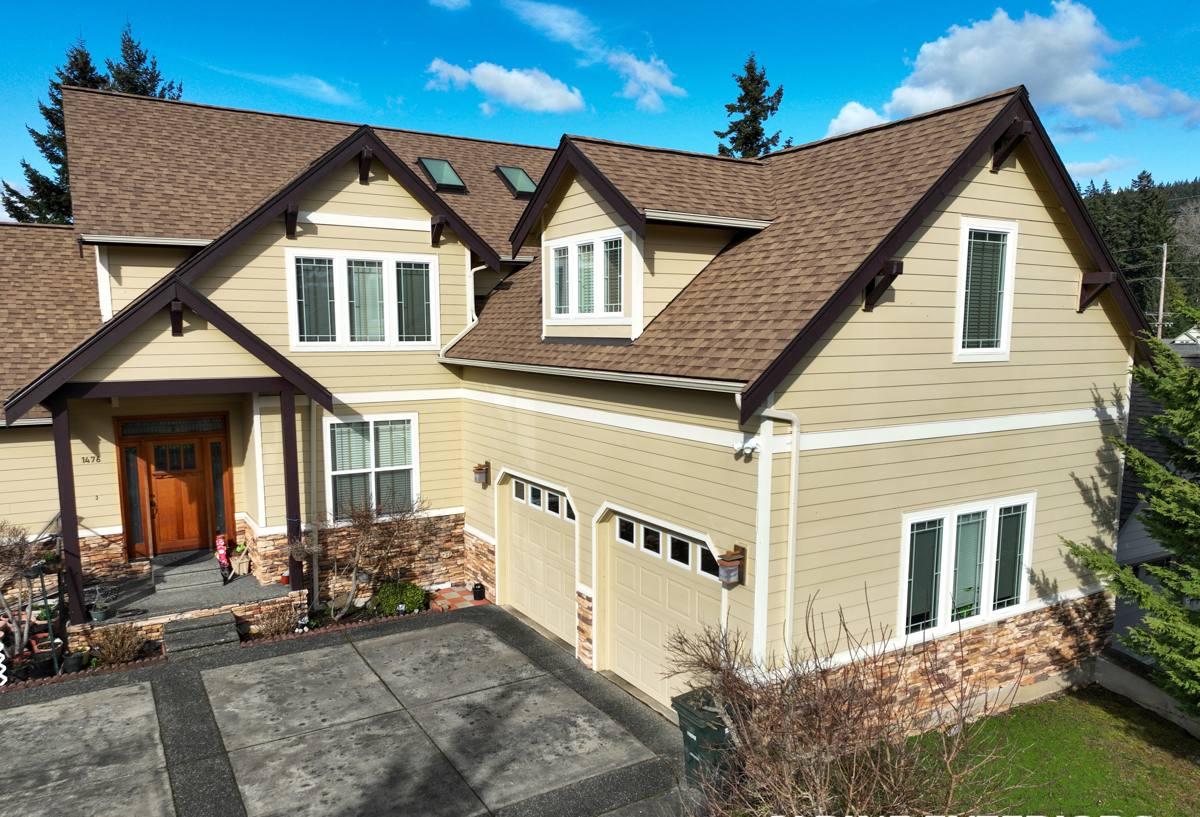
What Local Conditions Do to an Unprepared Deck
We've replaced or repaired enough decks around Bellingham to know which failures show up first when a deck wasn't built with this specific climate in mind.
- Moss and algae on decking and stair treads — a slip hazard as much as an appearance issue, especially on shaded north-facing sections common on hillside lots
- Fastener corrosion — salt-laden air accelerates rust on lower-grade screws and hardware faster than most homeowners expect
- Ledger board rot — the single most common structural failure point on older decks, caused by rain driving behind the ledger where it meets the house
- Cupping or warping in lower-grade lumber — repeated wet-dry cycling through the fall and winter stresses the wood fibers
- Railing post rot at the base — where standing water collects against wood that isn't properly isolated from moisture
Every one of these is preventable with the right materials and detailing. They're rarely preventable with a generic build that wasn't planned around Bellingham's wet season.
Designing Around Hillside Terrain
A lot of South Hill lots are sloped, which changes how a deck gets engineered before it changes how it looks. Steeper grades usually mean taller support posts, more attention to footing depth and lateral bracing, and sometimes a multi-level design rather than a single flat platform. That's not a bad thing — a tiered deck can actually work better with a hillside lot than trying to force one large flat structure — but it does mean the substructure needs more thought than a deck built on level ground.
What This Means in Practice
Footings on sloped terrain need to go deeper and may require engineered connections rather than standard prescriptive framing, depending on height and county requirements. Guardrails and stair geometry also become more of a factor when a deck sits higher off grade, since fall height affects code requirements for railing height and baluster spacing.
Choosing Materials That Hold Up
Material choice is where most of the long-term performance of a South Hill deck gets decided. There's no single right answer for every homeowner — budget, maintenance tolerance, and how the deck will be used all factor in — but here's how the common options actually perform under our conditions.
| Material | How It Handles Salt Air & Rain | Moss Resistance | Maintenance |
|---|---|---|---|
| Pressure-treated fir/hem-fir | Adequate if sealed regularly; end cuts need re-treating | Low — porous surface holds moisture | Annual cleaning and re-sealing |
| Cedar | Naturally rot-resistant, ages gracefully but grays without maintenance | Moderate | Periodic cleaning, occasional oil or stain |
| Composite decking | Very good — doesn't absorb moisture the way wood does | Moderate to good, varies by brand and surface texture | Low — occasional washing |
| PVC/capped polymer | Excellent — fully sealed surface sheds water | Good | Lowest — soap and water |
We install all of these depending on what the homeowner wants, but for shaded or north-facing decks on South Hill in particular, we steer people toward composite or capped polymer boards. Solid wood in a shaded, damp spot needs more upkeep than most owners realistically keep up with, and that gap in maintenance is exactly where moss and rot get a foothold. That's a maintenance-burden trade-off we're upfront about, not a knock on wood as a material — cedar and treated lumber are fine choices for sun-exposed decks where they'll dry out between rains.
Fasteners and Hardware
Because of the salt air, we spec stainless steel or high-grade coated fasteners and structural hardware rather than the minimum-code options. It costs a bit more up front. It also means you're not dealing with rust streaks or failing connectors five years in.
Getting the Water Management Right
Framing a deck is the easy part. Managing where water goes once the deck is built is what determines whether it's still solid in fifteen years. This is especially true given how much rain South Hill sees driven sideways off the bay.
- Proper ledger flashing where the deck attaches to the house, so water can't work its way behind the board and into the rim joist
- Gapped decking or a drainage system underneath, so water sheds through rather than pooling on the surface
- Post bases that hold wood off standing water rather than embedding it directly in concrete or soil
- Grading and drainage at the base of support posts so water isn't collecting around footings
These details rarely show up in a quick estimate walk-through, but they're the difference between a deck that needs board replacement in year eight and one that's still sound at year twenty-five.
Our Process for South Hill Deck Projects
1. On-Site Assessment
We walk the property, look at slope, sun exposure, drainage patterns, and how the house's siding and roofline will interact with the new structure. On hillside lots this step matters more than it would on flat ground.
2. Design and Material Selection
We talk through layout, decking material, railing style, and how the deck will actually be used — entertaining, grilling, a quiet spot to sit, stairs down to a lower yard. Budget and maintenance preference drive the material conversation.
3. Permitting
Most new decks and significant rebuilds in Bellingham and unincorporated Whatcom County require a permit, particularly once you're above a certain height off grade or attaching structurally to the house. We handle that process rather than leaving it to the homeowner.
4. Construction
Footings, framing, ledger flashing, decking, and railings, built to hold up specifically to wind-driven rain and salt exposure rather than to a bare-minimum code standard.
5. Final Walkthrough
We go over the finished deck together, and we go over what maintenance (if any) the material you chose actually needs.
Cost Factors Worth Understanding
Deck pricing varies a lot based on size, material, height off grade, and site access, so we won't quote a number that doesn't mean anything without seeing the property. What we can tell you is what tends to move the price:
| Factor | Why It Matters |
|---|---|
| Height off grade / slope of the lot | Taller support structures and engineered footings on hillside sites cost more than a low deck on flat ground |
| Decking material | Composite and PVC cost more upfront than wood but less over the life of the deck in maintenance |
| Railing style | Cable, glass, and custom metal railings cost more than standard wood balusters |
| Stairs and multiple levels | Each additional level and stair run adds framing, footings, and railing linear footage |
| Site access | Hillside lots with limited equipment access can add labor time |
Maintenance That Actually Fits South Hill's Climate
Whatever material you choose, a deck up here needs a maintenance routine built around the wet season, not a generic annual checklist.
- Clear leaves and debris from between boards before fall rains set in — trapped organic matter is what feeds moss growth
- Rinse or scrub shaded areas more often than sun-exposed ones, since moss establishes faster where boards stay damp
- Check ledger flashing and any spots where the deck meets the house for signs of water staining
- Inspect fasteners and hardware yearly for rust or loosening, especially on decks closer to the bay
- Reseal wood decking on the schedule the product actually calls for, not "whenever it looks dry" — cedar and treated lumber both need this to keep shedding water
Why a Local Crew Matters for This Job
South Hill's combination of slope, salt exposure, and shaded, moss-prone areas isn't the same as building a deck in a flat, sun-exposed neighborhood elsewhere in Whatcom County. A crew that already works this specific hillside — who knows how the wind comes off the bay, which sides of a lot stay damp longest, and what the county permitting process actually looks like for sloped-lot construction — builds a deck that's sized and detailed for the site instead of built to a generic template. That familiarity shows up later, in whether the deck is still tight and solid after its first few wet winters.
If you're planning a new deck or replacing one that's showing its age on South Hill, we're happy to come take a look and walk you through what makes sense for your property. The estimate is free, there's no pressure, and you'll get a straight answer about what your site actually needs — use the form below to get started.