 Bellingham Roofing
 Cordata's Climate Puts Real Demands on Siding
Cordata sits in north Bellingham, close enough to the water and the lowland weather patterns that move through Whatcom County to get the full package: salt-laden air rolling in off the Sound, driving rain that comes sideways more often than straight down, and a moss season that can stretch from fall through spring in a wet year. None of that is unusual for this part of Washington, but it does mean siding here works harder than siding in a dry climate ever has to.
Salt air is corrosive to unprotected metal fasteners and trim, and it accelerates the breakdown of coatings that aren't built for coastal exposure. Driving rain finds every gap, seam, and nail hole that wasn't sealed or flashed correctly, and it doesn't take long for water that gets behind siding to start working on the sheathing and framing underneath. Moss and algae need moisture and shade to establish, and Cordata's tree cover combined with our overcast stretches gives them plenty of both. A siding product and installation that aren't matched to these conditions don't fail all at once — they fail slowly, in ways that aren't obvious until there's a soft spot on the wall or a stain that won't wash off.
Why We Install James Hardie Fiber Cement Here
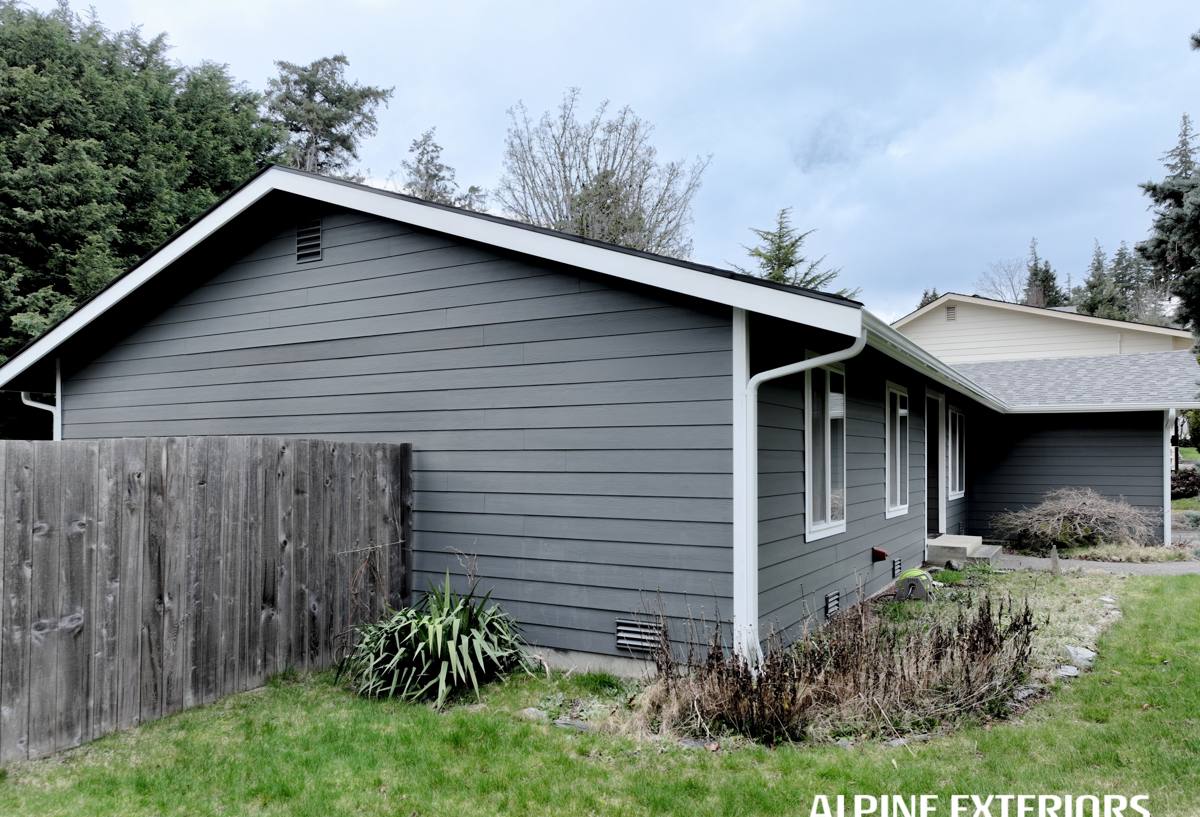
We install James Hardie fiber cement siding exclusively, and Cordata's climate is a big part of why. Hardie's boards are engineered specifically for the moisture and temperature conditions of different regions, sold under what Hardie calls its HZ5 and HZ10 formulations. HZ5 is built for climates that see freeze-thaw cycles and sustained damp weather — the Pacific Northwest — and it's the version we use on Bellingham homes. It's manufactured to resist moisture absorption, hold its shape through wet-dry cycles, and shrug off the kind of prolonged dampness that would eventually swell or rot a wood-based product.
The material itself is non-combustible fiber cement — sand, cement, and cellulose fibers — so it doesn't feed mold or fungus the way wood-based siding can, and it doesn't provide the organic surface that moss and algae latch onto as readily as untreated wood or some engineered wood products. It also holds a factory-applied ColorPlus finish baked on under controlled conditions, which resists fading and holds up to salt air and UV exposure far better than field-applied paint. That factory finish matters more here than in a drier climate, because repainting a full siding job every few years isn't something most Cordata homeowners want to sign up for.
What a Correct James Hardie Installation Actually Involves
The product is only half the equation. Fiber cement siding installed wrong will still let water in, still crack at the wrong fastener points, and still fail to protect the wall behind it — climate rating on the box notwithstanding. A correct job has several non-negotiable steps.
Moisture Barrier and Flashing First
Before a single board goes up, the water-resistive barrier underneath has to be intact and lapped correctly, and flashing has to be installed at every window, door, and horizontal trim transition. In a climate that gets driving rain, this layer is what actually keeps a house dry — the siding is the second line of defense, not the first.
Proper Gaps, Fastening, and Clearances
Hardie specifies exact gaps at butt joints, corners, and around penetrations to allow for expansion and to let any water that does get behind the boards drain and dry out rather than pool. Fasteners need to be corrosion-resistant and driven to the manufacturer's depth and spacing — over-driven or under-driven nails are one of the most common causes of premature siding failure, and they're invisible from the ground once the job is painted and done.
Clearance From Grade and Hard Surfaces
Siding installed too close to soil, decking, or roofing creates a wicking point where moisture sits against the bottom edge of the board. We hold to Hardie's minimum clearances, which matters more here than in a dry climate where that margin for error is more forgiving.
Caulking Done Right, Not Overused
Caulk has a place — at trim joints and specific transitions — but it's not a substitute for correct flashing and gapping. Over-reliance on caulk to "seal everything" is a shortcut that fails within a few years, especially with the UV and moisture cycling Cordata sees.
Our Process for a Cordata Home
- Assessment: We walk the whole exterior, check the existing siding and trim for hidden moisture damage, and look at what's happening at grade, roof lines, and window flashing before quoting anything.
- Tear-off and sheathing check: Once the old siding is off, we inspect the sheathing underneath. Any soft, rotted, or water-damaged sheathing gets repaired before new siding goes up — covering a compromised wall with new siding just hides the problem.
- Water-resistive barrier and flashing: New house wrap or building paper goes on correctly lapped, and flashing is installed at every opening and horizontal transition.
- Hardie installation: Boards, trim, and accessories go up to Hardie's fastening and clearance specifications, sized and configured for your home.
- Finish and detail work: Trim, caulking at the appropriate joints only, and touch-up of the factory ColorPlus finish where a cut edge needs it.
- Cleanup and walkthrough: We clear debris and old material, and walk the finished exterior with you.
Why It Matters to Hire a Crew That Already Works This Area
Siding installation isn't identical everywhere. A crew used to installing in a dry inland climate can do everything "by the book" and still miss the details that matter in a place like Cordata — the extra attention flashing needs where driving rain is the norm, how much clearance to leave given how often the ground stays damp, or which corners tend to trap moisture given our tree cover and shade patterns. A crew that already works Whatcom County has usually seen what happens when those details get skipped, because they've been called back to fix someone else's shortcuts.
There's also a practical side: permitting, disposal of old siding, and scheduling around our wetter months all go smoother with a crew that already knows how Bellingham and Whatcom County jobs typically run.
Siding Options Compared for Cordata's Climate
| Factor | James Hardie Fiber Cement | Vinyl | Wood / LP-Style Engineered Wood |
|---|---|---|---|
| Moisture resistance | Engineered for wet climates (HZ5) | Doesn't absorb water, but seams and gaps can let it behind the panel | Vulnerable to swelling and rot if the finish is compromised |
| Moss/algae resistance | Non-organic material, factory finish resists buildup | Can host moss and mildew in shaded, damp areas | More susceptible, especially at unfinished edges |
| Salt air / coastal durability | Cement-based, holds up well | Can become brittle over time with UV and temperature swings | Coatings degrade faster near salt air |
| Finish maintenance | Factory ColorPlus finish, long repaint intervals | Color molded in, but fades and chalks over time | Requires periodic repainting or resealing |
| Fire resistance | Non-combustible | Combustible | Combustible |
This isn't a knock on every alternative product across the board — it's why, after years of installing and repairing exterior siding in this climate, we made James Hardie the only product we put on homes.
Cost Factors to Expect
Every Cordata home is different, and an accurate number only comes from an in-person assessment, but a few things reliably move the price on a fiber cement siding project: how much of the existing wall needs sheathing repair, the complexity of the roofline and trim, the Hardie product line and profile you choose, and the amount of tear-off and disposal involved. Homes with hidden moisture damage from years of an underperforming siding system will cost more to get right than homes where the sheathing is sound — which is exactly why the assessment and tear-off inspection steps aren't skippable.
Signs Your Current Siding Needs Attention
- Soft or spongy spots when you press on the siding, especially near the bottom edge or around windows
- Persistent moss, algae, or dark staining that returns shortly after cleaning
- Paint that's peeling, bubbling, or chalking heavily
- Visible gaps, warping, or boards that have pulled away from the wall
- Rising energy bills that coincide with drafts near exterior walls
- Nail heads popping through the surface or visible fastener corrosion
If you're seeing any of these on a Cordata home, it's worth having it looked at before the next wet season adds to the damage.
If you'd like an honest look at what your home's siding actually needs, we offer a free, no-pressure estimate — walk-through, assessment, and straight answers about what's involved. Use the form below to get started.