 Bellingham Roofing
 Decking Built for South Hill's Weather, Not Just Its View
South Hill sits up above downtown Bellingham with some of the best outdoor living space in the city — porches, decks, and patios that look out over Bellingham Bay and the surrounding hills. That elevation and exposure is exactly why decking here takes a beating. Wind off the water carries salt air up the slope, rain comes in sideways more often than straight down, and the shaded, tree-lined lots that make South Hill attractive also keep decks damp for days after a storm passes. A deck built for a drier climate, or built without South Hill's specific exposure in mind, will show problems within a few seasons.
We install composite decking across South Hill because it's one of the few decking materials that holds up to this combination of moisture, salt, and shade without constant upkeep. This page covers what that actually means in practice — what the climate does to decking, what a correct composite installation looks like, and what to expect when you work with a crew that already knows this neighborhood.
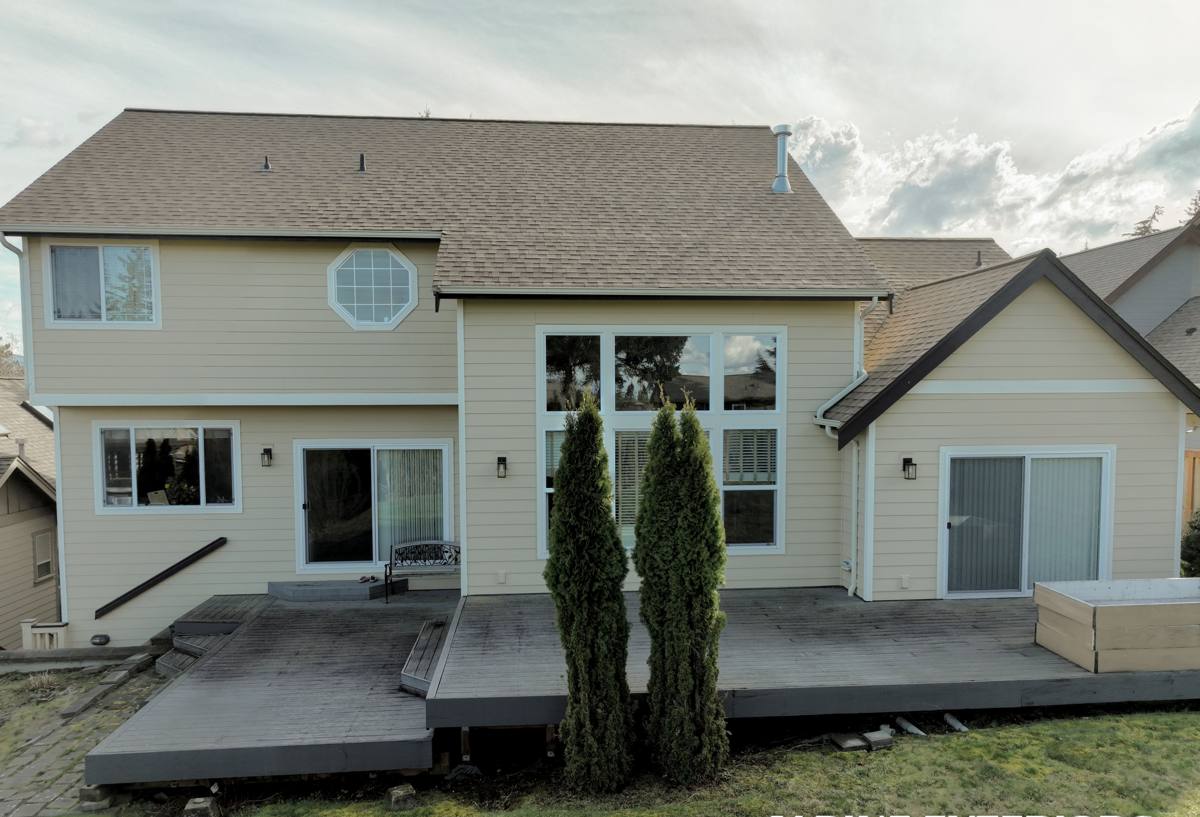
What Bellingham's Climate Does to a Deck
Whatcom County weather isn't extreme, but it's relentless. That's a different kind of hard on a deck than a place with harsher but shorter winters.
Driving Rain
Storms off the Strait of Georgia and Bellingham Bay frequently bring wind-driven rain rather than straight-down rain. On South Hill's exposed and sloped lots, that means water gets pushed under railings, into fastener holes, and along the edges of boards where a flatter, more sheltered deck wouldn't see nearly as much moisture intrusion.
Salt Air
Proximity to the bay means airborne salt settles on outdoor surfaces even without a direct waterfront view. Salt accelerates corrosion on fasteners, hardware, and any metal decking components, and it works its way into porous materials over time.
Moss Season
Bellingham's moss season runs long — realistically much of the fall through spring stretch, especially on shaded South Hill lots under mature trees. Moss and algae need moisture and low light to establish, and a deck that stays damp and shaded checks both boxes. Once moss gets a foothold in a deck surface, it holds moisture against the material and becomes a slip hazard, not just a cosmetic issue.
Freeze-Thaw Cycling
Whatcom County doesn't get deep, sustained freezes, but it gets enough freeze-thaw cycling each winter to open up small cracks in wood and stress joints in any material that isn't dimensionally stable. Repeated cycles turn a small weak point into a real one.
Why Composite Decking Fits South Hill Homes
Composite decking is manufactured from a blend of wood fiber and recycled plastic, capped (in most modern lines) with a protective polymer shell. That construction addresses the specific problems South Hill's climate creates:
- It doesn't absorb water the way solid wood does, so it isn't warping or cupping after a wet winter.
- The capped surface resists moss and algae adhesion far better than untreated wood, and what does grow rinses off more easily.
- It won't splinter, rot, or need annual staining — a real advantage on a shaded lot where a deck rarely gets enough sun to dry out quickly between rains.
- Color and texture are baked into the board, so salt air and sun exposure don't gray or bleach it the way they will bare wood.
Composite isn't maintenance-free — nothing outdoors in this climate is — but it removes the repetitive sanding, sealing, and staining cycle that wood decking demands here, and it holds up better against the moss and moisture pressure specific to shaded, elevated lots like South Hill's.
What a Correct Composite Installation Actually Involves
Composite decking fails early almost exclusively because of installation mistakes, not because of the material itself. In a wet climate, the substructure and detailing matter more than the boards.
Substructure and Framing
The joists, beams, and ledger board underneath the decking need to be either naturally durable or properly treated and flashed, since they're doing the structural work while sitting in the same damp environment. We check ledger board flashing carefully on South Hill homes, since a poorly flashed ledger is one of the most common sources of hidden water damage on any deck in this region.
Airflow Underneath
Composite boards need airflow beneath them to shed the moisture that inevitably gets underneath during driving rain. Decks built low to the ground or against a foundation without enough clearance trap moisture, which shortens the life of the substructure even when the decking on top looks fine.
Fastening
Given the salt air exposure, we use fasteners and hardware rated for coastal or high-moisture environments — standard interior-grade hardware corrodes faster here than it would inland. Hidden fastener systems, which most composite lines are designed around, also reduce the number of exposed holes where water can sit.
Board Spacing and Drainage
Gapping between boards has to account for both drainage and the material's expansion and contraction with temperature swings. Too tight, and water sits on the surface longer, which extends moss exposure. Too loose, and debris collects in the gaps.
Railings and Edge Details
On exposed or elevated South Hill lots, railings and edge trim take the brunt of wind-driven rain. These are also the spots most often installed with minimal flashing or sealing, since they're easy to treat as purely cosmetic. We treat them as functional, not just decorative.
Composite vs. Other Decking Materials for This Climate
| Material | Moisture & Moss Resistance | Maintenance | Typical Lifespan Here |
|---|---|---|---|
| Pressure-treated wood | Absorbs moisture; needs sealing to resist moss/rot | Annual cleaning, periodic staining/sealing | 10-15 years with upkeep |
| Cedar | Naturally rot-resistant but still absorbs water; grays without treatment | Regular sealing to maintain appearance and resistance | 15-20 years with diligent upkeep |
| Composite (capped) | Strong resistance to moisture absorption and moss adhesion | Periodic washing; no staining or sealing | 25-30+ years, per most manufacturer warranties |
| PVC | Excellent moisture resistance | Low; can show wear differently in temperature swings | Long lifespan; different installation sensitivities |
We install composite as our standard recommendation for most South Hill decks because it balances moisture and moss performance with a natural wood-grain look and a manageable maintenance routine. Wood remains a reasonable choice for homeowners who want that specific material and are committed to the upkeep it requires in this climate — that's a legitimate trade-off, not a wrong choice, and we'll walk through it honestly if it's what you want.
Our Process on a South Hill Composite Deck
1. On-Site Assessment
We walk the lot to look at sun exposure, tree cover, slope, and existing drainage patterns — all of which affect how much moss and moisture pressure a given deck will actually see. A shaded, north-facing deck needs different detailing than one that gets afternoon sun.
2. Substructure Evaluation
If you're replacing an existing deck, we check the ledger board, framing, and footings before assuming they can be reused. Reusing a compromised substructure under new composite boards just hides the problem for a few more years.
3. Material and Layout Planning
We plan board direction and spacing around drainage, not just appearance, and select fasteners and hardware rated for this region's salt and moisture exposure.
4. Installation
Framing and flashing work first, then decking, then railings and trim — in that order, so the parts most exposed to weather are built on a solid, correctly sealed base.
5. Final Walkthrough
We go over care basics specific to your deck's exposure — what to expect during moss season and how to handle it — so you're not guessing at maintenance later.
Maintaining a Composite Deck Through Moss Season
Composite resists moss far better than wood, but a shaded South Hill lot will still see some growth during the wet months. A simple seasonal routine keeps it from becoming a problem:
- Sweep debris (leaves, needles, seed pods) off the deck regularly — trapped organic matter holds moisture and feeds moss growth.
- Rinse the surface with a hose or low-pressure wash a few times through the wet season, focusing on shaded corners and under furniture.
- Use a soft-bristle brush and a manufacturer-approved cleaner on any established moss or algae rather than a wire brush, which can damage the capped surface.
- Keep gutters and downspouts near the deck clear so runoff isn't dumping extra water onto the surface.
- Trim back overhanging branches where possible to let in more light and air.
Why Hire a Crew That Already Works South Hill
South Hill's decks aren't all built the same way — slope, tree cover, and elevation vary block to block, and that changes how much wind-driven rain, shade, and moss pressure a given property actually deals with. A crew that installs decking across Bellingham and Whatcom County regularly sees how these variables play out over multiple seasons, not just at the time of installation. That experience shows up in small decisions — ledger flashing details, fastener choice, board spacing — that don't matter much in a drier climate but matter a lot here.
It also means we're not guessing at what "normal" wear looks like on a South Hill deck versus a problem worth addressing. If something needs attention down the road, we already know the property and the conditions it's dealing with.
Getting Started
If you're planning a new deck or replacing an aging one on South Hill, we're happy to walk the property, look at your specific sun and moisture exposure, and talk through composite options honestly — including what it costs, what it doesn't need, and how it'll hold up to Bellingham's rain, salt air, and moss season. Use the form below to request a free, no-pressure estimate.