 Bellingham Roofing
 Building a Deck That Actually Holds Up in Columbia
Columbia is one of Bellingham's older, established neighborhoods, with a mix of home ages and a lot of mature tree cover — which means a lot of shade, a lot of moisture, and decks that rarely get a full day of sun to dry out. Add in the salt air coming off Bellingham Bay and the steady, driving rain that Whatcom County sees for months at a time, and you've got a climate that's genuinely hard on outdoor structures. A deck built the way it might be built in a drier part of the country will not hold up here. One built specifically for this environment will.
This page is about custom deck building and replacement for homes in Columbia specifically — what the local conditions demand, what a correct build actually involves under the surface, and what to look for in a contractor before you sign anything.
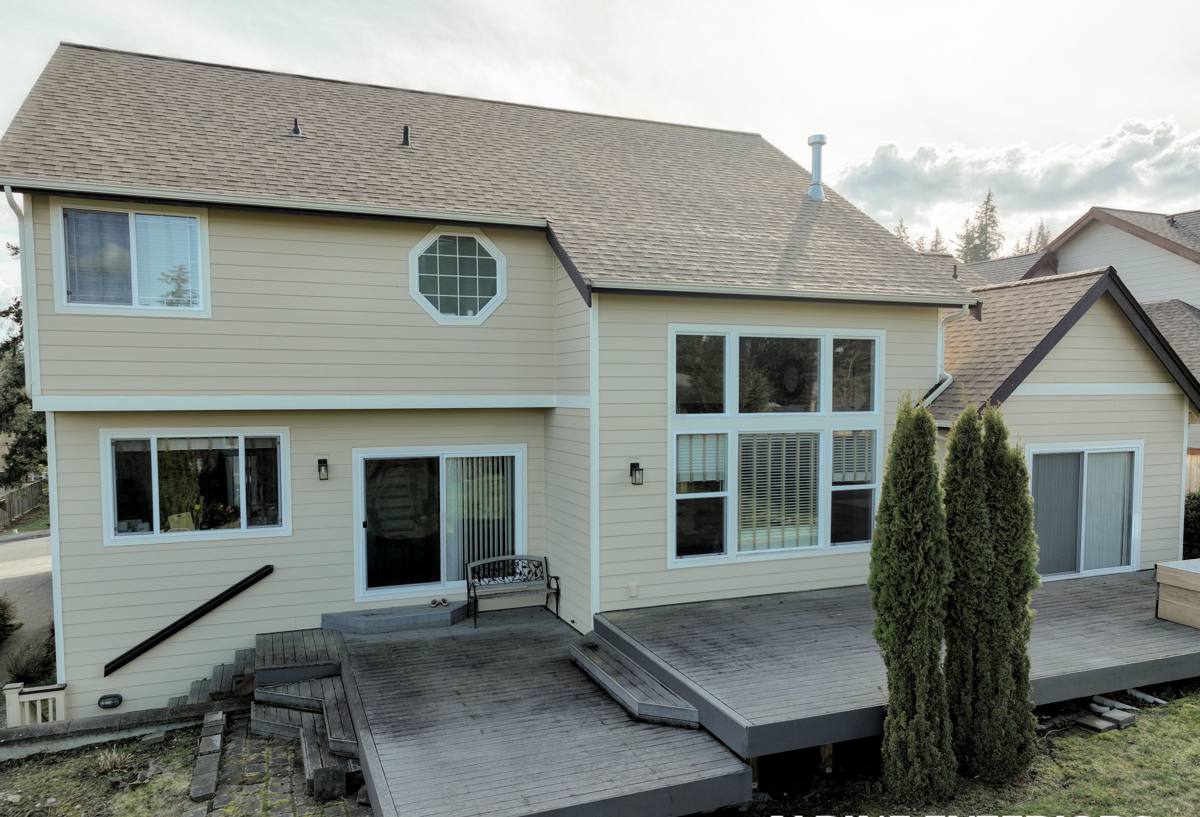
What Salt Air, Rain, and Shade Actually Do to a Deck
Most deck problems we get called out for aren't cosmetic — they start below the decking boards, where nobody's looking until something gives.
Moisture that never fully leaves
Decks in shaded, tree-covered lots stay damp longer after every rain. That extended dampness is what lets rot get started in ledger boards, joists, and post bases — areas that are structural, not decorative. A deck that looks fine on top can have soft framing underneath if it wasn't built with drainage and airflow in mind.
Salt air and hardware corrosion
Being near Bellingham Bay means airborne salt reaches fasteners, brackets, and flashing faster than it would further inland. Standard hardware corrodes, streaks, and eventually weakens at exactly the connection points that hold the deck together — the ledger-to-house attachment, joist hangers, and post-to-footing connections.
Moss, algae, and slick surfaces
Whatcom County's long moss season isn't just an aesthetic issue. Moss and algae hold moisture against the wood surface, and on stairs or a low deck they create a genuine slip hazard, especially through fall and winter.
Decking Material: What Actually Makes Sense Here
There's no single "best" decking material — it depends on how much maintenance you want to do, your budget, and how much shade and moisture the specific spot on your property gets. Here's how the common options actually compare for a shaded, damp, salt-air-adjacent lot like a typical Columbia property.
| Material | Moisture/Moss Behavior | Maintenance | Typical Lifespan Here |
|---|---|---|---|
| Pressure-treated wood | Absorbs moisture, holds moss on shaded boards, prone to cupping if not sealed regularly | Annual cleaning and re-sealing | 10-15 years with upkeep |
| Cedar | Naturally rot-resistant but still needs sealing in shade; grays without maintenance | Sealing every 1-2 years | 15-20 years with upkeep |
| Composite (capped) | Sheds surface moisture well, but still needs cleaning where moss can grow on the surface texture | Periodic washing, no sealing/staining | 25-30 years |
| PVC decking | Best resistance to moisture absorption; won't rot or swell | Occasional washing | 25-30+ years |
We install both quality wood and composite/PVC systems depending on what the homeowner wants, and we'll walk you through the real trade-offs — upfront cost versus long-term maintenance — rather than push whatever has the best margin. In a shaded, damp yard, we're honest that low-maintenance capped composite or PVC usually pays for itself over the life of the deck, even though the upfront cost is higher than wood.
The Structure Underneath Matters More Than the Boards
The decking surface is the part everyone sees, but it's the least likely part to actually fail. The framing, fasteners, and connections underneath are what determine whether a deck is safe and long-lasting — and they're where corner-cutting shows up years later as soft spots, sagging, or in worst cases a structural failure.
Ledger board and flashing
Where the deck attaches to the house is the single most important connection on the whole structure, and it's also the spot most exposed to water running down the siding. Correct flashing detail here — not just a bead of caulk — is what keeps water from getting behind the ledger and rotting the house's rim joist, not just the deck itself.
Fasteners and hardware
Given the salt air off the bay, we use corrosion-resistant, coated or stainless fasteners and structural hardware rated for exterior/coastal-adjacent exposure, not the cheapest galvanized option. It costs more upfront and it's the difference between hardware that's still solid in fifteen years and hardware that's rusted and weakened in five.
Footings and post bases
Whatcom County's soil holds moisture, and footings need to be set to the correct depth and properly isolated from ground contact at the post base. Undersized or shallow footings are a common shortcut on older decks in this area, and it's one of the first things we check when we're asked to evaluate an existing deck rather than build new.
Railings, Stairs, and Code Requirements
Washington's building code sets specific requirements for deck railings (height, baluster spacing, and load rating) and stair geometry, and Whatcom County/City of Bellingham permitting applies based on the deck's height above grade and how it attaches to the house. These aren't arbitrary rules — they exist because railings and stairs are where injuries actually happen when they're built wrong or without inspection.
We handle the permit and inspection process as part of the job on projects that require it, so you're not left figuring out code requirements on your own or discovering a problem when you go to sell the house.
Our Process, Start to Finish
- On-site visit: We look at your yard's sun/shade pattern, drainage, existing structure (if replacing), and how the deck ties into the house.
- Honest material discussion: We lay out wood versus composite/PVC trade-offs for your specific spot and budget — no pressure toward the higher-margin option.
- Written estimate: Clear scope, materials, and price before any work starts.
- Permit handling: We pull and manage permits when the project requires it.
- Build: Correct footings, flashing, and corrosion-resistant hardware first — the framing gets the same attention as the visible decking.
- Final walkthrough: We go over the finished deck and basic maintenance with you before we consider the job done.
Keeping Moss and Algae From Taking Over Afterward
A well-built deck still needs some seasonal attention in a climate like this one, especially on shaded lots. A few habits go a long way:
- Sweep leaves and debris off the deck regularly in fall — trapped organic matter is what moss needs to get started
- Keep gaps between boards clear so water drains through instead of pooling
- Wash the surface with a deck cleaner (not just a pressure washer on high, which can damage wood fibers or composite caps) once or twice a year
- Trim back overhanging branches where possible to let more light and air reach the deck
- Re-seal wood decking on the schedule the product actually calls for, not "whenever it looks dry"
- Check railing posts and stair stringers annually for movement, soft spots, or rust streaking at hardware
Why Hiring a Crew That Already Works in Columbia Matters
A contractor who already works in this neighborhood knows the general lot conditions — shade patterns, drainage tendencies, the level of salt exposure this close to the bay — without having to relearn it on your project. That translates into fewer surprises mid-build and a deck that's specified correctly for its actual location from day one, rather than built to a generic spec sheet and adjusted after something fails.
It also means we're not disappearing after the last board is nailed down. Warranty and follow-up service are a lot more meaningful when the crew is a short drive away in Bellingham rather than working out of another county.
A Quick Checklist Before You Hire Anyone for a Deck Project
- Do they carry current liability insurance and, in Washington, an active contractor registration?
- Will they pull permits themselves when the project requires it, rather than leaving that to you?
- Do they explain material trade-offs honestly, or just push one product?
- Does the written estimate specify fastener/hardware type, not just "decking material"?
- Do they inspect and address the framing and footings on replacement projects, not just the surface boards?
- Can they explain how they'll handle your specific site's drainage, shade, or moisture issues?
If you're planning a new deck or need an honest look at whether an existing one in Columbia is still sound, we're glad to come take a look. Use the form below to request a free, no-pressure estimate.