 Bellingham Roofing
 Why Birchwood Homes Need Siding Built for This Climate
Birchwood sits in one of the wetter, damper corners of Whatcom County, and the siding on a house here works harder than siding almost anywhere inland. Bellingham Bay pushes salt-laden air across the area, driving rain comes in sideways off the water for months at a stretch, and the shaded, moisture-heavy conditions that define our winters keep moss and algae in business nearly year-round. Any siding material that can't shed water fast, resist that constant dampness, and shrug off salt exposure is going to show it within a few years — peeling paint, soft spots, streaking, and eventually rot or delamination at the seams.
We install fiber cement siding — specifically James Hardie products — because it's built to take that abuse without turning into a maintenance project. This page covers what Birchwood homes specifically need from their siding, what a correct fiber cement install actually involves, and how we approach the job in this neighborhood.
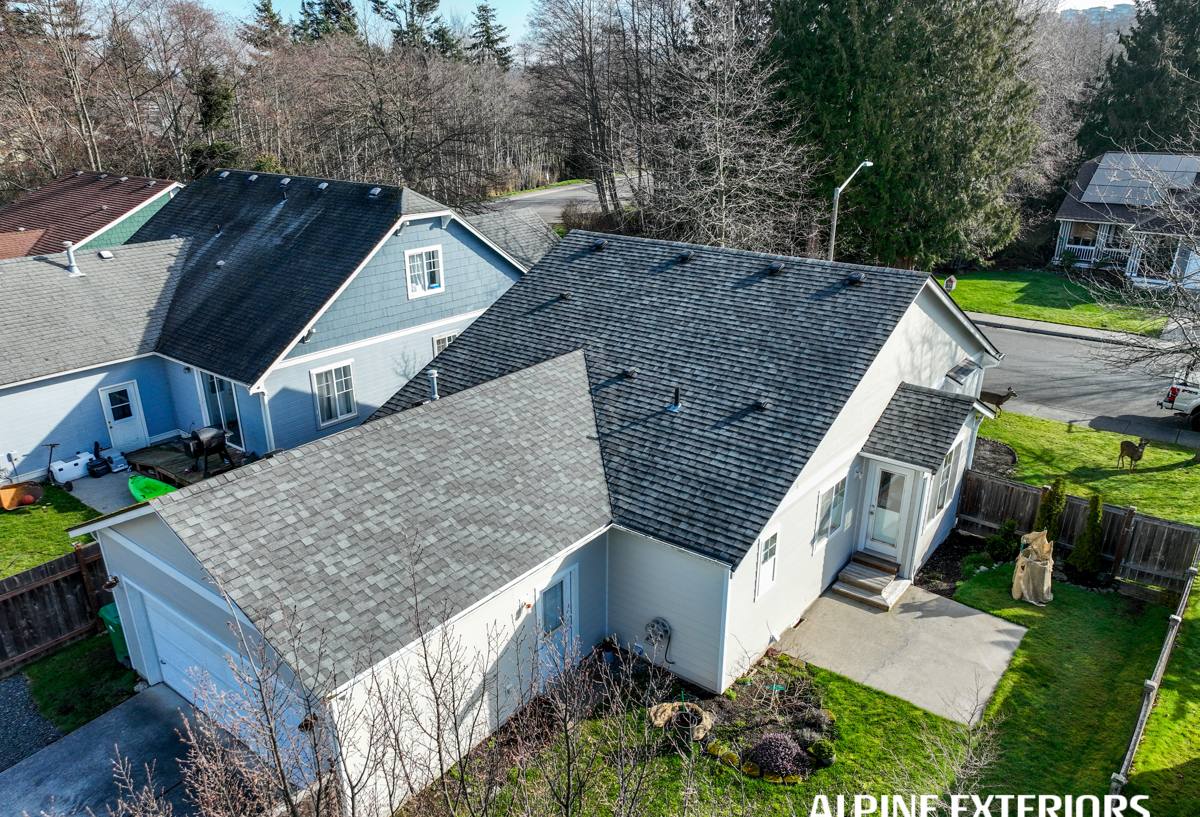
What Salt Air, Driving Rain, and Moss Season Actually Do to Siding
Salt Air
Airborne salt from the bay settles on exterior surfaces and accelerates corrosion of fasteners, trim metal, and any coating that isn't formulated to resist it. On wood and engineered wood products, salt exposure combined with moisture speeds up the breakdown of paint film and the wood fibers underneath. Fiber cement doesn't corrode and isn't organic material, so salt exposure doesn't attack the substrate the way it does with wood-based siding.
Driving Rain
Wind-driven rain doesn't just run down a wall — it gets pushed sideways and upward into laps, seams, and any gap in the water-resistive barrier. A siding system is only as good as its weakest joint. This is where installation quality matters as much as the material itself: correct flashing, house wrap integration, and lap spacing determine whether water sheds off the wall or finds its way behind it.
Moss and Algae Season
Whatcom County's long stretch of overcast, damp weather — especially on the shaded, north-facing walls common in wooded Birchwood lots — keeps surfaces wet long enough for moss and algae to take hold. On porous or absorbent siding, that growth can hold moisture against the material for weeks. James Hardie's factory-applied ColorPlus finish is baked on and far less hospitable to organic growth than field-applied paint, and it doesn't feed moss the way bare wood fiber can.
Why Fiber Cement Fits Birchwood Better Than the Alternatives
Fiber cement is cement, sand, and cellulose fiber — it doesn't rot, it isn't attractive to insects, and it doesn't expand and contract with moisture the way wood-based products do. That last point matters more here than in a drier climate: constant wet-dry cycling is what causes engineered wood siding to swell, crack at the edges, and eventually fail at the seams. Fiber cement holds its dimension through that cycling far better.
James Hardie also engineers specific product lines for different climate zones — HardiePlank and HardiePanel in the HZ10 formulation are built for wetter, colder regions like ours, with moisture management properties suited to exactly the conditions Birchwood sees most of the year. That's a meaningful difference from a generic siding product that wasn't engineered with Pacific Northwest weather in mind.
| Factor | James Hardie Fiber Cement | Engineered Wood (LP SmartSide) | Vinyl | Cedar / Primed Wood |
|---|---|---|---|---|
| Moisture resistance | Non-combustible, cement-based, doesn't absorb and swell | Wood-fiber core is vulnerable if the coating is breached | Doesn't absorb water, but seams and gaps can trap moisture behind it | Absorbs moisture readily; needs consistent maintenance |
| Salt air / coastal durability | Strong — non-organic substrate | Moderate — depends on coating integrity | Good against corrosion but can become brittle over time | Weak without regular refinishing |
| Moss/algae resistance | Strong with factory ColorPlus finish | Moderate | Moderate — surface growth is common but doesn't penetrate | Weak — porous surface holds growth |
| Finish life before repaint/recoat | 15+ years (ColorPlus factory finish) | 5–10 years (field-applied paint) | Color is molded in, but fades and chalks over time | 3–7 years |
| Fire resistance | Non-combustible | Combustible | Combustible, can melt/deform | Combustible |
What a Correct Fiber Cement Install Involves
The material is only half the equation. A fiber cement siding job that fails early almost always fails because of installation shortcuts, not the product itself. On a Birchwood home, we pay particular attention to:
- Water-resistive barrier and flashing: Correct lap order and integration with window and door flashing so wind-driven rain has nowhere to get behind the siding.
- Fastener placement and type: Corrosion-resistant fasteners driven to Hardie's specification — over- or under-driving nails is one of the most common causes of premature siding failure.
- Clearances: Proper gaps at grade, roofline, decks, and dissimilar materials so water and debris don't wick into the bottom edge of the siding — a common problem on shaded, damp lots where the ground stays wet longer.
- Caulking and joint treatment: Sealing only where Hardie's install guide calls for it, using a sealant rated for exterior movement — over-caulking traps moisture just as badly as under-caulking lets it in.
- Panel and lap spacing: Proper reveal and overlap so the siding can shed driving rain rather than channel it into the wall assembly.
We install strictly to James Hardie's published installation specifications, because that's what keeps the warranty valid and what actually performs in this climate — cutting corners on any one of these steps is where a "good enough" install turns into a five-years-later repair.
Signs Birchwood Homeowners Should Watch For
If your current siding is wood, engineered wood, or older vinyl, here's what typically shows up first in this climate:
- Paint peeling or bubbling, especially on north- and west-facing walls that stay shaded and damp longest
- Soft or spongy spots when pressed, particularly near the bottom courses and around window sills
- Persistent moss or algae staining that comes back within a season of cleaning
- Visible gaps or separation at seams and corners
- Swelling or bubbling at panel edges on engineered wood products
- Streaking or discoloration around fastener heads, often a sign of corrosion or water tracking
Any one of these on its own isn't necessarily an emergency, but they're worth a professional look before the next wet season, since damp Whatcom County winters give small problems a lot of time to get worse.
Our Process for a Birchwood Siding Job
1. On-Site Assessment
We walk the home, check the condition of the existing siding and sheathing, and identify problem areas — shaded walls, low clearance spots, past water intrusion — specific to how your lot sits and drains.
2. Tear-Off and Substrate Check
Old siding comes off and we inspect the sheathing underneath for hidden rot or moisture damage before anything new goes up. This is the step that catches problems a surface inspection can't.
3. Water Management Layer
House wrap and flashing get installed or repaired to current standards, since this layer — not the siding itself — is the first line of defense against driving rain.
4. Fiber Cement Installation
HardiePlank or HardiePanel goes up per James Hardie's specification, with attention to fastening, clearances, and joint treatment as outlined above.
5. Trim, Caulking, and Final Detail
Trim work and sealant are finished last, and we walk the job with you before calling it done.
Maintenance Once It's Installed
Fiber cement is low-maintenance, not no-maintenance. In Birchwood's climate, a simple annual routine keeps it performing:
- Rinse the siding once a year, focusing on shaded and north-facing walls where moss and algae take hold first
- Keep gutters clear so overflow doesn't run down the wall face
- Trim back vegetation and tree cover that keeps a wall shaded and damp longer than necessary
- Check and re-caulk high-movement joints (around windows, doors, trim) every few years
- Have any impact damage or cracked panels repaired promptly rather than left through a wet winter
Why a Crew That Already Works Birchwood Matters
Siding installation isn't one-size-fits-all across Whatcom County. A wall that faces open exposure to the bay needs different attention than a shaded lot tucked back in tree cover, and a crew that's worked through multiple Bellingham winters knows where water actually collects on homes in this area versus where a generic install guide assumes it will. That local pattern recognition — which walls to flash more carefully, which clearances to treat as non-negotiable, how much moss pressure to expect — comes from doing the work here repeatedly, not from a manual.
It also means faster response if something needs a look after the fact, and a crew that stands behind work they know has to hold up through another wet Northwest winter, not just look good on installation day.
If your Birchwood home's siding is showing its age or you're planning ahead for a replacement, we're glad to take a look and give you an honest assessment — no pressure, no obligation. Use the form below to request a free estimate.