 Bellingham Roofing
 Why Birch Bay Siding Takes a Different Kind of Beating
Birch Bay sits right on the water, and that changes what siding has to survive. Homes a few blocks inland in Bellingham deal with plenty of rain, but Birch Bay adds salt-laden air blowing straight off the bay, wind-driven rain that gets pushed sideways into wall assemblies, and a moss season that runs longer than most homeowners expect in Whatcom County. Put those three things together year after year and you get a stress test that a lot of siding materials simply weren't built for.
Salt air is corrosive to exposed metal fasteners and trim, and it accelerates the breakdown of paint films and caulk joints. Driving rain doesn't just fall on a wall, it gets forced into every gap, lap joint, and fastener hole that isn't detailed correctly. And moss and algae, which thrive in the Pacific Northwest's shaded, damp shoulder seasons, hold moisture against a wall surface far longer than open sun would allow. On a waterfront or near-waterfront property, all three of these pressures are happening at once, most of the year.
This is the environment we're installing into every time we work a Birch Bay job, and it's why the material choice and the installation details matter more here than they might on a drier, more sheltered lot.
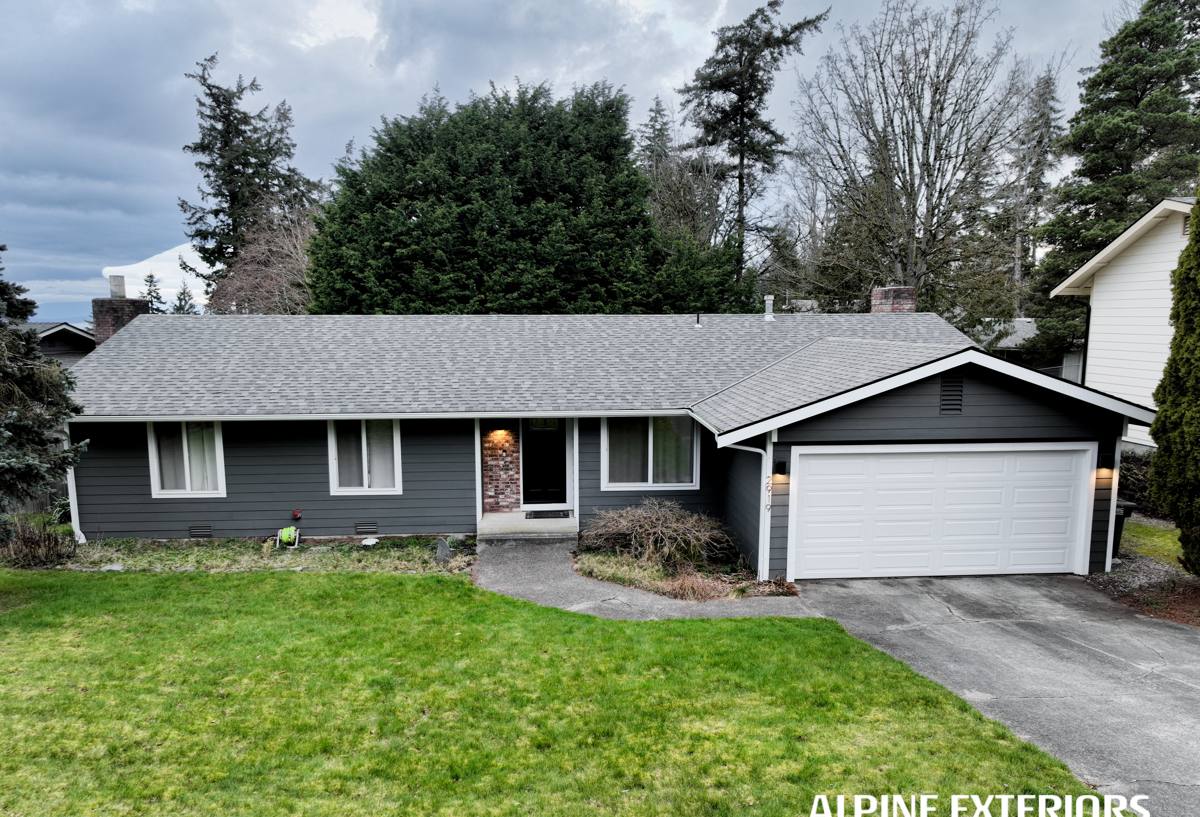
Why We Install James Hardie and Nothing Else
We're a James Hardie-only siding crew. We don't install vinyl, LP SmartSide, Cemplank, Allura, primed spruce, or cedar. That's not a marketing line, it's a standard we hold because of what we've seen these products do in coastal Pacific Northwest conditions over time. Wood species swell, cup, and eventually rot at end grain and fastener points no matter how well they're maintained. Vinyl expands and contracts with temperature swings and can crack or warp under wind loads, and it isn't fire-rated the way fiber cement is. Other fiber cement brands may look similar on a spec sheet, but Hardie backs its product with regional engineering and a factory finish system we trust enough to put our name behind.
HZ5 Engineering for Marine Exposure
James Hardie engineers its siding by climate zone, and homes in our part of Washington fall into the HZ5 category, built specifically for regions with sustained moisture exposure and freeze-thaw cycling. HZ5 products are formulated to resist moisture absorption and swelling better than a general-purpose fiber cement product would be. For a Birch Bay home sitting close to open water, that climate-specific engineering is the difference between siding that shrugs off decades of wet weather and siding that was never designed for the job.
ColorPlus Finish vs. Field Painting
Salt air is hard on paint. A field-applied paint job, no matter how good the crew, is going to chalk, fade, and lose adhesion faster in a marine environment than a factory-baked finish will. Hardie's ColorPlus technology applies the color in a controlled factory setting with multiple baked-on coats, which gives it better UV and moisture resistance than most site-applied paint. That matters directly for a Birch Bay home, where the siding color is fighting salt exposure and long wet seasons from day one.
What a Correct Installation Actually Involves
Fiber cement siding is only as good as the installation behind it. A huge share of the siding failures we get called out to inspect aren't material failures at all, they're installation shortcuts that let water in behind a perfectly good product. Getting it right matters everywhere, but in a driving-rain, salt-air environment like Birch Bay, there's very little margin for error.
Moisture Management Comes First
Before a single piece of siding goes up, the water-resistive barrier and flashing details have to be right. That means proper house wrap or weather barrier installation, correctly lapped and taped seams, flashing at every window and door head, kick-out flashing where a roofline meets a wall, and a weep path so any moisture that does get behind the cladding has somewhere to drain out instead of sitting against the sheathing. Skipping or rushing these details is invisible on installation day and expensive to discover five years later.
Fastening, Clearances, and Field Cuts
Hardie has specific fastening patterns, nail or screw spacing, and minimum clearances from grade, roof lines, and decks that are part of the manufacturer's installation requirements. Field-cut edges need to be sealed and primed per Hardie's specifications, and caulking has to be used at the right joints, not as a substitute for correct flashing. We follow these details as a baseline on every job, not as an upsell.
Ventilation Behind the Cladding
A rainscreen gap or properly vented assembly gives any moisture that reaches the wall plane a way to dry out instead of staying trapped against the sheathing. In a high-moisture, low-sun coastal pocket like Birch Bay, that drying capacity is one of the biggest factors in how long a wall assembly stays healthy behind the siding.
How Siding Options Compare for Coastal Exposure
| Material | Salt Air Behavior | Moss/Algae Resistance | Long-Term Maintenance |
|---|---|---|---|
| James Hardie Fiber Cement (HZ5) | Engineered for marine/moisture exposure, factory-finished | Dense, stable surface resists sustained moss growth better than wood | Occasional wash, no repainting for years with ColorPlus |
| Cedar / Primed Spruce | Absorbs moisture, salt accelerates weathering and checking | Prone to moss and algae holding moisture against grain | Regular re-staining or repainting, ongoing rot watch |
| Vinyl | Can become brittle and fade faster under coastal UV and salt | Moss grows on surface texture, harder to fully clean | Low upkeep but limited repair options once damaged |
| LP SmartSide / Other Engineered Wood | Wood-based core is moisture sensitive if any breach occurs | Susceptible where coatings wear thin | Depends heavily on coating integrity over time |
This isn't about declaring any product "bad." Every material on that list has a place. Our position is simply that for the exposure a Birch Bay home deals with, James Hardie's combination of climate-specific engineering and factory finish gives homeowners the best long-term value, and it's the only system we're willing to put our crew's name on.
Our Process on a Birch Bay Project
The steps are the same craft every time, but how we apply them shifts based on how exposed a given lot is to wind and salt spray.
1. On-Site Assessment
We walk the exterior and look at existing siding condition, wall orientation relative to prevailing wind and water, current flashing and trim details, and any signs of past moisture intrusion. A wall facing open water gets a different level of scrutiny than a more sheltered elevation.
2. Tear-Off and Sheathing Check
Old siding comes off and we inspect the sheathing underneath. Any water damage, soft spots, or compromised framing gets addressed before anything new goes up. Covering a problem with new siding just hides it.
3. Weather Barrier and Flashing Install
This is the step that determines how the wall performs for the next several decades. House wrap, flashing, and drainage details go in per manufacturer and code requirements, with extra attention on water-facing elevations.
4. Hardie Panel and Trim Installation
Siding, trim, and accessories go up following Hardie's fastening, spacing, and finishing specifications, keeping the ColorPlus finish intact and properly sealed at cut edges.
5. Final Walkthrough
We review the finished exterior with the homeowner, covering what was done and what ongoing care, if any, the siding needs.
Why Local Experience in Birch Bay Matters
Whatcom County covers a lot of different microclimates, from downtown Bellingham to the foothills to the shoreline communities. Birch Bay's direct water exposure puts it in its own category. A crew that mostly works sheltered, inland lots doesn't necessarily think about kick-out flashing at every roof-wall intersection, or how much more aggressively salt air ages exposed fasteners and trim, or where wind-driven rain actually concentrates on a home that fronts open water. A crew that's worked Birch Bay homes before treats those as standard details, not surprises discovered mid-project.
There's also a practical side to local familiarity: knowing what permitting and inspection expectations look like for Whatcom County exterior work, and understanding how a coastal property's siding needs may differ from a similar-sized home a few miles inland in Bellingham proper.
Maintenance in a Salt-Air, Moss-Prone Environment
James Hardie siding installed correctly is a low-maintenance product, but "low-maintenance" doesn't mean "no attention needed" on a waterfront lot. A few habits go a long way:
- Rinse siding periodically to clear salt residue and organic buildup, especially on shaded or north-facing walls where moss takes hold fastest
- Keep gutters clear so overflow doesn't run down the wall face and feed moss growth at trim and joints
- Trim back vegetation and landscaping that keeps a wall section shaded and damp
- Watch caulked joints at trim, window, and door edges for cracking or separation, and have them addressed before water gets behind the cladding
- Have flashing and kick-out details checked periodically, particularly where roof planes meet siding
None of this is heavy work, but on a property that sits in near-constant salt air and shoulder-season dampness, staying ahead of it protects the investment.
Warranty Protection That Follows the Home
James Hardie backs its siding products with a strong, transferable limited warranty, and the ColorPlus finish carries its own coverage for the factory finish itself. Because coverage depends on installation meeting Hardie's published requirements, correct installation isn't just a craftsmanship issue, it's what keeps that warranty intact. When we install to spec, homeowners get the full benefit of that protection, and it's an asset that carries forward if the home is sold.
Ready for an Honest Look at Your Siding
If your Birch Bay home is due for new siding, or you're seeing early signs of moss, staining, or moisture damage on what's there now, we're glad to come take a look. We'll walk the exterior with you, talk through what your specific exposure calls for, and give you a straightforward, no-pressure estimate for a James Hardie installation done right. Use the form below to get started.