 Bellingham Roofing
 Birch Bay's Waterfront Climate Is Harder on Siding Than People Expect
Birch Bay sits right up against the water, and that changes what siding has to deal with compared to a home a few miles inland in Bellingham. Salt-laden air moves off the bay and settles on exterior surfaces year-round, wind-driven rain hits walls at an angle instead of just running off a roof, and the long, damp Whatcom County winter keeps north-facing walls and anything shaded by trees or fences perpetually moist. That combination is exactly what accelerates failure in the wrong siding material: salt accelerates corrosion of fasteners and trim, moisture that can't dry out feeds rot and moss growth, and repeated wet-dry cycling stresses paint film and seams.
Board and batten is a striking look for a coastal or semi-rural property like the ones scattered through Birch Bay, but the style itself doesn't protect a home from any of this. The material behind it, and how it's installed, is what determines whether that look holds up for twenty years or starts showing problems in five.
What Board & Batten Siding Actually Is
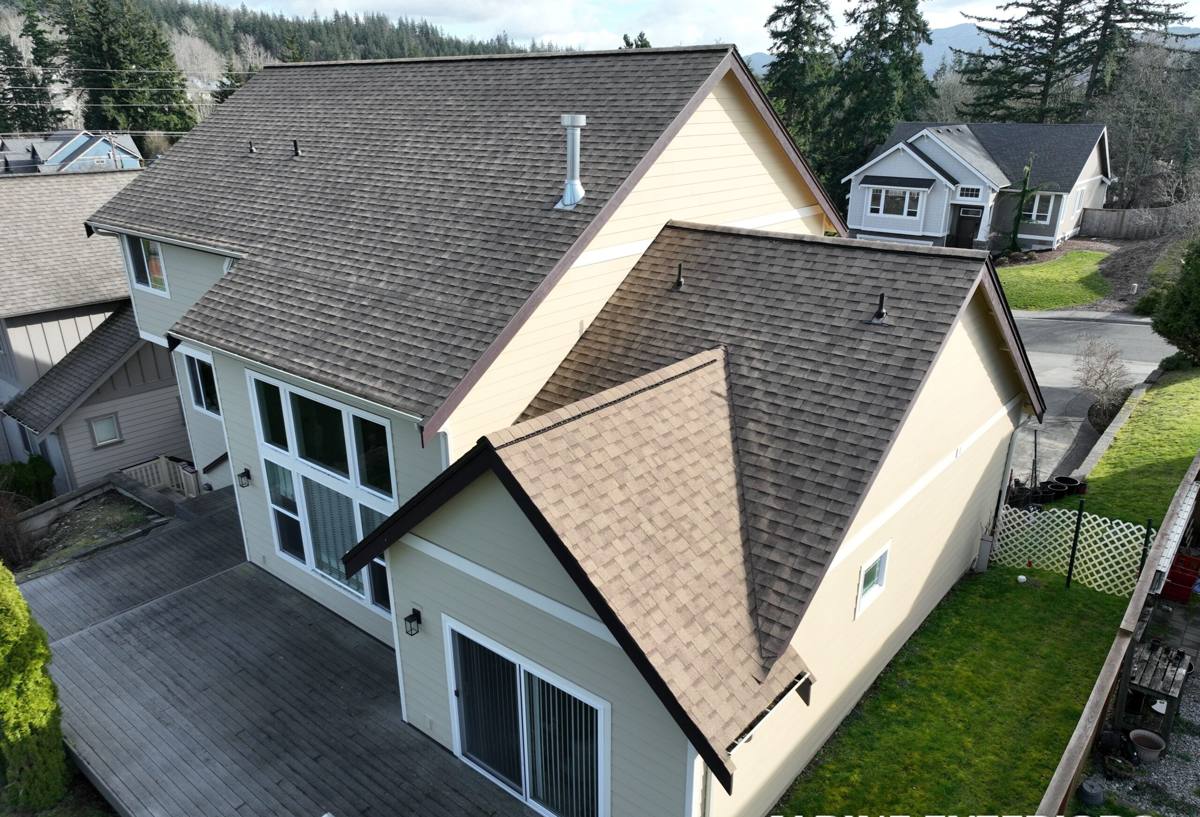
Board and batten is a vertical siding pattern: wide flat panels or boards installed side by side, with narrower strips (battens) covering the seams between them. It reads as a clean, linear, slightly more modern or farmhouse-style exterior compared to traditional horizontal lap siding, and it's a popular choice for accent walls, gables, shop buildings, and full exteriors on newer builds and remodels in this area.
The style has been around for centuries because vertical board siding sheds water reasonably well when it's built correctly — water runs down the face of the board instead of pooling on a horizontal ledge. But the batten seams are also the weak point. Every seam is a place where wind-driven rain can be pushed sideways and upward, especially in an exposed, breezy location like Birch Bay. How those seams are flashed, fastened, and backed matters more here than it would on a sheltered inland lot.
Why the Material Choice Matters More With This Style
Because board and batten has more linear seams per square foot than lap siding, the material behind those seams needs to hold its shape and resist moisture intrusion at the edges. A board that swells, cups, or rots at a cut edge will telegraph through the whole wall in a style this visually simple. That's a big part of why we don't install this pattern in every material that offers it.
Why We Only Install This in James Hardie Fiber Cement
Our company installs James Hardie fiber cement siding exclusively — we don't install vinyl board and batten, LP SmartSide, Cemplank, Allura, primed spruce boards, or cedar, even though several of those are sold as board and batten systems and some contractors in this region still use them.
For a style that lives or dies at the seams, fiber cement's dimensional stability is the deciding factor. James Hardie panels and battens don't expand and contract with humidity the way wood-based products do, and they don't soften at cut edges the way vinyl and some engineered wood products can once water gets behind them. Hardie is also non-combustible, which matters given how many Birch Bay and Whatcom County properties border trees, brush, or wooded lots. James Hardie's HZ5 product line is engineered specifically for the kind of wet, temperate, moisture-heavy climate we have here, and it carries a ColorPlus factory finish baked on under controlled conditions rather than field-painted, which holds up better against salt exposure and UV than a job-site paint job.
We're not saying every other product is unusable everywhere — we're saying that after years of working exteriors in this specific climate, this is the standard we settled on and the only one we'll put our name behind.
Material Comparison for a Coastal Board & Batten Job
| Material | Salt Air / Moisture Behavior | Seam Stability | Maintenance | Fire Resistance |
|---|---|---|---|---|
| James Hardie Fiber Cement | Engineered for wet coastal climates (HZ5) | Dimensionally stable, holds fastening | Low — factory ColorPlus finish | Non-combustible |
| Vinyl Board & Batten | Can warp/distort with heat and cold cycling | Seams can loosen over time | Low, but limited repair options if damaged | Combustible, can melt/deform |
| Cedar / Primed Spruce | Absorbs moisture, prone to swelling and rot at cuts | Seams are the first failure point | High — regular refinishing needed | Combustible |
| LP SmartSide / Engineered Wood Panel | Vulnerable if seams or cut edges aren't sealed | Moderate, installation-sensitive | Moderate — edge sealing and inspection | Combustible |
What a Correct Board & Batten Installation Involves
The visual style is simple, but a correct install has several steps that don't show up in a finished photo — and skipping them is how a board and batten wall ends up failing early in an exposed spot like Birch Bay.
Drainage Plane and Rainscreen
Behind the panels, a proper water-resistive barrier and a drainage gap (rainscreen) let any moisture that does get past the siding drain out and let the wall assembly dry. On a windward, salt-exposed wall this isn't optional — it's the difference between moisture passing through and moisture sitting against the sheathing.
Fastening Pattern and Batten Spacing
James Hardie specifies fastener type, spacing, and placement for board and batten assemblies, and battens need to land over a solid backing, not just tacked to the face of the panel seam. Correct spacing also controls how the wall expands and contracts seasonally without stressing the caulk lines.
Flashing at Every Penetration and Transition
Windows, doors, corners, and the base of the wall all need proper flashing and kick-out details. In a driving-rain environment, these transition points are where water actually gets in — the flat field of siding is rarely the problem.
Factory-Finished Color, Correctly Sealed
ColorPlus finished boards need touch-up paint and sealant matched to the system at cut ends and seams. Field-cut edges that aren't properly sealed are the one place a factory-finished product can still take on moisture.
Our Process, Start to Finish
We walk the exterior first and look at exposure — which walls face the prevailing wind and rain off the bay, where moss and algae are already established, where old caulk or flashing has failed. That assessment shapes the estimate, because a fully exposed waterfront-facing wall isn't priced or detailed the same way as a sheltered side yard.
From there: removal of the old siding (or in some cases install directly over a properly prepared wall), inspection and repair of the sheathing underneath, installation of the water-resistive barrier and rainscreen, then the Hardie board and batten system itself with correct fastening, flashing, and trim. We walk the finished job with the homeowner before we consider it done.
Maintenance in a Salt Air, Moss-Prone Environment
Fiber cement is low-maintenance, not zero-maintenance. In a Birch Bay location, a little seasonal attention keeps the wall performing the way it's designed to.
- Rinse salt residue off exterior walls a couple of times a year, especially after storms with onshore wind
- Keep gutters and downspouts clear so runoff isn't sheeting down the face of the siding
- Trim back vegetation and branches that shade a wall and keep it from drying out
- Check caulk lines at trim, corners, and penetrations annually and re-seal if it's cracked or pulling away
- Address moss or algae growth early with a gentle wash rather than letting it establish and hold moisture against the surface
- Watch north-facing and heavily shaded walls more closely — they dry the slowest
Why Hiring a Crew That Already Works Birch Bay Matters
Board and batten installed to spec in a sheltered inland neighborhood and the same system installed on an exposed waterfront wall in Birch Bay are not the same job, even though the material and pattern look identical. A crew that already knows which walls in this community take the worst of the weather, how far moss and salt spray typically travel inland from the water, and how the wind actually hits a given lot will make different, better decisions about flashing, rainscreen detailing, and where to spend extra attention — decisions that don't show up on an estimate line item but show up in how the wall performs ten years later.
We work Bellingham and the surrounding Whatcom County communities regularly, including Birch Bay, and we bring that exposure-specific judgment to every estimate rather than treating every wall the same.
Get a Straight Answer for Your Home
If you're considering board and batten siding for a home or addition in Birch Bay, we're glad to take a look, walk the exterior with you, and give you an honest read on what the job actually needs. There's no pressure and no obligation — just a straightforward estimate based on your home's exposure and condition. Use the form below to get started.