 Bellingham Roofing
 Siding Replacement in Barkley: A Different Project Than a Repair
Barkley homeowners usually start looking into siding replacement for one of two reasons: something visible has finally caught their attention — soft trim, peeling paint that won't stay fixed, moss creeping up from the ground line — or a contractor has already told them a repair won't hold. Full replacement is a bigger commitment than patching a damaged section, and it's worth understanding what the job actually involves before agreeing to it, not just what it costs.
Barkley sits within Bellingham, close enough to Bellingham Bay that its homes deal with the same combination of pressures found across Whatcom County: salt-tinged air moving in off the water, driving rain that arrives sideways more often than straight down, and a moss season that runs long on shaded walls and rooflines. A siding replacement done without that combination in mind tends to disappoint within a few winters, regardless of how good it looks on installation day. This page walks through what a correctly done replacement project looks like for a Barkley home, from the first inspection to the final finish work.
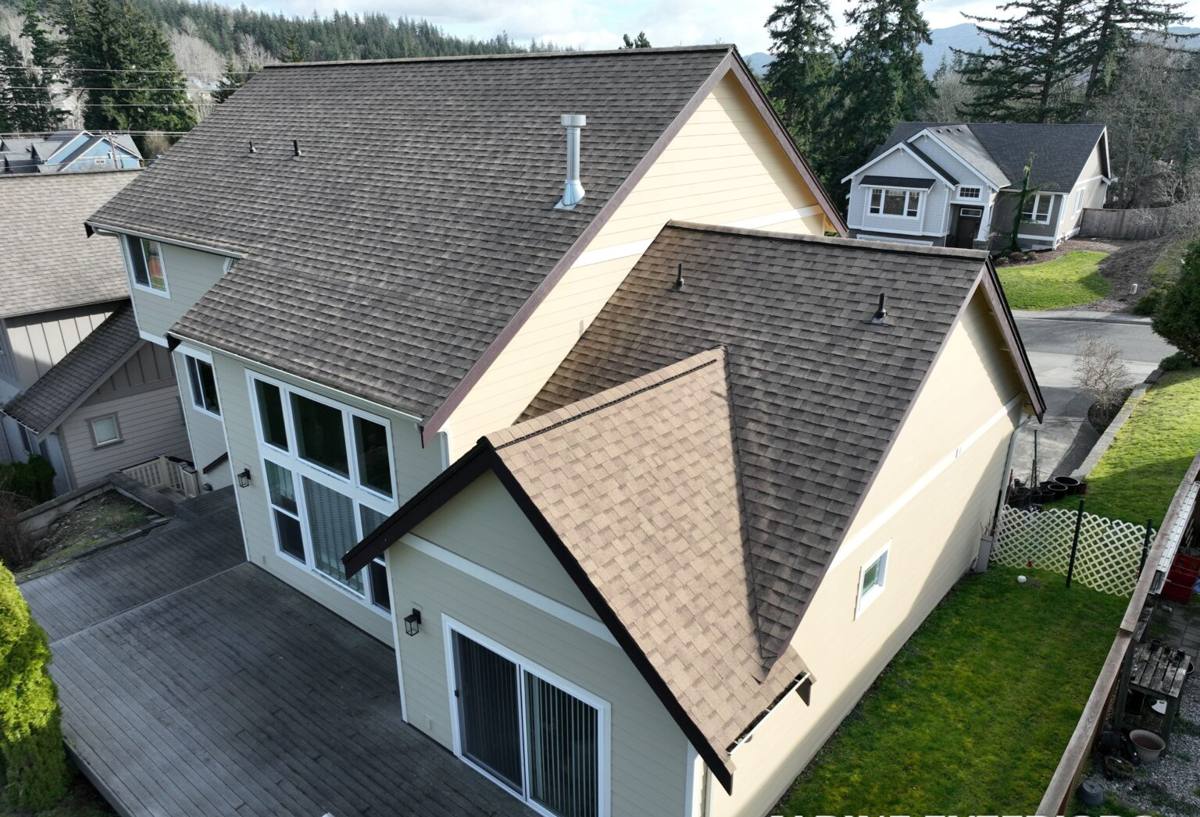
Signs a Barkley Home Needs Full Replacement, Not a Patch
Not every siding problem calls for tearing the whole wall off. A cracked board near a downspout or a single section damaged by a fallen branch is often a legitimate repair. Full replacement becomes the honest recommendation when the damage is widespread, when it points to a moisture problem working its way through the wall rather than sitting on the surface, or when the existing material has simply reached the end of what it can do.
- Soft or spongy siding in multiple locations, not just one isolated spot
- Persistent moss or dark staining across several walls, especially north-facing or heavily shaded ones
- Paint that keeps failing no matter how often it's redone, which usually points to moisture trapped underneath rather than a surface issue
- Visible warping, cupping, or separation at seams across multiple courses
- Rot discovered at one spot during a smaller repair, since it's rarely contained to just that area
- Siding that's simply old enough that its expected service life has passed, even if it looks acceptable from the street
If only one or two of these apply to a small area, a repair may genuinely be the more sensible and less expensive route. We'll say so plainly during an inspection rather than upselling a full replacement a house doesn't need yet.
What a Correct Siding Replacement Actually Involves
Inspection Before Any Number Gets Quoted
A real siding replacement estimate starts with a walk around the house, not a flat per-square-foot figure given over the phone. We look at how each wall's orientation affects its rain and sun exposure, where moss and shade have already done damage, and whether there are early signs of trapped moisture that will matter once the old siding comes off.
Tear-Off and What It Reveals
Removing the existing siding is the point where a project's real scope becomes clear. Sheathing that looked fine from outside sometimes turns out to be soft or delaminated underneath, especially around old fastener penetrations, window openings, and the lower courses closest to grade. We check every section of exposed sheathing before anything new goes up, since covering a compromised substrate just hides a problem that keeps getting worse behind the new wall.
Sheathing and Framing Repair
Where tear-off turns up rot or damage, that repair happens before installation starts, not as an afterthought squeezed in around it. We price this honestly once it's visible rather than guessing at it sight-unseen, which is one reason a full replacement quote can shift somewhat once old siding is off a Barkley home that's had long-term moisture exposure.
Weather-Resistive Barrier and Flashing
This is the step that determines whether a replacement actually solves the moisture problem it was meant to fix. House wrap gets lapped correctly, and flashing goes in at every window, door, and wall penetration so wind-driven rain is directed out and away from the wall assembly rather than trapped behind the new cladding. Most siding failures we encounter in this part of Whatcom County trace back to water getting behind the material, not through it — which makes this the step that's easiest to rush and hardest to inspect once the new siding is up.
Installation to Manufacturer Specification
James Hardie publishes exact fastening patterns, clearance requirements, and joint treatment for its products, and following that specification is what keeps both the warranty and the real-world performance intact. Correct nail spacing, proper gapping at butt joints, and keeping the bottom edge clear of grade and hardscape all matter more in a consistently wet climate than a dry one, where shortcuts take longer to show up as problems.
Finish Work and Cleanup
Trim, corner boards, and any touch-up at cut edges get finished with Hardie's matched touch-up product rather than field-mixed paint, which keeps the factory finish consistent at the joints most exposed to weather. Site cleanup and old-material disposal close out the project.
Why We Replace Old Siding With James Hardie Fiber Cement Only
When a Barkley homeowner is already committing to the cost and disruption of a full tear-off and replacement, the material going back up matters more than it would for a small patch. We install James Hardie fiber cement exclusively — not vinyl, not LP SmartSide or other engineered wood, not primed spruce or cedar, and not other fiber cement brands. That's a professional standard built around what actually holds up to this region's salt air, wind-driven rain, and long moss season.
| Material considered for replacement | Trade-off in this climate |
|---|---|
| Vinyl siding | Doesn't rot, but can warp or crack under sustained UV and temperature swings; panel seams give wind-driven rain a path inward |
| LP SmartSide / engineered wood | Wood-strand core is more moisture-sensitive at cut edges and fastener points than fiber cement |
| Primed spruce or cedar | Absorbs moisture readily and needs ongoing paint and caulk maintenance to avoid the same rot the replacement was meant to fix |
| Other fiber cement brands | May lack a climate-specific HZ-style formulation or the same factory-finish warranty depth as James Hardie |
| James Hardie fiber cement | Non-combustible, resists sustained moisture without swelling, and carries a factory-cured ColorPlus finish built for exactly this kind of exposure |
None of this means the alternatives are unusable everywhere. It means that for a replacement project we're going to stand behind for years, in a climate this consistently wet, fiber cement engineered for sustained moisture exposure is the material we're willing to install and warranty.
Timeline: What a Barkley Replacement Project Looks Like Week to Week
Every home is different, but a full siding replacement on a typical single-family home in Barkley generally runs one to two weeks from tear-off to finished trim, weather permitting. Homes with more sheathing repair, more complex rooflines, or larger square footage take longer. We'll give a realistic schedule specific to the property before work starts rather than a generic estimate that doesn't account for what an older Barkley home might have hiding under its existing siding.
| Stage | What happens |
|---|---|
| Inspection and estimate | Walk the property, assess exposure and existing condition, price the visible scope |
| Tear-off | Old siding removed; sheathing inspected before anything new goes up |
| Substrate repair | Any rot or damage found during tear-off is repaired and re-priced honestly |
| Weather barrier and flashing | House wrap and flashing installed at every window, door, and penetration |
| Siding installation | James Hardie panels or planks installed to manufacturer fastening and clearance spec |
| Trim, finish, and cleanup | Corner boards and touch-up completed; old material and debris hauled off site |
What Affects Siding Replacement Cost on a Barkley Property
Two Barkley homes of similar size can end up with meaningfully different replacement costs once the specifics are accounted for.
| Factor | Why it matters |
|---|---|
| Sheathing condition found at tear-off | Rot discovered underneath old siding adds repair scope that can't be priced accurately until it's exposed |
| Home size and wall complexity | More corners, dormers, and cutouts increase material waste and labor time versus a simple footprint |
| Siding profile and trim detail | Lap width, trim style, and any shingle or panel accent sections affect both material and labor cost |
| Access and site conditions | Steep lots, tight setbacks, or limited staging space can add time and equipment cost |
| Disposal of old material | Full tear-off generates more debris to haul and dispose of than a partial repair does |
We walk through these during the estimate instead of quoting a flat number sight-unseen, since the condition behind the old siding — not just the square footage — is usually what moves the final price.
Why a Crew That Already Works Barkley Matters for This Job
A full siding replacement exposes more of a house's problems than any other exterior project, simply because the whole wall gets opened up at once. A crew that works this specific pocket of Whatcom County regularly recognizes patterns faster: which walls in Barkley tend to hold moisture longest given local tree cover and lot orientation, how much clearance a given wall needs at grade, and which flashing details tend to fail first once a Bellingham winter sets in. That familiarity shows up in judgment calls made on site, not just in the finished look of the siding.
It also matters after the job is done. Warranty questions and minor issues are easier to resolve with a local crew that's still reachable years later than with an out-of-area company that was only ever passing through for one project.
Getting Started
If your Barkley home's siding has reached the point where patching no longer makes sense, we're glad to walk the property and give an honest read on what a full replacement would involve and cost — no pressure, no inflated scope. Use the form below to request a free estimate.