 Bellingham Roofing
 New Roof Installation in Barkley: What Local Homes Actually Need
Barkley homes sit close enough to the water and the tree line that a roof here works harder than one a hundred miles inland. Salt-laden air off Bellingham Bay accelerates corrosion on exposed metal fasteners and flashing. Long stretches of driving rain push water sideways under shingles that aren't properly lapped or sealed. And the shaded, moisture-heavy microclimate common to Whatcom County neighborhoods like Barkley gives moss and moderate growth a long season to work into shingle mat and roof valleys. A new roof installed here needs to be built for those three things specifically, not just installed to a generic code minimum.
When we quote a new roof installation in Barkley, we're not just pricing shingles and labor. We're accounting for the roof's exposure, the tree canopy over the house, the pitch and valley layout, and how water will actually move across that specific roof during a wet Bellingham winter. That's the difference between a roof that looks right on installation day and one that still looks right in year twelve.
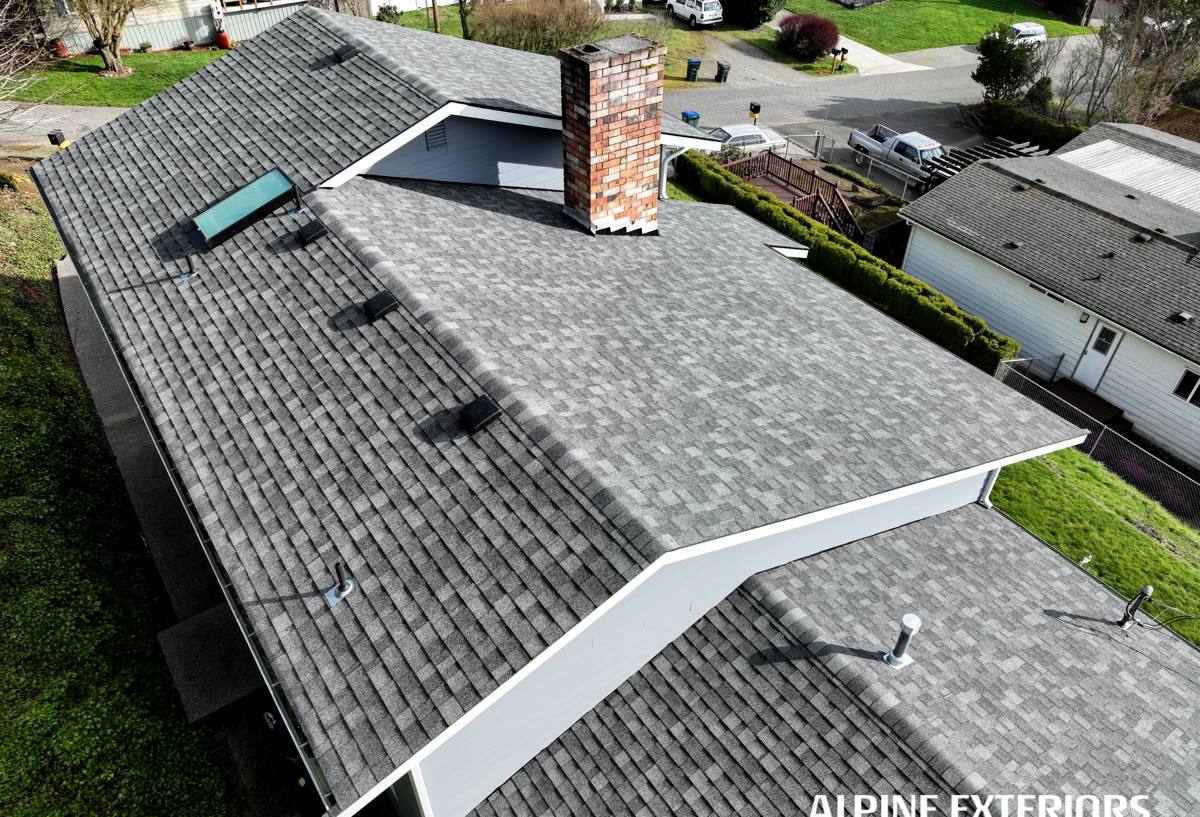
Why the Bellingham Climate Changes How a Roof Should Be Built
Salt Air and Metal Components
Flashing, drip edge, nails, and vent boots are all metal, and metal corrodes faster near coastal air. We spec corrosion-resistant fasteners and flashing on every new roof install rather than defaulting to standard-grade hardware, because a roof is only as durable as its weakest metal component. A shingle field can look perfect while an under-spec nail or flashing seam quietly fails underneath it.
Driving Rain and Wind-Driven Water
Bellingham doesn't just get rain — it gets rain pushed sideways by wind coming off the Sound. That means water doesn't always run straight down a roof plane the way manufacturer diagrams assume. Underlayment coverage, shingle nailing patterns, and valley treatment all need to account for wind-driven water finding its way under laps that would hold fine in a calmer climate.
Moss and Sustained Moisture
Shaded roof sections and north-facing planes in Barkley's tree-lined lots stay damp longer after every rain, and that extended dampness is exactly what moss needs to establish. Left unaddressed, moss holds moisture against the shingle surface and works its way under tabs and into fastener lines over time. A new roof install is the right moment to build in moss resistance rather than treating it as a maintenance afterthought later.
What a Correct New Roof Installation Involves
A roof replacement is a system, not a single layer of shingles. Every component below plays a role in how the roof performs over the next 20-30 years, and skipping or under-speccing any one of them is where premature leaks and shingle failure usually trace back to.
- Tear-off and deck inspection — full removal of the old roofing down to the deck, with every sheet of sheathing checked for soft spots, rot, or delamination before anything new goes down.
- Deck repair — any compromised sheathing replaced, not shimmed or skipped, since a new roof over a soft deck fails from the inside out.
- Ice-and-water shield — self-adhering membrane at eaves, valleys, and roof penetrations, which is where wind-driven rain and ice damming cause the most damage in this region.
- Synthetic underlayment — a full water-resistant layer across the whole deck, not just felt paper, for a secondary barrier against wind-driven moisture.
- Corrosion-resistant flashing and drip edge — at every roof-to-wall transition, valley, and chimney or skylight penetration.
- Balanced ventilation — intake at the eaves and exhaust at the ridge, sized to the attic, so moisture from inside the home doesn't condense against the underside of the new deck.
- Field shingles or roofing material — installed to manufacturer nailing specs and exposure, not a faster shortcut pattern.
- Final inspection and cleanup — magnetic sweep for nails, gutter and yard cleanup, and a walk-through before we call the job done.
Choosing Roofing Materials for a Barkley Home
Most Barkley new roof installations land on architectural asphalt shingles, and for good reason — they perform well in this climate, install cleanly on typical residential pitches, and carry manufacturer warranties that hold up when the system is installed to spec. Metal roofing and other materials come up occasionally for specific homes, and we'll talk through the honest trade-offs for your roof rather than pushing one product across the board.
| Material | Typical Lifespan | Moss Resistance | Best Fit |
|---|---|---|---|
| Architectural asphalt shingle | 25-30 years | Good with algae-resistant granules | Most homes, best cost-to-performance balance |
| Standard 3-tab shingle | 15-20 years | Fair | Budget-driven projects, lower-slope simplicity |
| Standing seam metal | 40-50 years | Very good | Steeper pitches, homeowners planning long-term ownership |
| Cedar shake | 20-30 years with upkeep | Requires regular maintenance | Homes prioritizing a specific traditional look |
We don't install every material on this list on every home. Where a product carries a real maintenance burden in our climate — cedar's upkeep needs, for example, or certain low-slope-rated shingles pushed onto steeper pitches than they're built for — we'll say so plainly and explain why, rather than sell it and let the homeowner find out the hard way three winters later.
Our Process for a New Roof Installation
1. On-Site Evaluation
We walk the roof, check the attic for existing ventilation and moisture issues, and look at tree coverage and drainage patterns specific to the property. This is where climate-specific decisions get made — not from a generic checklist.
2. Written Estimate
You get a clear scope of work and pricing before anything is scheduled — what's being torn off, what's being installed, and what the underlayment and flashing package includes. No vague line items.
3. Scheduling Around Bellingham Weather
We build installation timing around realistic weather windows rather than promising a date that ignores forecasted rain. A rushed tear-off on a day that turns wet is how decks and interiors get damaged.
4. Installation
Tear-off, deck inspection and repair, underlayment, flashing, ventilation, and field material go down in that order, with each layer inspected before the next goes on top of it.
5. Final Walk-Through
We review the finished roof with you, cover warranty paperwork, and make sure the property is cleaned up before we consider the job complete.
Cost Factors for a Barkley Roof Replacement
New roof installation pricing depends on more than square footage. The factors below are what actually move a quote up or down, and understanding them helps you compare estimates apples-to-apples rather than just by the bottom-line number.
| Factor | Why It Matters |
|---|---|
| Roof size and pitch | Steeper roofs require more labor, safety setup, and time |
| Number of layers to remove | Tear-off of multiple existing layers adds labor and disposal cost |
| Deck condition | Rot or soft sheathing found during tear-off requires repair before installation continues |
| Roof complexity | Valleys, dormers, chimneys, and skylights each add flashing detail work |
| Material selection | Shingle grade or metal roofing carries a wide price range on its own |
| Ventilation upgrades | Adding proper intake/exhaust venting where none existed adds scope but prevents future moisture issues |
Be cautious of any quote that's dramatically lower than the others you've collected — it's almost always a sign that underlayment, flashing quality, or deck repair contingency has been stripped out of the scope, not that the contractor found a discount.
Signs Your Barkley Home Needs a New Roof, Not a Repair
- Shingles that are cupping, curling, or losing granules across large sections rather than one isolated spot
- Daylight visible through the attic roof deck
- Soft or spongy spots underfoot when walking the roof
- Repeated leaks in different locations after previous patch repairs
- A roof already past or near the end of its material's expected lifespan
- Heavy, persistent moss growth that's lifted shingle tabs rather than just sitting on the surface
If your roof shows one or two of these signs in isolation, a repair may still be the right call, and we'll tell you that honestly during the evaluation. A new roof installation makes sense when the underlying material and deck are broadly past their useful life, not just cosmetically worn in one section.
Why a Crew That Already Works Barkley Matters
A contractor who works this specific area regularly knows how the local tree cover, moisture patterns, and typical home construction in Barkley affect a roof install before they ever climb the ladder. That familiarity shows up in small decisions — where extra ice-and-water shield gets placed, how ventilation gets balanced for a shaded lot, which flashing details need extra attention on the home styles common here. It also means faster response if something comes up during a Whatcom County wet spell, and a crew that stands behind the work because they're not driving in from out of the area for a one-off job.
If your roof in Barkley is showing its age or you're planning ahead rather than waiting for a leak, we're glad to come take a look. The estimate is free, there's no pressure attached to it, and you'll get a straight answer about whether you need a new roof now or can reasonably wait — just fill out the form below to get started.