 Bellingham Roofing
 South Hill Roofs Take a Different Kind of Beating
South Hill sits close enough to Bellingham Bay that salt-laden air is a real factor in how roofing materials age here, and its tree cover and hillside exposure mean homes catch both driving wind-driven rain off the water and heavy shade that keeps roofs damp long after a storm has passed. Whatcom County's weather doesn't produce many dramatic hailstorms, but it produces something arguably harder on a roof: long stretches of wind and rain that find every weak point, followed by a moss season that can run eight months or more if a roof doesn't get attention.
That combination changes what "storm damage" looks like on a South Hill roof compared to, say, a drier inland climate. It's rarely one catastrophic event. More often it's wind that lifted a few shingles during a fall storm, rain that found that opening over the following weeks, and moss that had already been holding moisture against the roof deck in that same spot. By the time a homeowner notices a stain on the ceiling, the roof has usually been dealing with more than one problem at once.
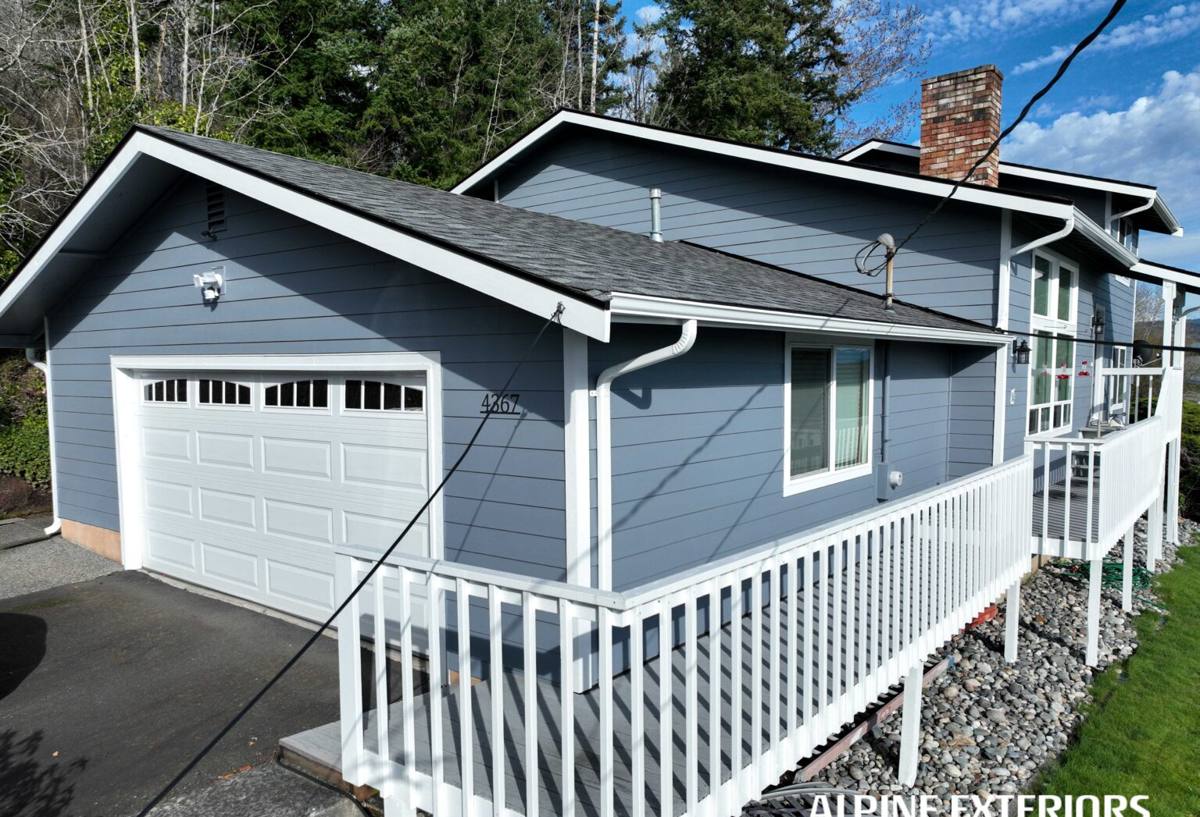
What Actually Counts as Storm Damage
Not every roof issue that shows up after bad weather is technically storm damage, and that distinction matters for both the repair plan and any insurance claim. A straightforward assessment separates these into a few categories.
Wind Damage
Wind lifts shingle tabs, breaks the sealant bond between courses, and can tear shingles loose entirely along ridges and edges where uplift is strongest. On a hillside property like South Hill, wind can also funnel and gust unpredictably depending on how the house sits relative to the slope and surrounding trees.
Wind-Driven Rain Intrusion
Even where shingles hold, sideways rain can push water up and under flashing, around vent pipes, and along valleys that weren't sealed as tightly as they should have been. This is often the damage homeowners never see from the ground.
Impact Damage
Falling branches and debris are common in wooded and hillside neighborhoods during high wind. Impact damage can range from obvious punctures to more subtle bruising of the shingle mat that shortens its life without an immediate leak.
Damage That Isn't Storm-Related
Some problems get blamed on the last storm when they're really the result of age, poor original installation, or long-term moss and moisture damage that a storm simply exposed. An honest inspection will tell you which is which rather than labeling everything storm damage by default.
The Hidden Damage Homeowners Miss
The damage that costs the most in the long run is usually the damage nobody sees right away. On roofs we look at around South Hill, three patterns show up again and again:
- Moss-trapped moisture: Moss doesn't just sit on top of shingles — it holds water against the granule surface and roof deck, softening the material underneath and making it more likely to tear or lift in the next windstorm.
- Granule loss along wear lines: Wind and driving rain wash away the protective granule layer faster in spots where water already tends to concentrate, like valleys and low-slope sections shaded by trees.
- Flashing that was never quite right: A lot of leaks that show up "after the storm" actually trace back to flashing around chimneys, skylights, or wall intersections that was marginal to begin with and finally gave out under wind-driven rain.
This is why a proper storm damage repair starts with a full inspection, not just a patch over the spot where the stain appeared inside.
What a Correct Storm Damage Repair Actually Involves
Inspection Before Anything Else
We walk the roof (not just look at it from the ground or a photo) to check the full field of shingles, flashing points, valleys, and any areas with moss buildup or shade exposure. We're checking for both the obvious damage and the secondary issues — soft decking, compromised underlayment, granule loss — that a quick patch would leave behind.
Matching the Repair to the Damage
A few lifted shingles from wind uplift may only need to be re-secured or replaced in kind. A section with wind-driven rain intrusion usually needs the shingles pulled back so we can check and, if needed, replace the underlayment underneath — patching over wet decking or damaged underlayment just traps the problem. Impact damage gets assessed shingle by shingle, since bruised shingles that aren't leaking yet can still fail early.
Flashing and Detail Work
Flashing is where a lot of repairs succeed or fail. Around chimneys, skylights, and wall step-flashing, we make sure the flashing is properly lapped and sealed rather than just caulked over — caulk is a short-term fix, not a repair.
Material Matching
We try to match existing shingle color and profile as closely as the manufacturer's current lineup allows, since discontinued colors and profiles are a real limitation on any repair — we'll tell you upfront if an exact match isn't possible so there are no surprises.
Our Process for South Hill Storm Calls
- Initial contact and scheduling — we get basic details about what you've noticed (a leak, missing shingles, storm timing) so we come prepared.
- On-site inspection — a full roof walk, not a drive-by, including attic access if there are interior signs of leaking.
- Written assessment — what we found, what caused it, and what repair options make sense, including honest input on whether a targeted repair or a larger section replacement is the better long-term call.
- Repair scheduling — timed around weather windows, since roof repair work depends on dry conditions to do it right.
- Completion walkthrough — we show you what was done and what to watch for going forward.
Repair vs. Replace: What Actually Drives the Decision
Storm damage doesn't automatically mean a full roof replacement, and it doesn't automatically mean a small patch will hold either. The right call depends on a handful of factors that we walk through with every homeowner.
| Factor | Favors a Targeted Repair | Favors Larger Replacement |
|---|---|---|
| Roof age | Roof is well within its expected service life | Roof is already near the end of its lifespan |
| Extent of damage | Isolated to one slope or section | Spread across multiple areas or slopes |
| Underlying deck condition | Deck is sound and dry | Deck shows rot or sustained moisture damage |
| Moss and moisture history | Minimal moss, roof drains and dries well | Chronic moss buildup and shaded, slow-drying sections |
| Material availability | Matching shingles still in production | Original shingle line discontinued |
We'd rather tell you a repair is the honest answer and save you money than push a replacement you don't need — and just as honestly, we'll tell you when a repair is only going to buy you a year or two before the same section fails again.
Insurance and Documentation
If your repair may involve an insurance claim, documentation matters. We provide a written inspection report describing the damage found, which is the kind of documentation most insurers want to see alongside your own claim filing. We're not a public adjuster and won't represent you to your insurance company, but we can give you an honest, detailed account of the roof's condition to support your claim.
What to Do — and Not Do — After a Storm
- Do check your attic (if safely accessible) for new water stains, damp insulation, or daylight coming through the roof deck.
- Do photograph any visible shingle debris in the yard or gutters, as it can help establish timing for a claim.
- Do call for an inspection promptly — a small opening that goes unaddressed through another rain event, or a full moss season, gets worse, not better.
- Don't get on the roof yourself to inspect it, especially on South Hill's sloped lots where footing and drop-offs add real risk.
- Don't rely on a tarp or caulk as a long-term fix — both are meant to hold until a proper repair, not replace one.
- Don't assume a small leak means small damage; water travels along the deck and framing before it shows up inside.
Why a Crew That Already Works South Hill Matters
Storm damage repair isn't the same job everywhere in Whatcom County. A crew that regularly works South Hill already understands how the salt air off the bay affects fastener and flashing corrosion over time, how the tree canopy on many lots shades roofs and extends moss season, and how driving rain behaves differently on a hillside than on flat ground. That local familiarity means fewer surprises during the inspection and a repair plan that accounts for the conditions your roof will keep facing after the storm damage itself is fixed.
If you've had recent wind or rain and want an honest look at what's going on up there, we're happy to come out for a free, no-pressure estimate — just fill out the form below and we'll get you scheduled.