 Bellingham Roofing
 Siding Built for Lynden's Climate, Not Just Its Curb Appeal
Lynden sits inland from Bellingham Bay in the Nooksack River valley, but "inland" in Whatcom County still means a wet, marine-influenced climate. Homes here go through long stretches of driving rain off the Pacific, damp river-valley air that holds moisture close to exterior walls, and a moss season that can run from fall through spring. Add occasional wind-driven salt air carried in off the Sound during storm systems, and you have a set of conditions that punishes the wrong siding choice fast. We install siding for Lynden homeowners with those specific conditions in mind, not a generic weather profile pulled from a national average.
The difference between siding that looks good for two years and siding that performs for decades usually isn't the product on the truck — it's whether the installer understood what this valley does to a wall system. That's the lens we bring to every Lynden project.
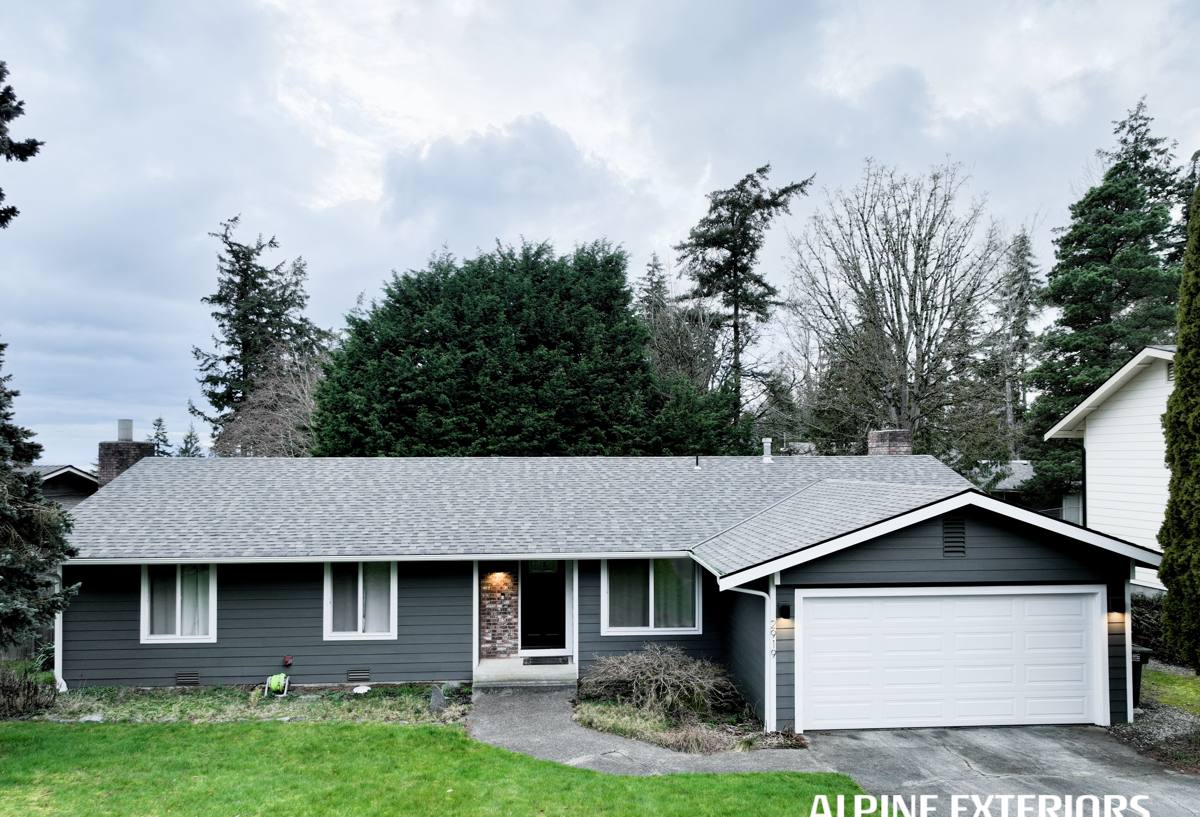
What Lynden's Climate Actually Does to Siding
Driving Rain and Wind-Driven Moisture
Storms moving through the valley don't just drop rain straight down — wind pushes it sideways into wall faces, seams, and trim joints. Siding that relies on tight caulk lines and face-sealing to stay dry will eventually let water in, because caulk is a maintenance item, not a permanent seal. A wall assembly with proper drainage behind the cladding handles wind-driven rain the way it's supposed to be handled: by letting incidental moisture drain and dry, not trapping it.
A Long, Real Moss and Mildew Season
Cool, damp, and shaded conditions for much of the year mean algae, moss, and mildew have plenty of time to establish on north-facing walls, under eaves, and anywhere airflow is limited. Porous or wood-based siding gives these organisms something to root into. Dense, factory-finished fiber cement gives them far less to hold onto, which matters over a 15- or 20-year ownership horizon, not just the first season.
Marine Air and Temperature Swings
Whatcom County's marine layer keeps humidity elevated even when it isn't actively raining, and coastal storms can carry salt-laden air well inland. Combined with the freeze-thaw swings of a Pacific Northwest winter, siding materials that absorb moisture expand and contract, which stresses paint film, fasteners, and joints over time.
Why Product Choice Matters More Than People Think
We install only James Hardie fiber cement siding, and Lynden's climate is a big part of why. Fiber cement doesn't absorb water the way wood-based products do, it doesn't feed mold and moss the way organic materials can, and it holds a factory-applied finish far longer than field-applied paint on wood or engineered wood substrates. We don't install vinyl, LP SmartSide, primed wood, or comparable fiber cement alternatives — not because those products have no merit anywhere, but because we've standardized on the one system that consistently holds up to this specific valley climate when installed correctly.
| Climate Stress in Lynden | What It Does to Weak Siding | How James Hardie Fiber Cement Responds |
|---|---|---|
| Driving, wind-driven rain | Forces water past face seals into seams and behind panels | Installed with proper drainage plane and flashing so incidental water manages out, not in |
| Long moss and algae season | Organic siding surfaces host growth, especially on shaded walls | Dense cement composition and factory ColorPlus finish resist organic growth far longer |
| Marine humidity and salt-tinged air | Accelerates paint failure and material swelling on wood-based products | Non-combustible, moisture-resistant substrate holds finish integrity through repeated wet-dry cycles |
| Freeze-thaw temperature swings | Stresses joints and fasteners on materials that absorb water | Engineered dimensional stability reduces expansion/contraction stress at seams |
What a Correct Siding Installation Actually Involves
Siding is a system, not a product. The panel itself is only one part of what keeps a Lynden home dry. A correct installation includes:
- Removal of old siding down to the sheathing so we can actually inspect what's underneath, not covering over hidden rot or moisture damage
- A weather-resistive barrier installed as a continuous drainage plane, not just stapled up as an afterthought
- Proper flashing at every window, door, and roof-wall intersection — the single most common failure point on poorly installed siding
- Correct fastening per manufacturer spec, including nail placement, spacing, and penetration depth specific to Hardie's engineered panels
- Rain-screen or drainage gap detailing where conditions call for it, to keep the back of the panel able to dry
- Factory-finished ColorPlus panels installed with the field-touch and caulking practices that preserve the warranty, rather than generic paint-grade handling
- Trim, corner, and joint details sized and sealed to shed water first, look clean second
Skip any one of these steps and you can end up with siding that looks correct from the curb for a year or two while moisture works its way in behind it — a problem that's far more expensive to fix once it's hidden behind new siding than it would have been to prevent.
Our Process for Lynden Projects
1. On-Site Assessment
We walk the exterior with you, look at current siding condition, check for signs of trapped moisture or rot at vulnerable points like window sills and lower wall sections, and talk through what your home's exposure looks like — sun, shade, prevailing wind, and drainage around the foundation all factor in.
2. Scope and Product Plan
We spec out the right James Hardie product line and profile for the home — lap, shingle-style, or panel — along with trim and color, and explain the reasoning so you understand the "why," not just the "what."
3. Tear-Off and Sheathing Inspection
Old siding comes off and we inspect the sheathing before anything new goes up. If there's water damage from a prior installation's mistakes, we address it before covering it back over — a step that gets skipped by installers trying to move fast.
4. Weather Barrier and Flashing
This is the step that determines whether the home stays dry for the next 20 years. We install the drainage plane and flashing details to spec, every time, whether or not it's visible in the finished product.
5. Installation to Manufacturer Spec
Panels go up per James Hardie's installation guidelines — fastening, gapping, and finishing — which is also what keeps the manufacturer's warranty intact.
6. Final Walkthrough
We walk the finished job with you, point out the details that matter, and answer questions about care and what to expect over the coming seasons.
Why Hiring a Crew That Already Works Lynden Matters
A siding crew that mostly works drier climates, or that treats every job the same regardless of region, tends to under-detail the parts of the job you can't see once it's finished — flashing laps, drainage gaps, fastener patterns. A crew that regularly works Whatcom County jobs already knows where wind-driven rain tends to find weak points on this style of home, how shaded north walls behave differently than sun-exposed south walls, and which trim details actually hold up through a Pacific Northwest winter instead of just a Pacific Northwest summer. That local pattern recognition isn't something you can fully substitute with a generic installation manual.
It also means faster, more accurate estimates: we're not guessing at how this valley's climate interacts with a given home's exposure, because we've already seen it play out on siding jobs nearby.
Signs Your Lynden Home May Need Siding Attention
- Soft or spongy spots when you press on siding, especially near the bottom courses or under windows
- Persistent moss or dark streaking that returns shortly after cleaning
- Peeling or bubbling paint, particularly on wood or engineered wood siding
- Visible gaps, warping, or buckling panels
- Musty smells or interior moisture signs on exterior-facing walls
- Siding that's approaching or past its expected service life for its material type
Catching these early usually means a straightforward siding replacement. Waiting can mean sheathing repair or framing work layered on top of the siding cost — which is exactly the kind of hidden cost a correctly installed drainage plane is designed to prevent in the first place.
What Affects the Cost of a Lynden Siding Project
Every home is different, but a few factors consistently move the number:
| Factor | Why It Matters |
|---|---|
| Home size and wall complexity | More corners, dormers, and trim details mean more labor and material cuts |
| Condition of existing sheathing | Rot or moisture damage found during tear-off adds repair scope before new siding goes on |
| Siding profile chosen | Lap, shingle-style, and panel products differ in material and labor cost |
| Trim and accessory scope | Corner boards, window trim, and fascia detailing add to both material and labor |
| Access and site conditions | Multi-story sections, tight lot lines, or landscaping can affect staging and labor time |
We give you real numbers for your specific home after an on-site look — not a rough range pulled from a website calculator.
Let's Look at Your Home
If you're weighing a siding replacement for a Lynden home, we're glad to come take a look, walk the exterior with you, and give you a straightforward, no-pressure estimate for a James Hardie installation built for this valley's climate. Use the form below to get started.