 Bellingham Roofing
 Decks Built for Lynden's Inland Climate
Lynden sits back from the water, out in Whatcom County's farmland, but that distance from Bellingham Bay doesn't mean the weather goes easy on a deck. Marine air still moves inland off the Sound and the Strait most of the year, carrying moisture that settles into wood grain and metal fasteners. What changes out here is the cold: without the coastline's moderating effect, Lynden sees harder frosts and more freeze-thaw cycling through the winter than neighborhoods right on the water. That combination — persistent damp most of the year, sharper cold snaps in the winter, and a long stretch where moss and algae have every reason to take hold — is what we design and build against when we put up a deck in this area.
A deck built to a generic spec sheet will survive a season or two here looking fine. The difference shows up in years three through ten, when ledger boards that weren't flashed correctly start to rot from the inside, when the wrong fastener rusts and streaks the decking, or when a structure that wasn't set below frost depth starts to shift. None of that is exotic engineering — it's just doing the ordinary parts of deck building correctly, with materials and details chosen for what this specific climate does to a structure that sits outside, uncovered, for decades.
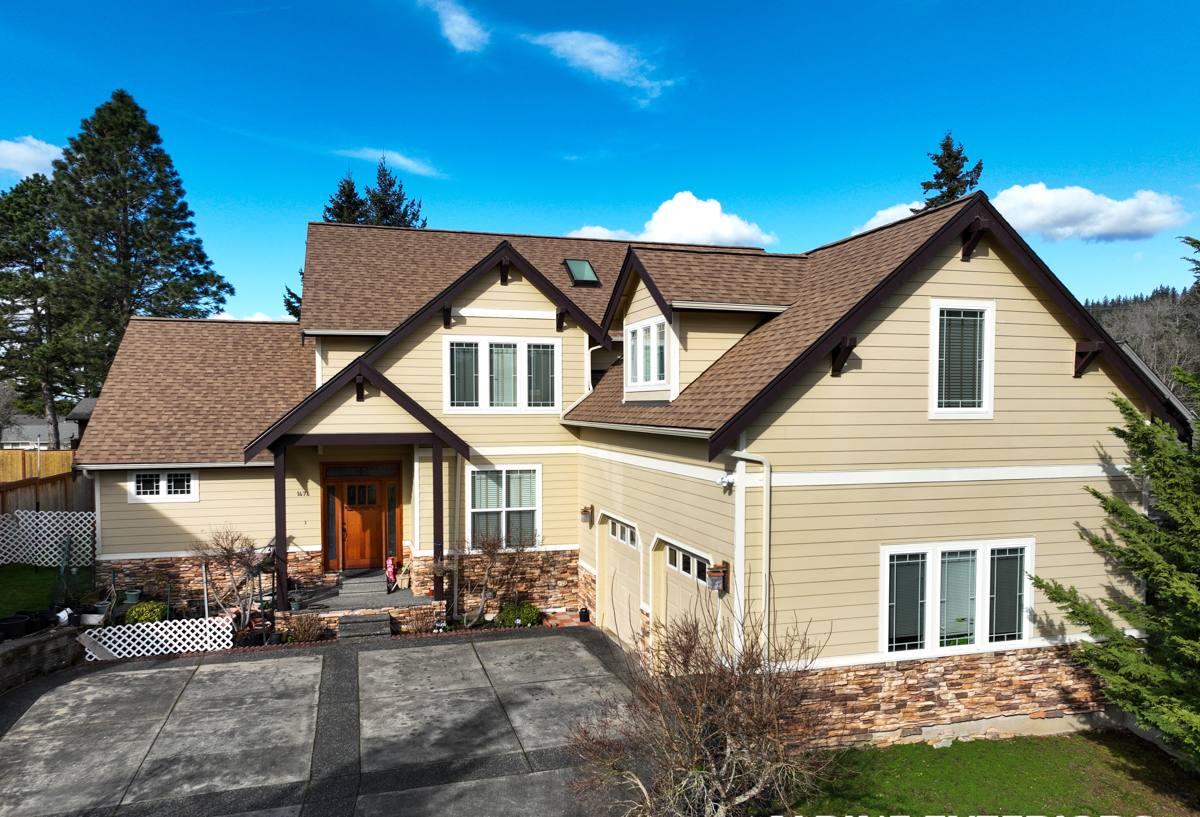
What Rain, Moss, and Freeze-Thaw Actually Do to a Deck
It helps to understand the failure pattern before talking about how we prevent it. Almost every deck problem we get called out for traces back to one of three things:
Trapped moisture
Wood and composite decking both handle rain fine when water can run off and the structure underneath can dry out between storms. Problems start when water gets trapped — behind a ledger board with no flashing, under decking boards laid tight with no drainage gap, or inside a post base that holds standing water against end grain. Whatcom County's rain isn't usually violent, it's persistent, and persistent moisture against wood that can't dry out is exactly what causes rot, not any single storm.
Moss and surface buildup
Long damp seasons with limited direct sun let moss, algae, and general grime build up on decking surfaces, especially on the north side of a house or under tree cover. Beyond the appearance issue, a mossy deck surface is a genuine slip hazard, and moss holds moisture against the board surface longer than bare wood or composite would on its own, which accelerates whatever wear pattern is already happening underneath.
Freeze-thaw movement
Inland Whatcom County gets cold snaps that the immediate coastline is buffered from. Water that gets into a crack, a fastener hole, or a poorly sealed footing can freeze, expand, and widen that opening — then thaw and let more water in next time. Over several winters this is what turns a hairline crack in a post base or a small gap around a ledger bolt into a real structural or moisture problem.
Choosing the Right Decking Material for This Climate
There's no single "correct" decking material — it depends on budget, maintenance appetite, and how the deck will be used. What matters here is understanding how each option actually behaves under sustained Pacific Northwest moisture, not just how it looks on day one.
| Material | How it handles this climate | Maintenance reality |
|---|---|---|
| Pressure-treated lumber | Handles moisture well when properly sealed and detailed; most affordable upfront | Needs re-staining or sealing every 1-3 years to keep water out and slow graying |
| Cedar | Naturally rot- and insect-resistant, ages to a silver-gray patina many homeowners like | Best appearance and lifespan with regular sealing; left bare it will still gray and can check |
| Composite decking | Doesn't absorb water or rot; resists moss better than wood but still needs airflow underneath | Occasional washing to prevent surface algae film; no staining or sealing required |
| PVC / capped composite | Fully sealed surface, best moisture and moss resistance of the common options | Lowest maintenance; highest upfront material cost |
We're straightforward with homeowners about trade-offs rather than pushing whatever has the best margin. Wood costs less to install but asks for ongoing upkeep; composite and PVC cost more upfront but take moisture and moss largely off the table as a maintenance chore. Either is a legitimate choice — the mistake is picking a material and then framing and flashing it like it's a different climate than the one it's actually in.
Framing, Footings, and Flashing — Where Decks Actually Fail
The decking surface is what you see; the framing underneath is what determines whether the deck is still safe and dry in fifteen years. A few details matter more here than in a drier climate:
Ledger flashing
Where a deck attaches to the house, the ledger board is the single most common point of failure we see in older decks. Water that gets behind an unflashed or poorly flashed ledger doesn't just rot the ledger — it can travel into the house's rim joist and wall framing. Correct flashing (and a proper gap or membrane between ledger and siding) is non-negotiable on every deck we build.
Footings set below frost depth
Post footings need to be set deep enough that freeze-thaw movement in the soil doesn't heave or shift them over time. This is a code requirement, not an upsell, and it's exactly the detail that a rushed or unpermitted job is most likely to skip because it's invisible once the deck is finished.
Drainage and airflow underneath
A deck built low to the ground with no airflow underneath stays damp longer after every rain. Where grading and height allow, we build in enough clearance and, where needed, drainage detailing so the structure underneath can actually dry between storms instead of sitting wet through an entire Whatcom County winter.
Fasteners and Hardware: Small Parts, Big Consequences
Corrosion-resistant fasteners and structural hardware aren't optional in a climate with this much sustained moisture. Standard fasteners that aren't rated for exterior or ground-contact use will rust, streak the decking around them, and weaken over time — and once a fastener is compromised, the connection it's holding is compromised with it. We use hardware rated for exterior and treated-lumber contact throughout the structure: joist hangers, post bases, ledger bolts, and the decking fasteners themselves. It costs more than a generic hardware pack, and it's the difference between hardware that's still doing its job in twenty years and hardware that's staining the deck and loosening connections in five.
Railings and Code Requirements
Most raised decks require guardrails, and Whatcom County follows the state building code for height, baluster spacing, and load requirements. Beyond meeting code, railing posts and connections need the same moisture and corrosion attention as the rest of the structure — a railing post that isn't properly flashed or fastened is a safety issue, not just a maintenance one, since it's the thing people actually lean on. We build railings to spec and to hold up outdoors long-term, not just to pass a one-time inspection.
Our Deck Building Process
Every deck starts with a look at the actual site — sun exposure, drainage, how the deck ties into the house, and what the homeowner actually wants to use the space for — before any material decisions get made.
- On-site walkthrough and honest assessment of the site, existing structure (if replacing a deck), and drainage conditions
- Design and material discussion, including realistic trade-offs between wood and composite/PVC options for the intended use and budget
- Permitting through Whatcom County or the applicable jurisdiction — we handle this rather than leave it to the homeowner
- Demolition of any existing structure and site prep, including grading or drainage work where needed
- Framing with correctly sized footings set to frost depth, proper ledger flashing, and corrosion-resistant hardware throughout
- Decking installation with attention to drainage gaps and airflow underneath
- Railings, stairs, and any final trim work, built to code
- Final walkthrough with the homeowner and care guidance specific to the material installed
We don't skip the permitting step and we don't shortcut the framing to hit a lower price — those are exactly the corners that a generic or out-of-town crew is most likely to cut, and they're the ones that cost homeowners the most later.
Deck Maintenance Checklist for Lynden Homeowners
Whatever material a deck is built with, a little seasonal attention goes a long way in this climate. A few things worth doing on a regular basis:
- Sweep debris and standing leaves off the decking regularly, especially in fall and under any tree cover
- Wash the surface periodically to remove moss and algae film before it builds up and becomes a slip hazard
- Check and re-seal or re-stain wood decking on the schedule appropriate to the product (typically every 1-3 years)
- Inspect the ledger flashing and the area where the deck meets the house at least once a year
- Check railing posts and stair stringers for looseness, especially after a hard winter
- Confirm gaps between decking boards aren't clogged with debris that traps moisture
- Look underneath the deck occasionally for standing water or poor drainage that's developed over time
Why Hire a Crew That Already Works in Lynden
Deck building isn't complicated in theory — the principles are the same everywhere. What's different is knowing, without guessing, how a specific area's soil, drainage, and seasonal weather actually behave, and building to that instead of to a generic spec. A crew that already works around Bellingham and out into Whatcom County's inland towns has already seen how ledger boards fail on homes like yours, how footings perform through a real Lynden winter, and which material choices hold up versus which ones look good in a showroom and disappoint outdoors. That's not a marketing point — it's the practical reason the framing and flashing details in this page matter more than the finish choices, and why we build them the same way on every deck regardless of what decking material ends up on top.
If you're planning a new deck or need to replace one that's showing its age, we're happy to come take a look and give you a straightforward, no-pressure estimate — just fill out the form below.