 Bellingham Roofing
 Composite Decking in Columbia: Built for What Bellingham Actually Throws at It
The Columbia neighborhood sits close enough to Bellingham Bay that salt air is a daily fact of life, not an occasional nuisance. Add in the long stretch of driving rain we get most of the year and the moss season that follows right behind it, and you've got one of the tougher environments in Whatcom County for an outdoor deck to survive. Composite decking, installed correctly, handles that combination better than almost any other decking material — but "installed correctly" is doing a lot of work in that sentence, and it's the part that separates a deck that looks good for fifteen years from one that's warping, staining, or growing moss in its board grooves by year three.
This page is about composite decking specifically for Columbia homes — what the local climate demands, what a correct installation actually involves, and why the details matter more here than they would in a drier part of the country.
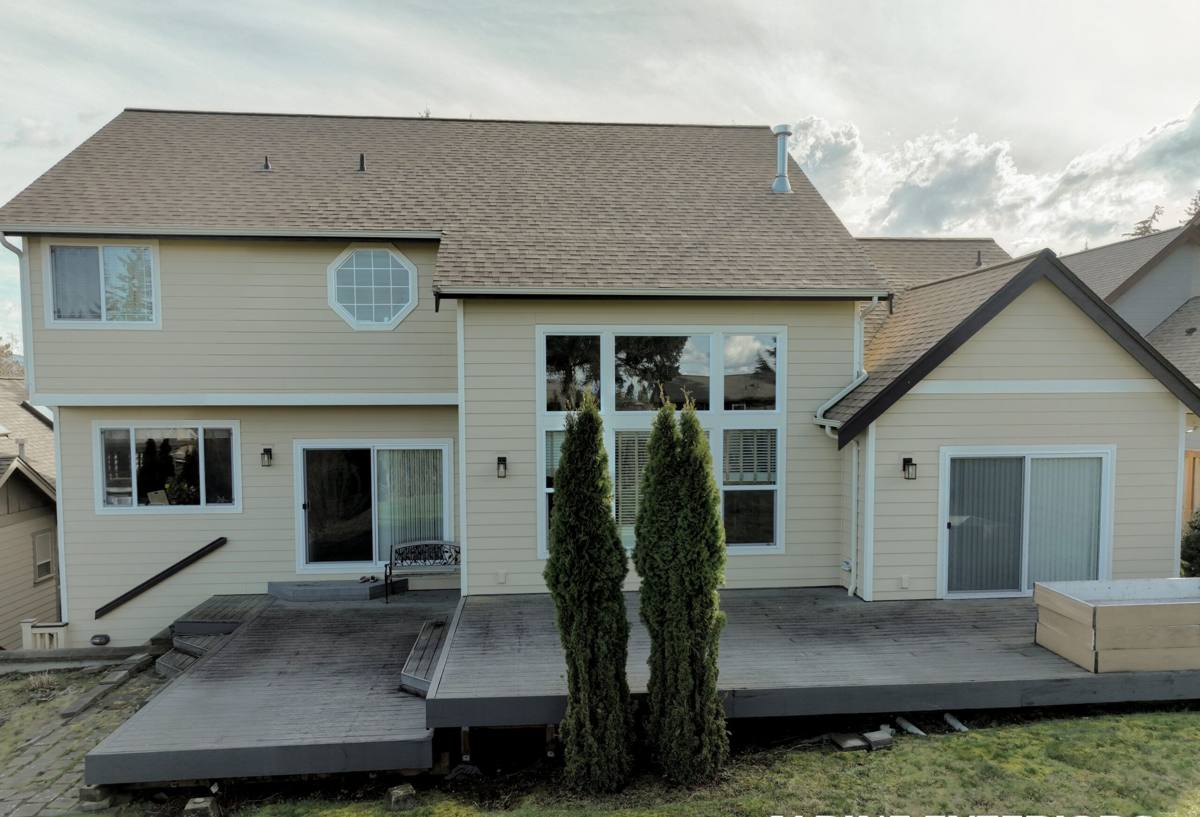
What Salt Air, Rain, and Moss Actually Do to a Deck
Salt Air and Metal Fasteners
Being close to the bay means a steady low-level exposure to salt-laden moisture in the air, even on days without direct rain. Over years, that exposure corrodes standard fasteners, brackets, and ledger hardware faster than it would ten or fifteen miles inland. A deck that looks fine on the surface can have hardware quietly failing underneath if the wrong grade of screws or connectors went in during the build.
Driving Rain and Water Intrusion
Bellingham's rain doesn't just fall straight down — wind-driven rain gets pushed sideways into ledger boards, fascia, and any gap where flashing wasn't done right. For a deck attached to the house, that ledger connection is one of the most common places we find rot and water damage on homes we're called out to inspect, regardless of what decking material sits on top.
Moss, Algae, and the Long Wet Season
Whatcom County's wet season runs long, and shaded or north-facing decks in Columbia rarely get enough sun to dry out between rains. That constant damp is exactly what moss and algae need. On wood decking, that means regular cleaning and re-sealing just to keep the surface from getting slick and the boards from holding moisture. On lower-quality composite products, it can mean staining in the surface texture that's hard to fully remove.
Freeze-Thaw Cycling
We don't get the deep freezes of the Midwest, but Whatcom County does see repeated freeze-thaw swings through the winter. Any water that gets trapped in a board, a fastener hole, or a joist connection expands and contracts with those temperature swings, which over time loosens hardware and stresses joints that weren't built with drainage in mind.
Why Composite Decking Makes Sense for Columbia Homes
None of this means wood decking is off the table — some homeowners want the look and are willing to keep up with the maintenance. But for most Columbia homeowners, composite decking is the more practical choice given the climate, for a few honest reasons:
- No annual sealing or staining. Wood decking in this climate needs re-sealing on a real schedule to keep water out; composite doesn't.
- Consistent moisture behavior. Composite boards don't cup, crown, or splinter the way wood can when it's wet more often than it's dry.
- Better resistance to surface organic growth. Modern composite capping sheds moss and algae more easily than raw wood grain, and cleans up with a simple wash rather than a sanding and re-sealing job.
- Longer real-world lifespan in wet climates. When the substructure and fasteners are done right, composite decking is built to handle sustained damp exposure better than dimensional lumber.
The trade-off is worth being upfront about: composite decking costs more up front than pressure-treated wood, and not every composite product is built the same. That's where installation quality and product selection start to matter as much as the material itself.
What a Correct Composite Deck Installation Actually Involves
The Substructure Comes First
Composite boards are only as good as what's underneath them. In a climate like ours, we pay close attention to joist spacing (often tighter than the manufacturer's bare minimum, especially for boards running at an angle), joist tape or flashing on top of every joist to stop water from wicking into the wood framing, and proper slope away from the house so water doesn't pool against the ledger.
Fasteners and Hardware Rated for This Environment
Given the salt air exposure in Columbia, we don't cut corners on hardware. That means stainless steel or coated fasteners rated for coastal exposure, corrosion-resistant joist hangers, and hidden fastener clip systems that are actually compatible with the board profile being used — not a generic clip forced onto a board it wasn't designed for.
Ledger Flashing and Water Management
Since the ledger-to-house connection is the most common failure point we see in wet climates, proper flashing here isn't optional. That includes house wrap integration, flashing tape, and a drip edge that actually directs water away from the wall assembly rather than behind it.
Ventilation Underneath the Deck
A low-clearance deck with no airflow underneath traps moisture against the joists and the ground below, which is exactly the setup that grows moss and accelerates rot in framing that isn't composite. We build in ventilation gaps and, where clearance allows, address grading and drainage underneath the deck itself.
Board Selection and Color
Darker composite boards absorb more heat in the (limited) sun we get, which helps them dry faster after rain — a real advantage in a shaded, damp lot. Lighter boards show less thermal expansion movement but can hold surface moisture a bit longer. We walk through this trade-off with homeowners rather than defaulting to whatever's easiest to source.
Comparing Decking Materials for a Climate Like Bellingham's
| Factor | Pressure-Treated Wood | Composite Decking | Solid PVC Decking |
|---|---|---|---|
| Upfront cost | Lowest | Mid-range | Highest |
| Maintenance | Annual sealing/staining | Occasional washing | Minimal |
| Moisture/moss resistance | Poor without upkeep | Good with quality capping | Very good |
| Expected lifespan (this climate) | 10-15 years with upkeep | 25-30+ years | 25-30+ years |
| Feel/appearance | Natural wood grain | Wood-look, wide color range | More uniform, plastic-like feel to some |
Composite lands in a practical middle ground for most Columbia homeowners: significantly less upkeep than wood without the higher cost and different feel of solid PVC. The right answer still depends on budget, sun exposure, and how the deck will be used.
Our Process for Columbia Deck Projects
- On-site assessment. We look at sun exposure, drainage, existing structure condition (if replacing an old deck), and proximity to the bay to judge hardware and flashing needs.
- Honest product walkthrough. We show real board samples and explain the actual trade-offs between lines and colors rather than pushing whatever has the best margin.
- Written scope and schedule. Substructure work, flashing details, fastener spec, and board layout are all spelled out before we start — no surprises mid-project.
- Build from the ground up. Framing and flashing corrections first, then decking, railing, and any stairs or fascia work.
- Final walkthrough. We go over basic care specific to our climate before we consider the job finished.
Maintaining a Composite Deck in a Wet, Mossy Climate
Composite decking cuts maintenance dramatically compared to wood, but "low-maintenance" isn't "no-maintenance" — especially here.
- Sweep debris and fallen leaves regularly through fall so organic matter doesn't sit against the board surface
- Wash the deck at least once or twice a year with a soft-bristle brush and a composite-safe cleaner to prevent moss and algae buildup
- Keep gutters and downspouts near the deck clear so overflow isn't adding extra water onto the surface
- Check railing posts and stair connections annually for any looseness, which can signal fastener or framing movement
- Trim back plants and shrubs that keep the deck surface shaded and damp longer than it needs to be
- Have the substructure inspected every few years, since that's where problems start even when the composite surface looks fine
Why Hiring a Crew That Already Works in Columbia Matters
A lot of decking problems in this area don't come from the composite material failing — they come from installation details that work fine in a drier climate but weren't built for salt air, sustained rain, and a long moss season. A crew that already works in Columbia and around Bellingham knows to spec corrosion-resistant hardware without being asked, to flash ledgers for wind-driven rain rather than just vertical rain, and to think about drainage and ventilation as part of the build, not an afterthought. That local familiarity is the difference between a deck that needs real repairs in year five and one that's still solid decades out.
If you're considering composite decking for a home in Columbia, we're happy to take a look at your property, talk through honest options for your specific site and budget, and put together a free, no-pressure estimate. There's a form below whenever you're ready.