 Bellingham Roofing
 Building Decks for Birch Bay's Coastal Climate
Birch Bay sits on the water in northern Whatcom County, and that location puts a deck through more than most inland builds ever see. Salt-laden air off the bay, wind-driven rain through the fall and winter, and a moss and mildew season that can run most of the year on shaded surfaces all work against wood, fasteners, and finishes at the same time. A deck built to a generic spec sheet, without accounting for that combination, tends to show fastener corrosion, soft framing, or slick moss buildup years before a deck built specifically for this exposure.
We build and repair decks for homes in and around Birch Bay, and we treat every deck as a structure that has to survive this exact climate for decades, not just look good on installation day. That means footings sized for the soil and frost conditions here, flashing details at the house connection that keep water out of the wall, hardware rated for corrosive coastal exposure, and a decking material chosen with an honest conversation about how it will actually hold up on a waterfront lot.
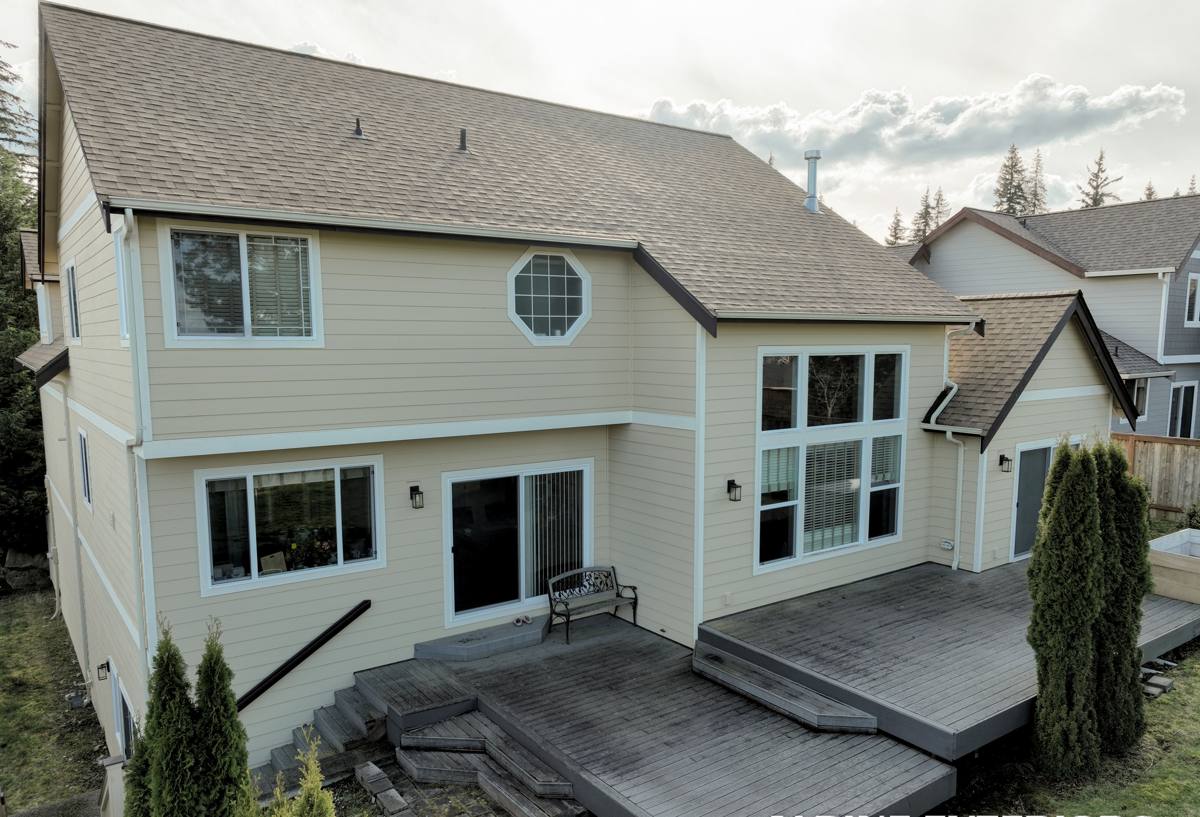
What Birch Bay's Climate Does to a Deck
Salt Air and Fastener Corrosion
Being this close to the water means more airborne salt reaching every exposed surface than a deck built a few miles inland would deal with. Salt accelerates corrosion in fasteners, joist hangers, post bases, and railing hardware. A screw or hanger that's rated for general outdoor use but not for coastal or high-corrosion exposure can start rusting and losing holding strength well before the wood around it shows any wear. On a structural component like a joist hanger, that's not just cosmetic — it's a safety issue over time.
Driving Rain at the House Connection
Most deck failures don't start out in the open field of the deck — they start where the deck ledger board attaches to the house. Wind-driven rain off the bay gets pushed sideways and upward into that connection point more aggressively than a calm, sheltered site would experience. If the ledger isn't flashed correctly, water works its way behind the siding and into the rim joist and wall framing, and that damage is often hidden until it's significant. This is the single detail we pay the most attention to on any Birch Bay deck attached to a house.
Moss, Mildew, and a Long Wet Season
Mild temperatures, shade, and near-constant moisture add up to a moss and mildew season that runs long on this part of the coast. Decking surfaces that stay damp — under trees, on the north side of a house, or in spots with poor airflow underneath — grow moss and algae faster than sun-exposed areas. Beyond looking bad, a mossy deck surface gets genuinely slippery, and moisture trapped against a board's surface is exactly the condition that shortens the life of lower-grade wood decking.
What a Correctly Built Deck Actually Involves
Footings Sized for the Site
Footings need to be sized and set to the depth required for the soil conditions and frost line on the specific lot, not just poured to a minimum that happens to pass inspection. Undersized or shallow footings are one of the more common causes of a deck that develops a wobble or settles unevenly a few years in, especially on lots with variable or sandy coastal soil.
Ledger Flashing Done Right
Where a deck attaches to the house, the ledger board needs proper flashing that sheds water away from the wall assembly rather than trapping it against the rim joist. That includes correctly lapped flashing, a gap or drainage plane behind the ledger in many cases, and fasteners sized and spaced to structural code — not just enough screws to hold the board up. This is the detail most likely to cause hidden rot if it's rushed.
Framing and Joist Spacing
Joist spacing has to match the decking material being used — composite and PVC decking generally call for tighter joist spacing than solid wood to avoid bounce and long-term sagging between boards. Using a wood-spec joist layout under a composite deck is a common shortcut that leads to a springy, uneven-feeling deck surface over time.
Hardware Rated for Coastal Exposure
Fasteners, joist hangers, post bases, and structural screws all need a corrosion rating suited to salt air exposure — standard galvanized hardware is often not enough this close to the water. We use fasteners and connectors rated for coastal and treated-lumber exposure as a baseline, not an upgrade, because replacing a rusted-through hanger buried inside a finished deck is a far bigger job than specifying the right one at build time.
Board Gaps and Drainage
Decking board spacing affects how quickly a surface dries out after rain. Gaps that are too tight trap moisture and debris between boards, which speeds up mildew growth and, on wood decking, rot at the board edges. Correct spacing lets water and airflow move through, which matters more in a climate with this much sustained moisture than it would somewhere drier.
Choosing a Decking Material for This Environment
There's no single right decking material for every homeowner — budget, maintenance tolerance, and how the deck will be used all factor in. What we do is give an honest read on how each option actually performs in salt air, driving rain, and a long moss season, rather than pushing whatever has the best margin.
| Material | Moisture & Salt Behavior | Maintenance Needed | Typical Lifespan Here |
|---|---|---|---|
| Composite decking | Resists rot and swelling; surface can still grow moss/algae in shaded, damp spots | Periodic cleaning; no staining or sealing required | 25-30+ years with proper ventilation underneath |
| PVC / capped polymer decking | Fully resists moisture absorption; least affected by salt exposure | Low; occasional washing | Comparable to or longer than composite |
| Pressure-treated wood | Absorbs and releases moisture readily; treatment resists rot but not corrosion of fasteners | Regular staining/sealing, especially in shaded areas | Shorter without consistent upkeep in this climate |
| Cedar | Naturally rot-resistant but still absorbs moisture over time | High; refinishing needed to hold color and resist mildew | Shorter without regular maintenance |
Composite and PVC decking tend to make the most sense for homeowners who want to minimize ongoing maintenance in a climate this wet, but they still need airflow underneath and periodic cleaning to keep moss and algae from taking hold on shaded sections. Wood decking can absolutely work here, but it comes with a real, ongoing maintenance commitment that we talk through honestly before anyone commits to it.
Railings, Stairs, and Code Requirements
Guardrails, baluster spacing, and stair details on a deck aren't optional design choices — they're set by building code, and inspectors in this area check them closely. Guardrails generally need to meet a minimum height, balusters need to be spaced so a small child can't pass through, and stair rise and run need to stay consistent from step to step. We build to current Whatcom County permitting requirements as a matter of course, not as a checklist item to fix after a failed inspection.
What a Permit-Compliant Deck Needs
- Footings and post connections sized to the deck's height and load, and inspected before decking goes on
- Guardrails at the required height wherever the deck surface is elevated above the code threshold
- Baluster spacing that meets current code, with no gaps wide enough to be a safety concern
- Consistent stair rise and run, with proper handrails where required
- Ledger flashing and fastening that meets structural attachment requirements, not just a visual fit
Maintenance: What Birch Bay Decks Need Over Time
Even a well-built deck needs some ongoing attention in this climate, and what it needs depends heavily on the material. Wood decking needs regular cleaning and refinishing to keep moisture out and slow mildew growth, especially on shaded sections that don't get much direct sun. Composite and PVC decking need far less upkeep but still benefit from periodic washing to clear moss and algae before it builds up on the surface. On any deck, checking the ledger flashing, fastener condition, and footing stability every year or two catches small issues — a loosening hanger, a hairline gap at the flashing — before they turn into bigger repairs.
Why a Crew That Already Works Birch Bay Matters
A crew that regularly builds and repairs decks along this stretch of coastline already knows how salt air, wind exposure, and sustained moisture behave differently here than they do a few miles inland. That shows up in the details: which hardware grade gets specified without being asked, how the ledger gets flashed against wind-driven rain, and where extra drainage or airflow gets built in underneath the deck. Those decisions are exactly what determines whether a deck holds up for twenty-plus years or starts needing repairs within five.
Questions Worth Asking Before Hiring a Deck Builder in Birch Bay
- Ask what footing depth and hardware corrosion rating they specify for coastal exposure, and why
- Confirm they carry current Washington contractor licensing and insurance, and pull the required building permit
- Ask how they flash and fasten the ledger board where it attaches to the house
- Ask about joist spacing relative to the specific decking material being installed
- Get a clear, written scope of work, including materials and hardware specifications, before signing anything
Our Process
We start with an on-site look at the lot — grade, drainage, sun and shade exposure, and how the deck will connect to the house — and talk through decking material options honestly, including the real maintenance trade-offs for this climate. From there we handle permitting, put together a clear written scope, and build with footings, ledger flashing, framing spacing, and hardware sized for coastal Whatcom County conditions as standard practice. We don't treat corrosion-resistant hardware or proper ledger flashing as upgrades; they're baseline requirements for a deck that's supposed to last on the water.
If you're planning a new deck or need an existing one repaired or replaced in Birch Bay, we're happy to take a look and give you an honest read on what the site and the structure actually need. Reach out below for a free, no-pressure estimate.